Results by title
3 books match the query 'Lotringer, Sylvère'

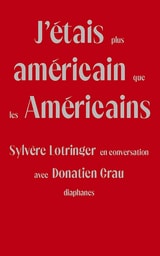
I Was More American than the Americans
Sylvère Lotringer in Conversation with Donatien GrauSylvère Lotringer and Donatien Grau
Diaphanes, 2021
In the mid-1970s, Sylvère Lotringer created Semiotext(e), a philosophical group that became a magazine and then a publishing house. Since its creation, Semio-text(e) has been a place of stimulating dialogue between artists and philosophers, and for the past fifty years, much of American artistic and intellectual life has depended on it. The model of the journal and the publishing house revolves around the notion of the collective, and Lotringer has rarely shared his personal journey: his existence as a hidden child during World War II; the liberating and then traumatic experience of the collective in the kibbutz; his Parisian activism in the 1960s; his time of wandering, that took him, by way of Istanbul, to the United States; and then, of course, his American years, the way he mingled his nightlife with the formal experimentation he invented with Semiotext(e) and with his classes. Since the early 2010s, Donatien Grau has developed the habit of visiting Lotringer during his trips to Los Angeles; some of their dialogs were published or held in public. This book is an entry into Lotringer's life, his friendships, his choices, and his admiration for some of the leading thinkers of our times. The conversations between Lotringer and Grau show bursts of life, traces of a journey, through texts and existence itself, with an unusual intensity.
J'étais plus américain que les Américains
Sylvère Lotringer en conversation avec Donatien GrauSylvère Lotringer and Donatien Grau
Diaphanes, 2021
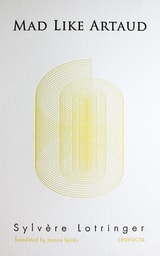
Mad Like Artaud
Sylvère Lotringer
University of Minnesota Press, 2015
Those who are mad like Antonin Artaud, are they just as mad as he was? Madness, like the plague, is contagious, and everyone, from his psychiatrists to his disciples, family, and critics, everyone who gets close to Artaud, seems to participate in his delirium. Sylvère Lotringer explores various embodiments of this shared delirium through what Artaud called “mental dramas”—a series of confrontations with his witnesses or “persecutors” where we uncover the raw delirium at work, even in Lotringer himself. Mad Like Artaud does not intend to add one more layer of commentary to the bitter controversies that have been surrounding the cursed poet’s work since his death in 1948, nor does it take sides among the different camps who are still haggling over his corpse. This book speaks of the site where “madness” itself is simmering.