Results by title
5 books match the query 'Low-income housing'
Architectures of Hope
Infrastructural Citizenship and Class Mobility in Brazil's Public HousingMoisés Kopper
University of Michigan Press, 2022
Architectures of Hope examines how communal idealism, electoral politics, and low-income consumer markets made first-time homeownership a reality for millions of low-income Brazilians over the last ten years.
Drawing on a five-year-long ethnography among city planners, architects, street-level bureaucrats, politicians, market and bank representatives, community leaders, and past, present, and future beneficiaries, Moisés Kopper tells the story of how a group of grassroots housing activists rose from oblivion to build a model community. He explores the strategies set forth by housing activists as they waited and hoped for—and eventually secured—homeownership through Minha Casa Minha Vida’s public-private infrastructure. By showing how these efforts coalesced in Porto Alegre—Brazil’s once progressive hotspot—he interrogates the value systems and novel arrangements of power and market that underlie the country’s post-neoliberal project of modern and inclusive development.
By chronicling the making and remaking of material hope in the aftermath of Minha Casa Minha Vida, Architectures of Hope reopens the future as a powerful venue for ethnographic inquiry and urban development.
Invisible City
Poverty, Housing, and New UrbanismBy John Ingram Gilderbloom
University of Texas Press, 2008
Shelter Poverty
New Ideas on Housing AffordabilityMichael E. Stone
Temple University Press, 1993
Spontaneous Shelter
Carl Patton
Temple University Press, 1988
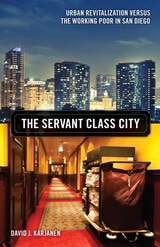
The Servant Class City
Urban Revitalization versus the Working Poor in San DiegoDavid J. Karjanen
University of Minnesota Press, 2016
San Diego, California, is frequently viewed as a model for American urban revitalization. It looks like a success story, with blight and poverty replaced by high-rises and jobs. But David J. Karjanen shows that the much-touted job opportunities for poor people have been concentrated in low-paying service work as the cost of living in San Diego has soared. The Servant Class City documents how, over a period of three decades, San Diego’s urban transformation actually eroded the economic standing of the city’s working poor.
Karjanen demonstrates that urban policy in San Diego, which has been devoted to increasing tourism, has fostered the creation of jobs that do not actually provide either livable wages or paths to upward mobility. Marshaling a wealth of heretofore uncollected data, he challenges the presumption that decades-long stagnation of job mobility in the united states is a result of insufficient worker training or a “skills mismatch,” or is attributable to various personal qualities of the urban poor.
Karjanen interweaves profiles of people with a compelling presentation of data. Each chapter addresses a significant topic: hospitality industry jobs, retail work, informal employment, “fringe banking,” and economic barriers to mobility. In revealing the true story of the “poverty traps” that are associated with low-wage jobs in the service economy, The Servant Class City complicates the rosy picture of life in an American tourist boomtown.