Results by title
10 books match the query 'Loyalty'
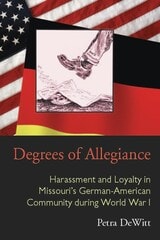
Degrees of Allegiance
Harassment and Loyalty in Missouri’s German-American Community during World War IPetra DeWitt
Ohio University Press, 2012
Historians have long argued that the Great War eradicated German culture from American soil. Degrees of Allegiance examines the experiences of German-Americans living in Missouri during the First World War, evaluating the personal relationships at the local level that shaped their lives and the way that they were affected by national war effort guidelines. Spared from widespread hate crimes, German-Americans in Missouri did not have the same bleak experiences as other German-Americans in the Midwest or across America. But they were still subject to regular charges of disloyalty, sometimes because of conflicts within the German-American community itself.
Degrees of Allegiance updates traditional thinking about the German-American experience during the Great War, taking into account not just the war years but also the history of German settlement and the war’s impact on German-American culture.
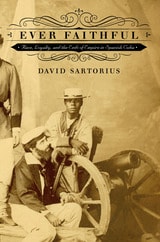
Ever Faithful
Race, Loyalty, and the Ends of Empire in Spanish CubaDavid Sartorius
Duke University Press, 2013
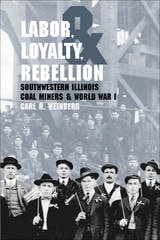
Labor, Loyalty, and Rebellion
Southwestern Illinois Coal Miners & World War ICarl R. Weinberg
Southern Illinois University Press, 2005
On April 5, 1918, as American troops fought German forces on the Western Front, German American coal miner Robert Prager was hanged from a tree outside Collinsville, Illinois, having been accused of disloyal utterances about the United States and chased out of town by a mob. In Labor, Loyalty, and Rebellion: Southwestern Illinois Coal Miners and World War I, Carl R. Weinberg offers a new perspective on the Prager lynching and confronts the widely accepted belief among labor historians that workers benefited from demonstrating loyalty to the nation.
The first published study of wartime strikes in southwestern Illinois is a powerful look at a group of people whose labor was essential to the war economy but whose instincts for class solidarity spawned a rebellion against mine owners both during and after the war. At the same time, their patriotism wreaked violent working-class disunity that crested in the brutal murder of an immigrant worker. Weinberg argues that the heightened patriotism of the Prager lynching masked deep class tensions within the mining communities of southwestern Illinois that exploded after the Great War ended.

Loyalty and Liberty
American Countersubversion from World War 1 to the McCarthy EraAlex Goodall
University of Illinois Press, 2013
Identifying varied interest groups such as business tycoons, Christian denominations, and Southern Democrats, Goodall demonstrates how countersubversive politics was far from unified: groups often pursued clashing aims while struggling to balance the competing pulls of loyalty to the nation and liberty of thought, speech, and action. Meanwhile, the federal government pursued its own course, which alternately converged with and diverged from the paths followed by private organizations. By the end of World War II, alliances on the left and right had largely consolidated into the form they would keep during the Cold War. Anticommunists on the right worked to rein in the supposedly dictatorial ambitions of the Roosevelt administration, while New Deal liberals divided into several camps: the Popular Front, civil liberties activists, and embryonic Cold Warriors who struggled with how to respond to communist espionage in Washington and communist influence in politics more broadly.
Rigorous in its scholarship yet accessible to a wide audience, Goodall's masterful study shows how opposition to radicalism became a defining ideological question of American life.
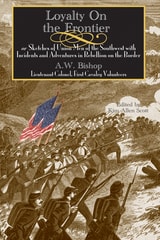
Loyalty on the Frontier
Sketches of Union Men of the South-West with Incidents and Adventures in Rebellion on the BorderA.W. Bishop
University of Arkansas Press, 2003
First published in 1863, this book has the immediacy, passion, and intimacy of its wartime context. It tells the remarkable story of Albert Webb Bishop, a New York lawyer turned Union soldier, who in 1862 accepted a commission as lieutenant colonel in a regiment of Ozark mountaineers. While maintaining Union control of northwest Arkansas, he collected stories of the social coercion, political secession, and brutal terrorism that scarred the region.
His larger goal, however, was to popularize and inspire sympathy for the South’s Unionists and to chronicle the triumph of Unionism in a Confederate state. His account points to the complex and divisive nature of Confederate society and in doing so provides a perspective that has long been absent from discussions of the Civil War

The Complex Friendships of Alexander the Great
Loyalty, Love, Advantage, and IntrigueJoseph Roisman
University of Texas Press, 2026
A first-of-its-kind study of Alexander the Great that examines the diverse manifestations and pivotal role of friendship in his campaigns, decisions, and enduring legacy.
Modern scholarship has illuminated nearly every aspect of Alexander the Great’s life and campaigns––but Joseph Roisman turns to a dimension of Alexander’s world that has yet to receive sustained analysis: the structure and function of friendship in the king’s regime. In this first-of-its-kind study, The Complex Friendships of Alexander the Great explores the central role friendship played in Alexander’s social, political, and cultural world. Moving beyond utilitarian perspectives, Roisman shows that friendship with the king involved affective, noninstrumental bonds that shaped his decisions, successes, and failures.
Using Aristotle’s philosophy of friendship as a starting point, Roisman examines the making, breaking, and remaking of bonds with Macedonian companions, including his closest allies, as well as with foreigners encountered during his campaigns. The book concludes with the first comprehensive list of Alexander’s friends drawn from ancient sources. Combining meticulous scholarship with new interpretive insight, this study reevaluates how we understand Alexander the Great’s leadership, social networks, and legacy.
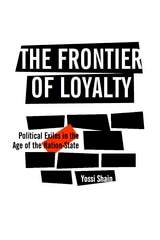
The Frontier of Loyalty
Political Exiles in the Age of the Nation-StateYossi Shain
University of Michigan Press, 2005
"In a world increasingly shaped by transnational organizations and processes, this is a timely and welcome subject, and Yossi Shain provides an informative overview."
--Rogers Brubaker, Harvard University, in The American Journal of Sociology
"Engrossing."
--International Affairs
"Mr. Shain is at his best stitching together information that hitherto had not been systematically related to analytical themes. . . . A major contribution to understanding the patterns and complexities of the politics of those at home abroad."
--International Migration Review
"The Frontier of Loyalty is the first comprehensive and theoretically oriented study of exile politics; the types of exile activity; the relation to both the home and host governments; and the difficulties and ambiguities of exile politics, particularly the struggle for legitimacy as spokesman for the opposition at home and for recognition from the outside."
--- Juan J. Linz, Yale University
"An ingenious and sensitive analysis of political exiles as 'voice from without,' which contributes to our understanding of the transnational character of contemporary politics."
--- Aristide R. Zolberg, New School for Social Research
"Drawing upon a wide literature on contemporary political exiles, Yossi Shain presents a sophisticated, learned and sensible survey of their place in political life today. More important, his meditation on the role of exiles proves such essential political categories as legitimacy,
national loyalty, and opposition in the modern state. One test of any work of scholarship is whether it enhances our understanding of concepts that we have previously taken for granted. By this measure, Shain's book passes with flying colors."
--- Michael R. Marrus, University of Toronto
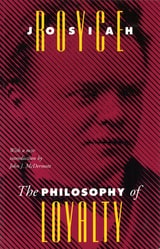
The Philosophy of Loyalty
Josiah Royce
Vanderbilt University Press, 1995
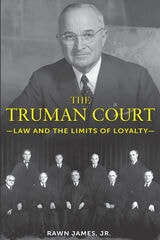
The Truman Court
Law and the Limits of LoyaltyRawn James
University of Missouri Press, 2021
The Truman Court: Law and the Limits of Loyalty argues that the years between FDR’s death in 1945 and Chief Justice Earl Warren’s confirmation in 1953—the dawn of the Cold War—were, contrary to widespread belief, important years in Supreme Court history. Never before or since has a president so quickly and completely changed the ideological and temperamental composition of the Court. With remarkable swiftness and certainty, Truman constructed a Court on which he relied to lend constitutional credence to his political agenda.
With Blood in Their Eyes
Thomas Cobb
University of Arizona Press, 2013
Winner, Spur Award for Best Western Long Novel (Western Writers of America) and Southwest Book Award (Border Regional Library Association)
On February 10, 1918, John Power woke to the sound of bells and horses’ hooves. He was sharing a cabin near the family mine with his brother Tom and their father Jeff; hired man Tom Sisson was also nearby. Then gunfire erupted, and so began the day when the Power brothers engaged the Graham County Sheriff’s Department in the bloodiest shootout in Arizona history.
Now Thomas Cobb, author of Crazy Heart and Shavetail, has taken up the story in this powerful and meticulously researched nonfiction novel. What seems at first a simple tale of crime and pursuit takes on much greater meaning and complexity as the story traces the past lives of the main characters and interconnects them—all leading back to the deadly confrontation that begins the book. Cobb cunningly weaves the story of the Power brothers’ escape with flashbacks of the boys’ father’s life and his struggle to make a living ranching, logging, and mining in the West around the turn of the century. Deftly drawn characters and cleverly concealed motivations work seamlessly to blend a compelling family history with a desperate story of the brothers as they attempt to escape.
Grappling with themes of loyalty, masculinity, technology, and honor, this sweeping saga reveals the passion and brutality of frontier life in Arizona a hundred years ago. Richly authentic and beautifully written, With Blood in Their Eyes breathes dramatic new life into this nearly forgotten episode of the American West.