Results by title
14 books match the query 'Lucas, Ceil'
Language and the Law in Deaf Communities
Ceil Lucas
Gallaudet University Press, 2003
Linguistics of American Sign Language Text, 3rd Edition
An IntroductionClayton Valli
Gallaudet University Press, 2001
Linguistics of American Sign Language
An Introduction, 5th Ed.Clayton Valli
Gallaudet University Press, 2011
Completely reorganized to reflect the growing intricacy of the study of ASL linguistics, the 5th edition presents 26 units in seven parts. Part One: Introduction presents a revision of Defining Language and an entirely new unit, Defining Linguistics. Part Two: Phonology has been completely updated with new terminology and examples. The third part, Morphology, features units on building new signs, deriving nouns from verbs, compounds, fingerspelling, and numeral incorporation. Part Four: Syntax includes units on basic sentence types, lexical categories, word order, time and aspect, verbs, and the function of space. The fifth part, Semantics, offers updates on the meanings of individual signs and sentences.
Part Six: Language in Use showcases an entirely new section on Black ASL in the unit on Variation and Historical Change. The units on bilingualism and language and ASL discourse have been thoroughly revised and updated, and the Language as Art unit has been enhanced with a new section on ASL in film. Two new readings update Part Seven, and all text illustrations have been replaced by video stills from the expanded video content. Also, signs described only with written explanations in past editions now have both photographic samples in the text and full demonstrations in the video.
*** You can find the supplemental video content on the Gallaudet University Press YouTube channel. ***
Multicultural Aspects of Sociolinguistics in Deaf Communities
Ceil Lucas
Gallaudet University Press, 2001
This collection offers a wide variety of fascinating studies that consider multicultural aspects among deaf people worldwide. Mala Kleinfeld and Noni Warner investigate variation in the use of gay, lesbian, and bisexual signs in the Deaf community; Jan Branson, Don Miller, and I Gede Marsaja, assisted by I Wayan Negara, profile a deaf village in Bali, Indonesia in which hearing people are fluent in both sign and spoken languages. Alejandro Oviedo in Venezuela comments on bilingual deaf education in Venezuela, and Sara Schley outlines the sociolinguistic and educational implications of comparing ASL and English word definitions.
Susan Mather discusses initiation in visually constructed dialogue from reading books with 3- to 8-year-old students who are deaf or hard of hearing. Pietro Celo offers insights on the interrogative in Italian Sign Language, and Julie Wilson examines narrative structure in American Sign Language ASL) through her analysis of “the tobacco story.” Rhonda Jacobs completes this significant, wide-ranging volume with her research on second language learning, as she presents the case for ASL as a truly foreign language by posing the question, “Just how hard is it to learn ASL?”
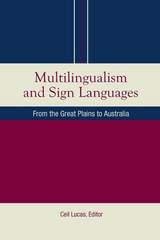
Multilingualism and Sign Languages
From the Great Plains to AustraliaCeil Lucas
Gallaudet University Press, 2006
The 12th Volume in the Sociolinguistics in Deaf Communities Series
The latest entry in the Sociolinguistics in Deaf Communities series continues to mine the rich resources found in signing communities throughout the world. Divided into four parts, this collection features 16 internationally renowned linguistics experts whose absorbing studies reflect an astonishing range of linguistic diversity.
The sole essay in Part One: Multilingualism describes historic and contemporary uses of North American Indian Sign Language. Part Two: Language Contact examines language-contact phenomena between Auslan/English interpreters and Deaf people in Australia, and the features of bimodal bilingualism in hearing, Italian, native signers. Part Three: Variation reports the results of a study on location variation in Australian Sign Language.
Part Four: Discourse Analysis begins with an analysis of how deaf parents and their hearing toddlers establish and maintain sight triangles when conducting signed conversations. The ensuing chapter explores the use of evaluation within an informal narrative in Langue des Signes Québécoise. The final chapter explicates how a signer depersonalizes the concept of “self” in an American Sign Language narrative through the use of signs for “he” and “I.”
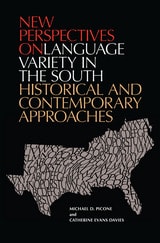
New Perspectives on Language Variety in the South
Historical and Contemporary ApproachesMichael D. Picone
University of Alabama Press, 2015
Beginning with an introduction to American Indian languages of the Southeast, five fascinating essays discuss indigenous languages, including Caddo, Ofo, and Timucua, and evidence for the connection between the Pre-Columbian Southeast and the Caribbean.
Five essays explore the earlier Englishes of the South, covering topics such as the eighteenth century as the key period in the differentiation of Southern American English and the use of new quantitative methods to trace the transfer of linguistic features from England to America. They examine a range of linguistic resources, such as plantation overseers’ writings, modern blues lyrics, linguistic databases, and lexical and locutional compilations that reveal the region’s distinctive dialectal traditions.
New Perspectives on Language Variety in the South: Historical and Contemporary Approaches widens the scope of inquiry into the linguistic influences of the African diaspora as evidenced in primary sources and records. A comprehensive essay redefines the varieties of French in Louisiana, tracing the pathway from Colonial Louisiana to the emergence of Plantation Society French in a diglossic relationship with Louisiana Creole. A further essay maps the shift from French to English in family documents.
An assortment of essays on English in the contemporary South touch on an array of compelling topics from discourse strategies to dialectal emblems of identity to stereotypes in popular perception.
Essays about recent Latino immigrants to the South bring the collection into the twenty-first century, taking into account the dramatic increase in the population of Spanish speakers and illuminating the purported role of “Spanglish,” the bilingual lives of Spanish-speaking Latinos in Mississippi, and the existence of regional Spanish dialectal diversity.
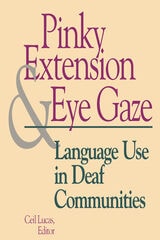
Pinky Extension and Eye Gaze
Language Use in Deaf CommunitiesCeil Lucas
Gallaudet University Press, 1998
The Sociolinguistics in Deaf Communities Series continues its detailed exploration of language dynamics among deaf people in the fourth entry, Pinky Extension and Eye Gaze: Language Use in Deaf Communities. This volume’s ten meticulously prepared chapters reflect the refinements of research in six major sociolinguistics areas. Rob Hoopes’ work, “A Preliminary Examination of Pinky Extension: Suggestions Regarding Its Occurrence, Constraints, and Function,” commences Part One: Variation with a sound explanation of this American Sign Language (ASL) phonological characteristic. Part Two: Languages in Contact includes findings by Jean Ann on contact between Taiwanese Sign Language and written Taiwanese.
Priscilla Shannon Gutierrez considers the relationship of educational policy with language and cognition in deaf children in Part Three: Language in Education, and in Part Four: Discourse Analysis, Melanie Metzger discusses eye gaze and pronominal reference in ASL. Part Five: Second-Language Learning presents the single chapter “An Acculturation Model for ASL Learners,” by Mike Kemp. Sarah E. Burns defines Irish Sign Language as Ireland’s second minority language after Gaelic, in Part Six: Language Attitudes, the final area of concentration in this rigorously researched volume. These studies and the others by the respected scholars featured in Pinky Extension and Eye Gaze make it an outstanding and eminently valuable addition to this series.

Sign Language Research
Theoretical IssuesCeil Lucas
Gallaudet University Press, 1990
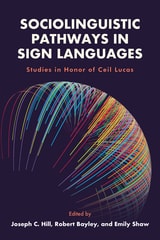
Sociolinguistic Pathways in Sign Languages
Studies in Honor of Ceil LucasJoseph C. Hill
Gallaudet University Press, 2026
Sociolinguistic Variation in American Sign Language
Ceil Lucas
Gallaudet University Press, 2001
Sociolinguistics in Deaf Communities
Ceil Lucas
Gallaudet University Press, 1995
The first volume in the new Sociolinguistics in Deaf Communities series presents a rich collection of essays showcasing the breadth and depth of this exciting discipline. Topics of inquiry in the premiere volume include fingerspelling in Langue des Signes Quebecoise (LSQ) in Quebec, Canada; language used by a Navajo family with deaf children; language policy, classroom practice, and multiculturalism in deaf education; aspects of American Sign Language (ASL) discourse and of Filipino Sign Language discourse; and the nature and role of rhetorical language in Deaf social movements.
Among the noted contributors are Dominique Machabee, Arlene Blumenthal-Kelly, Jeffrey Davis, Melanie Metzger, Samuel Supalla, Barbara Gerner de Garcia, Liza B. Martinez, Kathy Jankowski, and also Ceil Lucas. Sociolinguistics in Deaf Communities affords an invaluable opportunity to assess up-to-date information on sign language linguistics worldwide and its impact on policy and planning in education, interaction with spoken languages, interpreting, and the issues of empowerment.
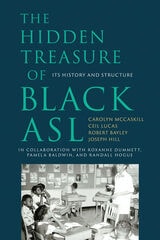
The Hidden Treasure of Black ASL
Its History and StructureCarolyn McCaskill
Gallaudet University Press, 2020
Black ASL has long been recognized as a distinct variety of American Sign Language based on abundant anecdotal evidence. The Hidden Treasure of Black ASL, originally published in 2011, presents the first sociohistorical and linguistic study of this language variety. Based on the findings of the Black ASL Project, which undertook this unprecedented research, Hidden Treasure documents the stories and language of the African American Deaf community. With links to online supplemental video content that includes interviews with Black ASL users (formerly on DVD), this volume is a groundbreaking scholarly contribution and a powerful affirmation for Black Deaf people.
This paperback edition includes an updated foreword by Glenn B. Anderson, a new preface that reflects on the impact of this research, and an expanded list of references and resources on Black ASL.
The supplemental video content is available online at the Gallaudet University Press YouTube Channel. Under Playlists, click “The Hidden Treasure of Black ASL: Companion Video to the Book.” The original Black ASL Project research videos are also available.
Featured in the film Signing Black in America: The Story of Black ASL, produced by The Language and Life Project at North Carolina State University (Dr. Walt Wolfram, Executive Producer). Look for it on PBS.

Turn-Taking, Fingerspelling, and Contact in Signed Languages
Ceil Lucas
Gallaudet University Press, 2002
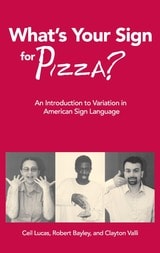
What's Your Sign for Pizza?
An Introduction to Variation in American Sign LanguageCeil Lucas
Gallaudet University Press, 2019
What’s Your Sign for Pizza? derives from an extensive seven-year research project in which more than 200 Deaf ASL users representing different ages, genders, and ethnic groups from seven different regions were filmed sharing their signs for everyday vocabulary. The film clips form a supplemental resource to the text and are referenced in their relevant chapters. The text begins with an explanation of the basic concepts of language and the structure of sign language. Each part of the text concludes with questions for discussion, and the final section offers three supplemental readings that provide further information on variation in both spoken and signed languages. What’s Your Sign for Pizza also briefly sketches the development of ASL, which explains the relationships between language varieties throughout the country.
The videos are available online at www.youtube.com/GallaudetUniversityPress.