Results by title
7 books match the query 'Luczak, Raymond'
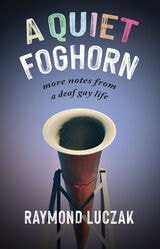
A Quiet Foghorn
More Notes from a Deaf Gay LifeRaymond Luczak
Gallaudet University Press, 2022
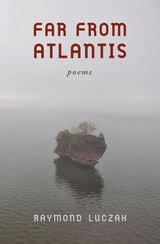
Far from Atlantis
PoemsRaymond Luczak
Gallaudet University Press, 2023
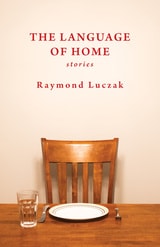
The Language of Home
StoriesRaymond Luczak
Gallaudet University Press, 2025
This short story collection offers readers many possible answers that reveal the Deaf experience in all its complexities. Written over nearly forty years by celebrated Deaf author Raymond Luczak, this collection of thirty stories paints a vivid panorama of Deaf lives. From a young DeafBlind boy feeling lost within his hearing family to a hearing son of Deaf parents caught between their infighting and a hearing mother realizing in the split second of her own death the full impact of the missteps she has taken while raising her Deaf son, Luczak crafts narratives that resonate with authenticity. Other stories feature an ASL interpreter feeling conflicted about a Deaf neighbor and a Deaf woman who becomes blacklisted as a backstabber. These characters often navigate the murky waters of the hearing world, sometimes with a touch of ASL gloss. The Language of Home is an exciting literary contribution that offers rare, nuanced representations of Deaf characters.
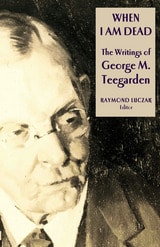
When I Am Dead
The Writings of George M. TeegardenRaymond Luczak
Gallaudet University Press, 2007
The Sixth Volume in the Gallaudet Classics in Deaf Studies Series
George M. Teegarden (1852-1936) taught at the Western Pennsylvania School for the Deaf for 48 years, established the printing department, and also served as the first editor of the school’s magazine. Despite these significant contributions, his greatest gift to deaf people was his skill as a writer and poet who was deaf, as readers will discover in When I Am Dead: The Writings of George M. Teegarden.
Editor Raymond Luczak selected Teegarden’s prose in When I Am Dead from several books, including Raindrop, and Stories, Old and New. Noting that these stories were never written for hearing readers, Luczak marvels at Teegarden’s ability to write English prose that the ASL-familiar reader would find incredibly easy to transliterate. By employing a rich blend of original stories and revisions of fables and myths, Teegarden taught his students the importance of improving their reading and writing skills to outfit them “for the battle of life.” He produced a body of work that Luczak characterizes as “a breath of fresh air: quick, painless, and usually told with a sense of wonder.”
Luczak’s choice of poems came from Teegarden’s self-published volume Vagrant Verses, a summation of his affection for Gallaudet College, the Deaf community, and all deaf people. The eponymous poem “When I Am Dead” articulates concisely the beliefs that directed Teegarden’s life of service:
“When I am dead, I hope to be
Remembered—this is true—
Not for my wit or vanities
But what I did for you.”
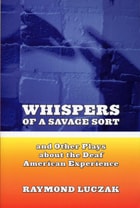
Whispers of a Savage Sort
And Other Plays about the Deaf American ExperienceRaymond Luczak
Gallaudet University Press, 2009
“Oh, why can’t the deaf community be more like a family?” is the plaint of a character in Raymond Luczak’s title play Whispers of a Savage Sort. It also goes far in characterizing the main thread that runs through his remarkable collection of work offered in this new volume. Whispers of a Savage Sort and Other Plays about the Deaf American Experience presents a progression of plays that depict Deaf people in situations well-known by the community’s members. Written to be signing-driven, these plays feature Deaf characters from the various strata of Deaf society. Each play centers on different yet equally familiar issues.
Snooty brings to life the difficulties of surviving the social pecking order in a deaf residential school. The main character’s only escape is a rich fantasy life in which he is in control. Doogle confronts its characters with the intrusion of technological communication devices parallel to the virtually forced intimacy of such a small, close community. Brought into stark focus by the specter of AIDS, Love in My Veins explores how trust, betrayal, and ultimately forgiveness can transform a Deaf couple’s love for each other in a Deaf community. The collection’s eponymous Whispers of a Savage Sort reveals the relentless damage that rumor and innuendo can do to a diverse group of Deaf individuals. The emotions, identities, and consequences created by Luczak in these dramas illuminate the Deaf American community in fascinating detail rarely seen in any medium today.
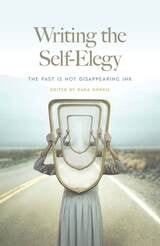
Writing the Self-Elegy
The Past Is Not Disappearing InkEdited by Kara Dorris
Southern Illinois University Press, 2023
Honest, aching, and intimate, self-elegies are unique poems focusing on loss rather than death, mourning versions of the self that are forgotten or that never existed. Within their lyrical frame, multiple selves can coexist—wise and naïve, angry and resigned—along with multiple timelines, each possible path stemming from one small choice that both creates new selves and negates potential selves. Giving voice to pain while complicating personal truths, self-elegies are an ideal poetic form for our time, compelling us to question our close-minded certainties, heal divides, and rethink our relation to others.
In Writing the Self-Elegy, poet Kara Dorris introduces us to this prismatic tradition and its potential to forge new worlds. The self-elegies she includes in this anthology mix autobiography and poetics, blending craft with race, gender, sexuality, ability and disability, and place—all of the private and public elements that build individual and social identity. These poems reflect our complicated present while connecting us to our past, acting as lenses for understanding, and defining the self while facilitating reinvention. The twenty-eight poets included in this volume each practice self-elegy differently, realizing the full range of the form. In addition to a short essay that encapsulates the core value of the genre and its structural power, each poet’s contribution concludes with writing prompts that will be an inspiration inside the classroom and out. This is an anthology readers will keep close and share, exemplifying a style of writing that is as playful as it is interrogative and that restores the self in its confrontation with grief.
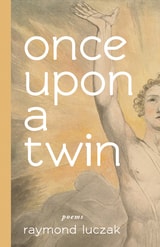
once upon a twin
poemsRaymond Luczak
Gallaudet University Press, 2021