Results by title
3 books match the query 'Lunbeck, Elizabeth'
Feminism in Twentieth-Century Science, Technology, and Medicine
Edited by Angela N. H. Creager, Elizabeth Lunbeck, and Londa Schiebinger
University of Chicago Press, 2001
Contributors:
Ruth Schwartz Cowan
Linda Marie Fedigan
Scott Gilbert
Evelynn M. Hammonds
Evelyn Fox Keller
Pamela E. Mack
Michael S. Mahoney
Emily Martin
Ruth Oldenziel
Nelly Oudshoorn
Carroll Pursell
Karen Rader
Alison Wylie
Histories of Scientific Observation
Edited by Lorraine Daston and Elizabeth Lunbeck
University of Chicago Press, 2010
Observation is the most pervasive and fundamental practice of all the modern sciences, both natural and human. Its instruments include not only the naked senses but also tools such as the telescope and microscope, the questionnaire, the photographic plate, the notebook, the glassed-in beehive, and myriad other ingenious inventions designed to make the invisible visible, the evanescent permanent, the abstract concrete. Yet observation has almost never been considered as an object of historical inquiry in itself. This wide-ranging collection offers the first examination of the history of scientific observation in its own right, as both epistemic category and scientific practice.
Histories of Scientific Observation features engaging episodes drawn from across the spectrum of the natural and human sciences, ranging from meteorology, medicine, and natural history to economics, astronomy, and psychology. The contributions spotlight how observers have scrutinized everything—from seaweed to X-ray radiation, household budgets to the emotions—with ingenuity, curiosity, and perseverance verging on obsession. This book makes a compelling case for the significance of the long, surprising, and epistemologically significant history of scientific observation, a history full of innovations that have enlarged the possibilities of perception, judgment, and reason.
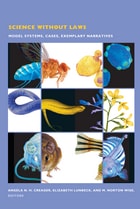
Science without Laws
Model Systems, Cases, Exemplary NarrativesAngela N. H. Creager, Elizabeth Lunbeck and M. Norton Wise, eds.
Duke University Press, 2007
Contributors examine the role of the fruit fly Drosophila and nematode worms in biology, troops of baboons in primatology, box and digital simulations of the movement of the earth’s crust in geology, and meteorological models in climatology. They analyze the intensive study of the prisoner’s dilemma in game theory, ritual in anthropology, the individual case in psychoanalytic research, and Athenian democracy in political theory. The contributors illuminate the processes through which particular organisms, cases, materials, or narratives become foundational to their fields, and they examine how these foundational exemplars—from the fruit fly to Freud’s Dora—shape the knowledge produced within their disciplines.
Contributors
Rachel A. Ankeny
Angela N. H. Creager
Amy Dahan Dalmedico
John Forrester
Clifford Geertz
Carlo Ginzburg
E. Jane Albert Hubbard
Elizabeth Lunbeck
Mary S. Morgan
Josiah Ober
Naomi Oreskes
Susan Sperling
Marcel Weber
M. Norton Wise