Results by title
4 books match the query 'Lyre'
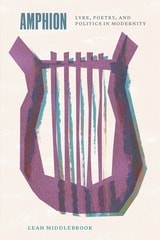
Amphion
Lyre, Poetry, and Politics in ModernityLeah Middlebrook
University of Chicago Press, 2024
Amphion is the figure in Greek mythology who played so skillfully on a lyre that stones moved of their own accord to build walls for Thebes. While Amphion still presides over music and architecture, he was once fundamental to the concept of lyric poetry. Amphion figured the human power to inspire action, creating and undoing polities by means of language. In contrast to the individual inspiration we associate with the better-known Orpheus, Amphion represents the relentless, often violent, play of harmony and disorder in human social life.
In this wide-ranging study, Leah Middlebrook introduces readers to Amphion-inspired poetics and lyrics and traces the tradition of the Amphionic from the Renaissance through modernist and postmodern poetry and translation from the Hispanic, Anglophone, French, Italian, and ancient Roman worlds. Amphion makes a significant contribution to scholarship on the connection between poetry and politics and the history of the lyric, offering an account well-suited to our times.
Greening The Lyre
Environmental Poetics And EthicsDavid W. Gilcrest
University of Nevada Press, 2002
This work covers important and neglected ground—environmental language theory. Gilcrest poses two overarching questions: To what extent does contemporary nature poetry represent a recapitulation of familiar poetics? And, to what extent does contemporary nature poetry engage a poetics that stakes out new territory? He addresses these questions with important thinkers, especially Kenneth Burke, and considers such poets as Frost, Kunitz, Heaney, Ammons, Cardenal, and Rich.
The Bow and the Lyre
The Poem, The Poetic Revelation, Poetry and HistoryBy Octavio Paz
University of Texas Press, 1973
In The Bow and the Lyre Octavio Paz, one of the most important poets writing in Spanish, presents his sustained reflections on the poetic phenomenon and on the place of poetry in history and in our personal lives. It is written in the same prose style that distinguishes The Labyrinth of Solitude. The Bow and the Lyre will serve as an important complement to Paz's poetry.
Paz's discussions of the different aspects of the poetic phenomenon are not limited to Spanish and Spanish American literature. He is almost as apt to choose an example from Homer, Vergil, Blake, Whitman, Rimbaud as he is from Lope de Vega, Jiménez, Darío, Neruda. In writing these essays, he draws on his vast storehouse of knowledge, revealing a world outlook of ample proportions. In reading these essays, we share the observations of a searching, original, highly cultivated mind.
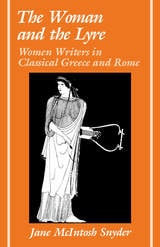
The Woman and the Lyre
Women Writers in Classical Greece and RomeJane McIntosh Snyder
Southern Illinois University Press, 1989
Beginning with Sappho in the seventh century B.C.E and ending with Egeria in the fifth century C.E., Snyder profiles ancient Greek and Roman women writers, including lyric and elegiac poets and philosophers and other prose writers. The writers are allowed to speak for themselves, with as much translation from their extant works provided in text as possible. In addition to giving readers biographical and cultural context for the writers and their works, Snyder refutes arguments representing prejudicial attitudes about women’s writing found in the scholarly literature. Covering writers from a wide historical span, this volume provides an engaging and informative introduction to the origins of the tradition of women’s writing in the West.