Results by title
4 books match the query 'Márquez, Benjamin'
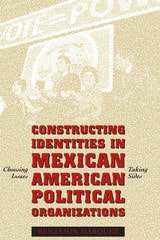
Constructing Identities in Mexican-American Political Organizations
Choosing Issues, Taking SidesBy Benjamin Márquez
University of Texas Press, 2003
A Choice Outstanding Academic Book, 2002
The formation of a group identity has always been a major preoccupation of Mexican American political organizations, whether they seek to assimilate into the dominant Anglo society or to remain separate from it. Yet organizations that sought to represent a broad cross section of the Mexican American population, such as LULAC and the American G.I. Forum, have dwindled in membership and influence, while newer, more targeted political organizations are prospering—clearly suggesting that successful political organizing requires more than shared ethnicity and the experience of discrimination.
This book sheds new light on the process of political identity formation through a study of the identity politics practiced by four major Mexican American political organizations—the Southwest Network for Environmental and Economic Justice, the Southwest Industrial Areas Foundation, the Texas Association of Mexican American Chambers of Commerce, and the Mexican American Women's National Association (now known as MANA—A National Latina Organization). Through interviews with activists in each organization and research into their records, Benjamin Marquez clarifies the racial, class-based, and cultural factors that have caused these organizations to create widely differing political identities. He likewise demonstrates why their specific goals resonate only with particular segments of the Mexican American community.

Democratizing Texas Politics
Race, Identity, and Mexican American Empowerment, 1945-2002By Benjamin Márquez
University of Texas Press, 2014
Winner, Outstanding Book Award, NACCS Tejas Foco Award for Non-Fiction, National Association for Chicana and Chicano Studies Tejas, 2015
By the beginning of the twenty-first century, Texas led the nation in the number of Latino officeholders, despite the state’s violent history of racial conflict. Exploring this and other seemingly contradictory realities of Texas’s political landscape since World War II, Democratizing Texas Politics captures powerful, interrelated forces that drive intriguing legislative dynamics. These factors include the long history of Mexican American activism; population growth among Mexican American citizens of voting age; increased participation among women and minorities at state and national levels in the Democratic Party, beginning in the 1960s; the emergence of the Republican Party as a viable alternative for Southern conservatives; civil rights legislation; and the transition to a more representative two-party system thanks to liberal coalitions.
Culling extensive archival research, including party records and those of both Latino activists and Anglo elected officials, as well as numerous interviews with leading figures and collected letters of some of Texas’s most prominent voices, Benjamin Márquez traces the slow and difficult departure from a racially uniform political class to a diverse one. As Texas transitioned to a more representative two-party system, the threat of racial tension and political exclusion spurred Mexican Americans to launch remarkably successful movements to ensure their incorporation. The resulting success and dilemmas of racially based electoral mobilization, embodied in pivotal leaders such as Henry B. Gonzalez and Tony Sanchez, is vividly explored in Democratizing Texas Politics.
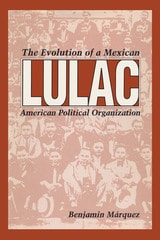
LULAC
The Evolution of a Mexican American Political OrganizationBy Benjamin Márquez
University of Texas Press, 1993
The League of United Latin American Citizens (LULAC) is one of the best-known and active national organizations that represent Mexican Americans and their political interests. Since its founding in Corpus Christi, Texas, in 1929, it has served as a vehicle through which Mexican Americans can strive for equal rights and economic assimilation into Anglo American society.
This study is the first comprehensive political history of LULAC from its founding through the 1980s. Márquez explores the group’s evolution from an activist, grassroots organization in the pre– and post–World War II periods to its current status as an institutionalized bureaucracy that relies heavily on outside funding to further its politically conservative goals. His information is based in part on many primary source materials from the LULAC archives at the University of Texas at Austin, the Houston Public Library, and the University LULAC publications, as well as interviews with present and past LULAC activists.
Márquez places this history within the larger theoretical framework of incentive theory to show how changing, and sometimes declining, membership rewards have influenced people’s participation in LULAC and other interest groups over time. Ironically, as of 1988, LULAC could claim fewer than 5,000 dues-paying members, yet a dedicated and skillful leadership secured sufficient government and corporate monies to make LULAC one of the most visible and active groups in Mexican American politics.
Given the increasing number of interest groups and political action committees involved in national politics in the United States, this case study of a political organization’s evolution will be of interest to a wide audience in the political and social sciences, as well as to students of Mexican American and ethnic studies.

The Politics of Patronage
Lawyers, Philanthropy, and the Mexican American Legal Defense and Educational FundBy Benjamin Márquez
University of Texas Press, 2021
Co-winner, Latino Politics Best Book Award, American Political Science Association
The first book about the Mexican American Legal Defense and Educational Fund, the influential work it has done for the Latina/o community, and the issues stemming from its dependence on large philanthropic organizations.
Founded in 1968, the Mexican American Legal Defense and Educational Fund (MALDEF) is the Latino equivalent to the NAACP: a source of legal defense for the Latina/o community in cases centered on education, state immigration laws, redistricting, employment discrimination, and immigrant rights. Unlike the NAACP, however, MALDEF was founded by Mexican American activists in conjunction with the larger philanthropic structure of the Ford Foundation—a relationship that has opened it up to controversy and criticism.
In the first book to examine this little-known but highly influential organization, Benjamin Márquez explores MALDEF’s history and shows how it has thrived and served as a voice for the Latina/o community throughout its six decades of operation. But he also looks closely at large-scale investments of the Ford Foundation, Rockefeller Foundation, and others, considering how their ties to MALDEF have influenced Mexican American and Latinx politics. Its story crafted from copious research into MALDEF and its benefactors, this book brings to light the influence of outside funding on the articulation of minority identities and the problems that come with creating change through institutional means.