Results by title
3 books match the query 'MOOCs (Web-based instruction)'
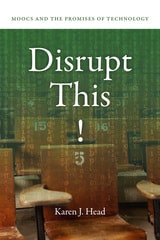
Disrupt This!
MOOCs and the Promises of TechnologyKaren J. Head
University Press of New England, 2017
In this smart and incisive work, Karen J. Head describes her experience teaching a Massive Open Online Course (MOOC) and the attendant pressure on professors, especially those in the humanities, to embrace new technologies in the STEM era. And yet, as she argues, MOOCs are just the latest example of the near-religious faith that some universities have in the promise of technological advances. As a teacher of rhetoric, Head is well versed at sniffing out the sophistry embedded in the tech jargon increasingly rife in the academy. Disrupt This! is a broader-based critique of the promises of technological “disruption” and the impact of Silicon Valley thinking on an unsuspecting, ill-prepared, and often gullible university community grasping for relevance, while remaining in thrall to the technologists.
[more]
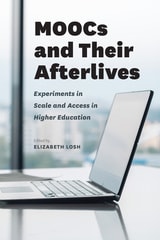
MOOCs and Their Afterlives
Experiments in Scale and Access in Higher EducationEdited by Elizabeth Losh
University of Chicago Press, 2017
A trio of headlines in the Chronicle of Higher Education seem to say it all: in 2013, “A Bold Move Toward MOOCs Sends Shock Waves;” in 2014, “Doubts About MOOCs Continue to Rise,” and in 2015, “The MOOC Hype Fades.” At the beginning of the 2010s, MOOCs, or Massive Open Online Courses, seemed poised to completely revolutionize higher education. But now, just a few years into the revolution, educators’ enthusiasm seems to have cooled. As advocates and critics try to make sense of the rise and fall of these courses, both groups are united by one question: Where do we go from here?
Elizabeth Losh has gathered experts from across disciplines—education, rhetoric, philosophy, literary studies, history, computer science, and journalism—to tease out lessons and chart a course into the future of open, online education. Instructors talk about what worked and what didn’t. Students share their experiences as participants. And scholars consider the ethics of this education. The collection goes beyond MOOCs to cover variants such as hybrid or blended courses, SPOCs (Small Personalized Online Courses), and DOCCs (Distributed Open Collaborative Course). Together, these essays provide a unique, even-handed look at the MOOC movement and will serve as a thoughtful guide to those shaping the next steps for open education.
Elizabeth Losh has gathered experts from across disciplines—education, rhetoric, philosophy, literary studies, history, computer science, and journalism—to tease out lessons and chart a course into the future of open, online education. Instructors talk about what worked and what didn’t. Students share their experiences as participants. And scholars consider the ethics of this education. The collection goes beyond MOOCs to cover variants such as hybrid or blended courses, SPOCs (Small Personalized Online Courses), and DOCCs (Distributed Open Collaborative Course). Together, these essays provide a unique, even-handed look at the MOOC movement and will serve as a thoughtful guide to those shaping the next steps for open education.
[more]
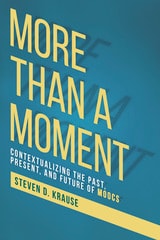
More than a Moment
Contextualizing the Past, Present, and FutureSteven D. Krause
Utah State University Press, 2019
As recently as 2012, massive open online courses (MOOCs) looked poised to revolutionize higher education, but in just a few years their flaws and problems have made them into a less relevant model. In More than a Moment, Steven D. Krause explores MOOCs and their continuing impact on distance learning in higher education, putting them in the context of technical innovations that have come before and those that will be part of the educational future.
Krause writes about his own experiences as a participant in several MOOCs and the experiences of faculty who developed and taught MOOCs. Contrary to many early claims from educational entrepreneurs, they were never entirely “new,” and MOOCs and their aftermath are still at the heart of the tensions between nonprofit universities and for-profit entities, particularly online program management firms, in delivering distance education.
While MOOCs are no longer a threat to education in the United States, they are part of the ongoing corporatization of education and remain part of conversations about experienced-based credit, corporate training, and open education. Presenting historical, student, teacher, and administrative perspectives, More than a Moment is a well-rounded treatment that will be of interest to academics and entrepreneurs interested in distance education, online pedagogy, online program management, and public-private partnerships in higher education.
[more]