Results by title
5 books match the query 'MacKenzie, Raymond N.'
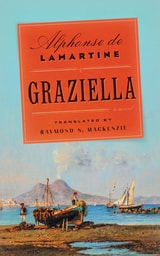
Graziella
A NovelAlphonse de Lamartine
University of Minnesota Press, 2018
In its first modern translation, a novel-cum-memoir of a Frenchman’s erotic awakening in Italy by a preeminent writer of the Romantic period
In 1812 Alphonse de Lamartine, a young man of means, traveled through southern Italy, where, during a sojourn in Naples, he fell in love with a young woman who worked in a cigar factory—and whose death after he returned to France would haunt him throughout his writing life. Graziella, Lamartine called this lost girl in his poetry and memoirs—and also in Graziella, a novel that closely follows the story of his own romance.
“When I was eighteen,” the narrator begins, as if penning his memoir, “my family entrusted me to the care of a relative whose business affairs called her to Tuscany.” The tale that unfolds, of the young man’s amorous experiences amid the natural grandeur and subtle splendors of the Italian countryside, is one of the finest works of fiction in the French Romantic tradition, a bildungsroman that is also a melancholy portrait of the artist as a young man discovering the muse who would both inspire and elude him.
Remarkable for its contemplative prose, its dreamy passions and seductive drawing of the Italian landscape, and its place in the Romantic canon, Graziella is a timeless portrait of love, chronicling the remorse and the misguided ideals of youth that find their expression, if not their amends, in art.

Italian Chronicles
Raymond N. Stendhal
University of Minnesota Press, 2017
Nineteenth-century French writer Marie-Henri Beyle, better known by his pen name Stendhal, is one of the earliest leading practitioners of realism, his stories filled with sharp analyses of his characters’ psychology. This translation of Stendhal’s Chroniques italiennes is a collection of nine tales written between 1829 and 1840, many of which were published only after his death. Together these collected tales reveal a great novelist working with highly dramatic subject matter to forge a vision of life lived at its most intense.
The setting for these tales is a romanticized Italy, a place Stendhal viewed as unpolluted by bourgeois inhibitions and conformism. From the hothouse atmosphere of aristocratic convents to the horrors of the Cenci family, the tales in Italian Chronicles all feature passionate, transgressive characters engaged in “la chasse au bonheur”—the quest for happiness. Most of the tragic, violent tales are based on historical events, with Stendhal using history to validate his characters’ extreme behaviors as they battle literal and figurative oppression and try to break through to freedom.
Complete with revenge, bloody daggers, poisonings, and thick-walled nunneries, this new translation of Italian Chronicles includes four never-before-translated stories and a fascinating introduction detailing the origins of the book. It is sure to gratify established Stendhal fans as well as readers new to the writer.

Red and Black
A Chronicle of 1830Raymond N. Stendhal
University of Minnesota Press, 2022
A masterpiece of nineteenth-century literature in a fresh translation that fully captures the language, psychology, and social reach of Stendhal’s original
Fueled with a combustible mix of ambition, naivete, and Napoleonic ideals, Julien Sorel sets his sights on the heights of French society. But for the son of a provincial carpenter in post-Napoleonic France, the prospects for advancement are vanishingly narrow, the chances for glory rarer yet. After securing a toehold as a tutor to a wealthy family, Julien proceeds through a series of misadventures, illicit affairs, and lucky reversals to breach the ranks of French aristocracy—only to be undone by treasonous schemes, cynical romantic calculations, and an unexpectedly genuine and ultimately disastrous passion.
Shocking at the time of its original publication, startling in its relevance today, Stendhal’s masterpiece is a scorching social satire, a remarkably detailed portrait of a fraught moment in history and, as perhaps the first psychological novel, a brilliant precursor to modern literature at once comical and tragic, cerebral and passionate. This new translation faithfully reproduces the nimble wit, emotional depth, and social acuity of Stendhal’s text. Distinguished translator Raymond N. MacKenzie includes an extensive introduction to Stendhal’s world and time, as well as copious annotations that explain allusions and terms for the modern reader.
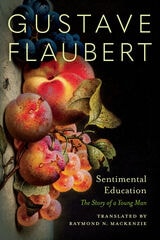
Sentimental Education
The Story of a Young ManGustave Flaubert
University of Minnesota Press, 2024
A fresh and vivid translation of Flaubert’s influential bildungsroman
Gustave Flaubert conceived Sentimental Education, his final complete novel, as the history of his own generation, one that failed to fulfill the promise of the Revolution of 1848. Published a few months before the start of the 1870 Franco–Prussian War, it offers both a sweeping panorama of French society over three decades and an intimate bildungsroman of a young man from a small town who arrives in Paris when protests against the monarchy are increasing.
The novel’s protagonist, Frédéric Moreau, alternates between aimlessness and ambition as he searches for a meaningful life through love affairs and republican politics. Flaubert’s narrative includes scenes of high drama, as scattered protests across Paris swell into revolution, and quiet moments of self-aware romanticism, crafting a story that possesses the sweep and scope of a historical novel combined with deep emotion and scandalous intimacy. Suffused with tragedy and the poignancy of lost chances and wasted lives, Sentimental Education is sharpened by satirical observations of what Flaubert condemned as the Second Empire’s endemic hypocrisy and willful blindness.
This vibrant, new translation by Raymond N. MacKenzie includes an extensive critical introduction and annotations to help the modern reader appreciate Flaubert’s achievement. Sentimental Education intertwines the personal, the intimate, and the subjective with the political, social, and cultural, embedding Frédéric’s story in the larger arc of what Flaubert saw as France’s decline into mediocrity and imbecility in its politics and manners.

The Bewitched
Jules Barbey d’Aurevilly
University of Minnesota Press, 2026
A haunting, resonant novel of passion and betrayal—in its first English translation since 1928
“When we bring true passions into our works, we don’t fear the cries of the offended.” So declared Jules Barbey d’Aurevilly in 1853 as he prepared to publish The Bewitched in book form, restoring the sections that were unceremoniously deleted from its serialized release by an editor who deemed them too explicit, irreverent, and inflammatory. Newly translated into English for modern readers, The Bewitched is a beguiling tale of politics, obsession, and horror set against the backdrop of Normandy in postrevolutionary France.
Late at night in a foggy moor, the far clock tower rends the still air to mark the midnight hour. As the darkness settles back into silence, another bell rings out, slow and somber, calling all who hear it to the abbé de La Croix-Jugan’s Mass of the Dead. Returned to the priesthood in shame after breaking his vows by shedding blood in battle and attempting suicide in defeat, the disfigured man enthralls the inhabitants of this small village. Before long, a young married woman becomes infatuated with the enigmatic priest, and their fates are irrevocably intertwined. When she succumbs to despair over her unrequited love, her husband is consumed by jealousy and vows revenge.
Layering stories within stories and continually shifting points of view, Barbey d’Aurevilly engages a mosaic of narrators to depict the era’s tensions between the aristocracy, the peasant class, and the church. Raymond N. MacKenzie’s lively translation is accompanied by his detailed introduction and notes that ground the novel in its historical, political, and literary contexts. A classic of French Gothic literature, The Bewitched blends religious transgression, satanic possession, and political upheaval into a fatal love story that is as gripping now as it was nearly two centuries ago.
Retail e-book files for this title are screen-reader friendly.