Results by title
3 books match the query 'Macau (China : Special Administrative Region)'
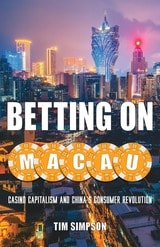
Betting on Macau
Casino Capitalism and China's Consumer RevolutionTim Simpson
University of Minnesota Press, 2023
A comprehensive look into how Macau’s recent decades of gambling-related growth produced one of the wealthiest territories on the planet
Betting on Macau delves into the radical transformation of what was formerly the last remaining European territory in Asia, returned to the People’s Republic of China in 1999 after nearly half a millennium of Portuguese rule. Examining the unprecedented scale of its development and its key role in China’s economic revolution, Tim Simpson follows Macau’s emergence from historical obscurity to become the most profitable casino gaming locale in the world.
Identified as a UNESCO World Heritage Site and renowned for its unique blend of Chinese and Portuguese colonial-era architecture, contemporary Macau has metamorphosed into a surreal, hypermodern urban landscape augmented by massive casino megaresorts, including two of the world’s largest buildings. Simpson situates Macau’s origins as a strategic trading port and its ensuing history alongside the emergence of the global capitalist system, charting the massive influx of foreign investment, construction, and tourism in the past two decades that helped generate the territory’s enormous wealth.
Presented through a cross section of postcolonial studies and social theory with extensive insight into the global gambling industry, Betting on Macau uncovers the various roots of the territory’s lucrative casino capitalism. In turn, its trenchant analysis provides a distinctive view into China’s broader project of urbanization, its post-Mao economic reforms, and the continued rise of its consumer culture.
Macao and the British, 1637–1842
Prelude to Hong KongAustin Coates
Hong Kong University Press, 2009
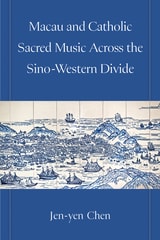
Macau and Catholic Sacred Music Across the Sino-Western Divide
Jen-yen Chen
University of Michigan Press, 2026
Drawing from sound studies and musicological methods, Chen argues that Chinese descriptions of Catholic sounds in Macau, including the ringing of church bells, the playing of the organ, and choral singing, illuminate spatial, sonic, and ideological mobilities that reconfigure Chinese and European identities. Macau and Catholic Music Across the Sino-Western Divide also extends to contemporary times to explore how present day members of Macau’s Catholic community position themselves in relation to the historical narratives often told about their city, cultivating a rich individuality of identity that refuses conformity to fixed notions of Asianness or Westernness.