Results by title
6 books match the query 'Machiavelli, Niccoláo'
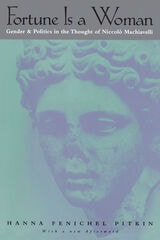
Fortune Is a Woman
Gender and Politics in the Thought of Niccolo MachiavelliHanna Fenichel Pitkin
University of Chicago Press, 1999
"Fortune is a woman, and if you want to keep her under, you've got to knock her around some."—Niccolò Machiavelli
Hanna Pitkin's provocative and enduring study of Machiavelli was the first to systematically place gender at the center of its exploration of his political thought. In this edition, Pitkin adds a new afterword, in which she discusses the book's critical reception and situates the book's arguments in the context of recent interpretations of Machiavelli's thought.
"A close and often brilliant exegesis of Machiavelli's writings."—The American Political Science Review
[more]
Hypocrisy and Integrity
Machiavelli, Rousseau, and the Ethics of PoliticsRuth W. Grant
University of Chicago Press, 1997
Questioning the usual judgements of political ethics, Ruth W. Grant argues that hypocrisy can actually be constructive while strictly principled behavior can be destructive. Hypocrisy and Integrity offers a new conceptual framework that clarifies the differences between idealism and fanaticism while it uncovers the moral limits of compromise.
[more]
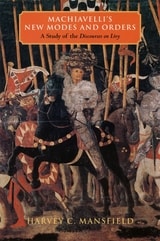
Machiavelli's New Modes and Orders
A Study of the Discourses on LivyHarvey C. Mansfield
University of Chicago Press, 2001
Machiavelli's New Modes and Orders is the only full-length interpretive study on Machiavelli's controversial and ambiguous work, Discourses on Livy. These discourses, considered by some to be Machiavelli's most important work, are thoroughly explained in a chapter-by-chapter commentary by Harvey C. Mansfield, one of the world's foremost interpreters of this remarkable philosopher.
Mansfield's aim is to discern Machiavelli's intention in writing the book: he argues that Machiavelli wanted to introduce new modes and orders in political philosophy in order to make himself the founder of modern politics. Mansfield maintains that Machiavelli deliberately concealed part of his intentions so that only the most perceptive reader could see beneath the surface of the text and understand the whole of his book. Previously out of print, Mansfield's penetrating study brings to light the hidden thoughts lurking in the details of the Discourses on Livy to inform and challenge its readers at every step along the way.
Mansfield's aim is to discern Machiavelli's intention in writing the book: he argues that Machiavelli wanted to introduce new modes and orders in political philosophy in order to make himself the founder of modern politics. Mansfield maintains that Machiavelli deliberately concealed part of his intentions so that only the most perceptive reader could see beneath the surface of the text and understand the whole of his book. Previously out of print, Mansfield's penetrating study brings to light the hidden thoughts lurking in the details of the Discourses on Livy to inform and challenge its readers at every step along the way.
[more]
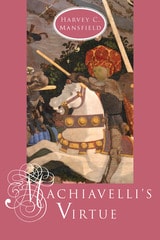
Machiavelli's Virtue
Harvey C. Mansfield
University of Chicago Press, 1996
Uniting thirty years of authoritative scholarship by a master of textual detail, Machiavelli's Virtue is a comprehensive statement on the founder of modern politics. Harvey Mansfield reveals the role of sects in Machiavelli's politics, his advice on how to rule indirectly, and the ultimately partisan character of his project, and shows him to be the founder of such modern and diverse institutions as the impersonal state and the energetic executive. Accessible and elegant, this groundbreaking interpretation explains the puzzles and reveals the ambition of Machiavelli's thought.
"The book brings together essays that have mapped [Mansfield's] paths of reflection over the past thirty years. . . . The ground, one would think, is ancient and familiar, but Mansfield manages to draw out some understandings, or recognitions, jarringly new."—Hadley Arkes, New Criterion
"Mansfield's book more than rewards the close reading it demands."—Colin Walters, Washington Times
"[A] masterly new book on the Renaissance courtier, statesman and political philosopher. . . . Mansfield seeks to rescue Machiavelli from liberalism's anodyne rehabilitation."—Roger Kimball, The Wall Street Journal
[more]
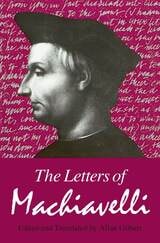
The Letters of Machiavelli
Niccolò Machiavelli
University of Chicago Press, 1988
This collection of the most brilliant and characteristic letters of Niccolò Machiavelli displays the vital and penetrating mind of the man who wrote the first work of modern political science. These letters, which reveal Machiavelli's critical intelligence, sense of humor, and elegant sense, are our chief source of information about his personal life. As such, they will serve as a vivid introduction to the personalities and events of the most turbulent period of the Renaissance, and they will also enlighten people who have been fascinated by the political thinker who wrote The Prince and The Discourses on Livy.
[more]

Thoughts on Machiavelli
Leo Strauss
University of Chicago Press, 1958
Leo Strauss argued that the most visible fact about Machiavelli's doctrine is also the most useful one: Machiavelli seems to be a teacher of wickedness. Strauss sought to incorporate this idea in his interpretation without permitting it to overwhelm or exhaust his exegesis of The Prince and the Discourses on the First Ten Books of Livy. "We are in sympathy," he writes, "with the simple opinion about Machiavelli [namely, the wickedness of his teaching], not only because it is wholesome, but above all because a failure to take that opinion seriously prevents one from doing justice to what is truly admirable in Machiavelli: the intrepidity of his thought, the grandeur of his vision, and the graceful subtlety of his speech." This critique of the founder of modern political philosophy by this prominent twentieth-century scholar is an essential text for students of both authors.
[more]