Results by title
19 books match the query 'Machine'
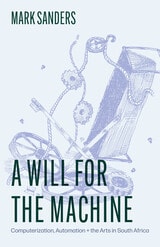
A Will for the Machine
Computerization, Automation, and the Arts in South AfricaMark Sanders
University of Chicago Press, 2026
There are many books about the history and discourses of computerization in the United States but relatively little about these phenomena anywhere in the Global South. In A Will for the Machine, Mark Sanders outlines South Africa’s entry into the computer age in the 1960s and ’70s and explains how it coincided with the high point of apartheid. South Africa’s government viewed automation and computerization as one way of barring Black Africans from skilled work and reserving it for whites. Sanders unpacks this peculiar history, relates it to early twentieth-century struggles around mechanization in mining and telephony in South Africa, and analyzes responses to it by the writers Miriam Tlali and J. M. Coetzee, the artist William Kentridge, and Handspring Puppet Company. Showing how the arts realize ideas about the ethics and politics of automation, Sanders contributes to debates about locally divergent understandings of computer technology and human-computer interaction.
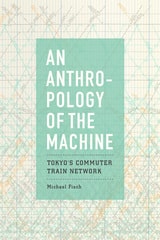
An Anthropology of the Machine
Tokyo's Commuter Train NetworkMichael Fisch
University of Chicago Press, 2018
An Anthropology of the Machine is a creative ethnographic study of the culture, history, and experience of commuting in Tokyo. At the same time, it is a theoretically ambitious attempt to think through our very relationship with technology and our possible ecological futures. Fisch provides an unblinking glimpse into what it might be like to inhabit a future in which more and more of our infrastructure—and the planet itself—will have to operate beyond capacity to accommodate our ever-growing population.

Breathing Race Into The Machine
Luncy Braun
University of Minnesota Press, 2024
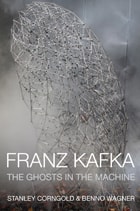
Franz Kafka
The Ghosts in the MachineStanley Corngold
Northwestern University Press, 2011
Corngold and Wagner frame Kafka’s writings as cultural events, each work reflecting the economic and cultural discourses of his epoch. In pursuing Kafka’s avowed interest in the theory and practice of insurance, the authors view the two systems of his literary worlds—the official and the personal—as a “bundling” together of the various cultural accidents of Kafka’s time. The work of two of the leading scholars of the single most influential writer of literary modernity, Franz Kafka: The Ghosts in the Machine constitutes a breathtakingly original advance in the study of both the more famous and less well-known works of this enigmatic master.
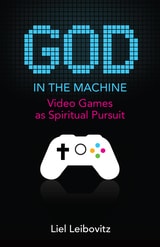
God in the Machine
Video Games as Spiritual PursuitLiel Leibovitz
Templeton Press, 2014
Yet video games remain relatively unexplored by both scholars and pundits alike. Few have advanced beyond outmoded and futile attempts to tie gameplay to violent behavior. With this rumor now thoroughly and repeatedly disproven, it is time to delve deeper. Just as the Museum of Modern Art in Manhattan recently acquired fourteen games as part of its permanent collection, so too must we seek to add a serious consideration of virtual worlds to the pantheon of philosophical inquiry.
In God in the Machine, author Liel Leibovitz leads a fascinating tour of the emerging virtual landscape and its many dazzling vistas from which we are offered new vantage points on age-old theological and philosophical questions. Free will vs. determinism, the importance of ritual, transcendence through mastery, notions of the self, justice and sin, life, death, and resurrection all come into play in the video games that some critics so quickly write off as mind-numbing wastes of time. When one looks closely at how these games are designed, their inherent logic, and their cognitive effects on players, it becomes clear that playing these games creates a state of awareness vastly different from when we watch television or read a book. Indeed, the gameplay is a far more dynamic process that draws on various faculties of mind and body to evoke sensations that might more commonly be associated with religious experience. Getting swept away in an engaging game can be a profoundly spiritual activity. It is not to think, but rather to be, a logic that sustained our ancestors for millennia as they looked heavenward for answers.
As more and more of us look “screenward,” it is crucial to investigate these games for their vast potential as fine instruments of moral training. Anyone seeking a concise and well-reasoned introduction to the subject would do well to start with God in the Machine. By illuminating both where video game storytelling is now and where it currently butts up against certain inherent limitations, Liebovitz intriguingly implies how the field and, in turn, our experiences might continue to evolve and advance in the coming years.
MUSE IN THE MACHINE
AMERICAN FICTION AND MASS PUBLICITYMARK CONROY
The Ohio State University Press, 2004
Machine
Thomas Pringle
University of Minnesota Press, 2018
On the social consequences of machines
Automation, animation, and ecosystems are terms of central media-philosophical concern in today’s society of humans and machines. This volume describes the social consequences of machines as a mediating concept for the animation of life and automation of technology. Bernard Stiegler’s automatic society illustrates how digital media networks establish a new proletariat of knowledge workers. Gertrud Koch offers the animation of the technical to account for the pathological relations that arise between people and their devices. And Thomas Pringle synthesizes how automation and animation explain the history of intellectual exchanges that led to the hybrid concept of the ecosystem, a term that blends computer and natural science. All three contributions analyse how categories of life and technology become mixed in governmental policies, economic exploitation and pathologies of everyday life thereby both curiously and critically advancing the term that underlies those new developments: ‘machine.’
Machine and Sovereignty
For a Planetary Thinkingyuk
University of Minnesota Press, 2024
Developing a new political thought to address today’s planetary crises
What is “planetary thinking” today? Arguing that a new approach is urgently needed, Yuk Hui develops a future-oriented mode of political thought that encompasses the unprecedented global challenges we are confronting: the rise of artificial intelligence, the ecological crisis, and intensifying geopolitical conflicts.
Machine and Sovereignty starts with three premises. The first affirms the necessity of developing a new language of coexistence that surpasses the limits of nation-states and their variations; the second recognizes that political forms, including the polis, empire, and the state, are technological phenomena, which Lewis Mumford terms “megamachines.” The third suggests that a particular political form is legitimated and rationalized by a corresponding political epistemology. The planetary thinking that this book sketches departs from the opposition between mechanism and organism, which characterized modern thought, to understand the epistemological foundations of Hegel’s political state and Schmitt’s Großraum and their particular ways of conceiving the question of sovereignty. Through this reconstruction, Hui exposes the limits of the state and reflects on a new theoretical matrix based on the interrelated concepts of biodiversity, noodiversity, and technodiversity.
Arguing that we are facing the limit of modernity, of the eschatological view of history, of globalization, and of the human, Hui conceives necessary new epistemological and technological frameworks for understanding and rising to the crises of our present and our future.
Retail e-book files for this title are screen-reader friendly.

Machine in the Studio
Constructing the Postwar American ArtistCaroline A. Jones
University of Chicago Press, 1996
"Jones manages to analyze art works in their historical, political, and conceptual context, giving them a thickness of description rarely possible in standard art history. . . . This is one of the best books on the period I have read so far. To paraphrase Clement Greenberg, it gives contemporary art history a good name."—Serge Guilbaut, Bookforum
"Though we are some 30 years past the events of the '60s, our world is still largely responding to them, as this marvelous book amply demonstrates."—David McCarthy, New Art Examiner

People of the Machine
Computers and Human Reason in the Cold WarJoy Rohde
University of Chicago Press, 0
How Cold War computational experts invested in diplomacy, world peace, and human agency created systems that threatened democratic values.
Beginning in the 1950s, international relations experts and United States government officials built novel computer systems designed to make foreign policy knowledge and practice more scientific. Human reason, they feared, might not be enough to guarantee the survival of American democracy in a nuclear-armed world. They didn’t seek to replace humans with machines; they hoped computers would sift information or provide interactive models that analysts could use to make better decisions. But as they struggled to deliver on their ambitious goals, and as the Defense Department became more involved in their projects after the Vietnam War, their commitments to advancing knowledge, policy agency, and peace gave way to very different computing systems, ones in which correlation replaces causality and prediction replaces understanding.
In People of the Machine, Joy Rohde reveals how even the best-intentioned attempts at fostering political engagement and human autonomy evolved into an anti-democratic nightmare. Her political and intellectual history shows how the subtle and corrosive effects of technological change set the template for today’s political and conceptual regimes. Doing so reveals not just the roots of contemporary inequality and disfranchisement but how thoroughly that antihumanism has been baked into our institutions and norms.
Rereading the Machine in the Garden
Nature and Technology in American CultureEdited by Eric C. Erbacher, Nicole Maruo-Schröder, and Florian Sedlmeier
Campus Verlag, 2014
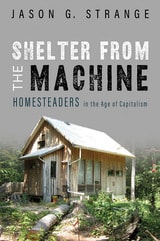
Shelter from the Machine
Homesteaders in the Age of CapitalismJason G. Strange
University of Illinois Press, 2020
Jason Strange shows where homesteaders fit, and don't fit, within contemporary America. Blending history with personal stories, Strange visits pig roasts and bohemian work parties to find people engaged in a lifestyle that offers challenge and fulfillment for those in search of virtues like self-employment, frugality, contact with nature, and escape from the mainstream. He also lays bare the vast differences in education and opportunity that leave some homesteaders dispossessed while charting the tensions that arise when people seek refuge from the ills of modern society—only to find themselves indelibly marked by the system they dreamed of escaping.
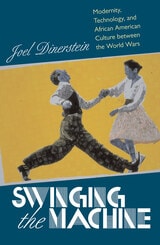
Swinging the Machine
Modernity, Technology, and African American Culture between the World WarsJoel Dinerstein
University of Massachusetts Press, 2003
In any age and any given society, cultural practices reflect the material circumstances of people's everyday lives. According to Joel Dinerstein, it was no different in America between the two World Wars—an era sometimes known as the “machine age”—when innovative forms of music and dance helped a newly urbanized population cope with the increased mechanization of modern life. Grand spectacles such as the Ziegfeld Follies and the movies of Busby Berkeley captured the American ethos of mass production, with chorus girls as the cogs of these fast, flowing pleasure vehicles.
Yet it was African American culture, Dinerstein argues, that ultimately provided the means of aesthetic adaptation to the accelerated tempo of modernity. Drawing on a legacy of engagement with and resistance to technological change, with deep roots in West African dance and music, black artists developed new cultural forms that sought to humanize machines. In “The Ballad of John Henry,” the epic toast “Shine,” and countless blues songs, African Americans first addressed the challenge of industrialization. Jazz musicians drew on the symbol of the train within this tradition to create a set of train-derived aural motifs and rhythms, harnessing mechanical power to cultural forms. Tap dance and the lindy hop brought machine aesthetics to the human body, while the new rhythm section of big band swing mimicked the industrial soundscape of northern cities. In Dinerstein's view, the capacity of these artistic innovations to replicate the inherent qualities of the machine-speed, power, repetition, flow, precision-helps explain both their enormous popularity and social function in American life.
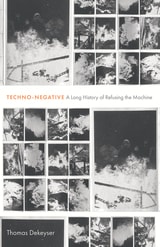
Techno-Negative
A Long History of Refusing the MachineThomas Dekeyser
University of Minnesota Press, 2026
A radical history of technology told through acts of resistance, not progress
The history of technology is often told as a history of progress, moving optimistically and inevitably from one emancipatory invention to the next. Techno-Negative turns this story on its head, taking us on a journey to the critical junctures where people have pointedly rejected and tried to undo, rather than adopt, new technologies. Beginning with Archimedes’s decision to destroy his own war machines, this book explores the will to negate technology as a deep—but persistently condemned—current in history.
As he presents a new theory of technological power, Thomas Dekeyser argues that technologies, never neutral, operate as “ontological policing,” drawing the boundaries of humanness as they are unequally leveraged by select groups. Looking beyond the Luddites to medieval monks banning tools, seventeenth-century loom burners, revolutionary lantern smashers, and computer arsonists, Dekeyser shows how people have long recognized and resisted the machine as a violent, sometimes deadly force implicated in defining who counts as human and whose lives (and ways of life) are worth saving.
Against the ubiquitous demands to reform or accelerate technological “advancement” that have failed to disrupt our present, Dekeyser proposes a spirited alternative: abolition. He challenges us to rethink the terms of our technological present and future. In a time when Big Tech grows increasingly enmeshed with authoritarian control, Techno-Negative is a conceptual declaration, and source of inspiration, for those searching for a new paradigm of technological politics.
Retail e-book files for this title are screen-reader friendly.
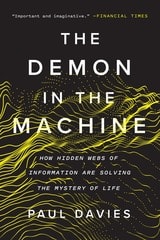
The Demon in the Machine
How Hidden Webs of Information Are Solving the Mystery of LifePaul Davies
University of Chicago Press, 1991
A Financial Times, Sunday Times, and Telegraph Best Science Book of the Year
What is life? For generations, scientists have struggled to make sense of this fundamental question, for life really does look like magic: even a humble bacterium accomplishes things so dazzling that no human engineer can match it. Huge advances in molecular biology over the past few decades have served only to deepen the mystery.
In this penetrating and wide-ranging book, world-renowned physicist and science communicator Paul Davies searches for answers in a field so new and fast-moving that it lacks a name; it is a domain where biology, computing, logic, chemistry, quantum physics, and nanotechnology intersect. At the heart of these diverse fields, Davies explains, is the concept of information: a quantity which has the power to unify biology with physics, transform technology and medicine, and force us to fundamentally reconsider what it means to be alive—even illuminating the age-old question of whether we are alone in the universe.
From life’s murky origins to the microscopic engines that run the cells of our bodies, The Demon in the Machine journeys across an astounding landscape of cutting-edge science. Weaving together cancer and consciousness, two-headed worms and bird navigation, Davies reveals how biological organisms garner and process information to conjure order out of chaos, opening a window onto the secret of life itself.
The Intelligence of a Machine
Jean Epstein
University of Minnesota Press, 2014
The advent of the cinema radically altered our comprehension of time, space, and reality. With his experience as a pioneering avant-garde filmmaker, Jean Epstein uses the universes created by the cinematograph to deconstruct our understanding of how time and space, reality and unreality, continuity and discontinuity, determinism and randomness function both inside and outside the cinema. Time, he says, should be regarded as the first, not the fourth, dimension—and the cinematograph allows us, for the first time, to manipulate it in directions and speeds of our choosing.
The theoretical work of Jean Epstein greatly influenced later generations of cinema philosophers, notably Gilles Deleuze and Jacques Rancière, but the bulk of his work remains unpublished. The Intelligence of a Machine, his first major title published in English, is one of the earliest philosophies of cinema.

The Maverick and the Machine
Governor Dan Walker Tells His StoryDan Walker
Southern Illinois University Press, 2007
Best Memoir of 2008, San Diego Book Awards
Illinois State Historical Society Certificate of Excellence, 2008
The Monster in the Machine
Magic, Medicine, and the Marvelous in the Time of the Scientific RevolutionZakiya Hanafi
Duke University Press, 2000
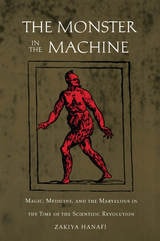
Noting that the word “monster” is derived from the Latin for “omen” or “warning,” Hanafi explores the monster’s early identity as a portent or messenger from God. Although monsters have always been considered “whatever we are not,” they gradually were tranformed into mechanical devices when new discoveries in science and medicine revealed the mechanical nature of the human body. In analyzing the historical literature of monstrosity, magic, and museum collections, Hanafi uses contemporary theory and the philosophy of technology to illuminate the timeless significance of the monster theme. She elaborates the association between women and the monstrous in medical literature and sheds new light on the work of Vico—particularly his notion of the conatus—by relating it to Vico’s own health. By explicating obscure and fascinating texts from such disciplines as medicine and poetics, she invites the reader to the piazzas and pulpits of seventeenth-century Naples, where poets, courtiers, and Jesuit preachers used grotesque figures of speech to captivate audiences with their monstrous wit.
Drawing from a variety of texts from medicine, moral philosophy, and poetics, Hanafi’s guided tour through this baroque museum of ideas will interest readers in comparative literature, Italian literature, history of ideas, history of science, art history, poetics, women’s studies, and philosophy.
The Terror of the Machine
Technology, Work, Gender, and Ecology on the U.S.-Mexico BorderBy Devon G. Peña
University of Texas Press, 1995
Born of thirteen years of field research, this interdisciplinary work explores the complex intersections of technology, class, gender, and ecology in the transnational milieu of Mexico's maquiladoras, foreign-owned assembly plants located along the U.S. border.
Devon Peña examines workplace and community struggles from the perspective of the women who work in the maquiladoras. He describes the workers' struggles for workplace democracy, social justice, and sustainable development. He also observes the circulation of struggle from the factory to the community, highlighting the efforts to establish worker-owned cooperatives in the border region during the 1970s and 1980s.
Female maquila workers are typically portrayed as passive, apolitical, and easily exploited. This book, however, presents an opposing view, investigating the "subaltern life of the shop floor"—the workers' informal methods of resistance to hazardous conditions, sexual harassment, and managerial tyranny. Using survey research, oral history, discourse analysis, and site ethnography, the author develops a cogent critique of labor-process theory, a critique grounded on his extensive study of actual workplace politics in the maquiladoras.
The Terror of the Machine is a trenchant analysis of the political, cultural, and environmental effects of maquila industrialization and an eloquent and persuasive call for alternatives in the direction of ecologically sustainable and culturally appropriate modes of development.