Results by title
3 books match the query 'Madsen, David B.'
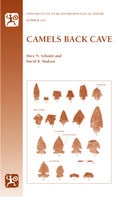
Camels Back Cave
Anthropological Paper 125Dave N. Schmitt
University of Utah Press, 2005
University of Utah Anthropological Paper No. 125
Camels Back Cave is in an isolated limestone ridge on the southern edge of the Great Salt Lake Desert. Recent archaeological investigations there have exposed a series of stratified deposits spanning the entire Holocene era (10,000 BP–present), deposits that show intermittent human occupations dating back through the past 7,600 years. Most human visits to the cave were brief—many likely representing overnight stays—and visitors did not dig pits or move sediment. As a result, fieldworkers were able to recognize and remove thirty-three stratigraphic horizons; radiocarbon analysis provided a pristine, high-resolution chronological sequence of human use. The brevity of visits and the undisturbed nature of the deposits also allowed researchers to identify portions of eight “living surfaces” where they exposed and mapped artifacts and ecofacts across contiguous blocks of units.
Aside from presenting model field techniques, this volume provides new and unique information on regional Holocene climates and biotic communities, cave taphonomy and small mammal hunting, as well as updated human chronologies for Great Basin occupation.
Entering America
Northeast Asia and Beringia Before the Last Glacial MaximumDavid B. Madsen
University of Utah Press, 2004
Where did the first Americans come from and when did they get here? That basic question of American archaeology, long thought to have been solved, is re-emerging as a critical issue as the number of well-excavated sites dating to pre-Clovis times increases. It now seems possible that small populations of human foragers entered the Americas prior to the creation of the continental glacial barrier. While the archaeological and paleoecological aspects of a post-glacial entry have been well studied, there is little work available on the possibility of a pre-glacial entry.
Entering America seeks to fill that void by providing the most up-to-date information on the nature of environmental and cultural conditions in northeast Asia and Beringia (the Bering land bridge) immediately prior to the Last Glacial Maximum. Because the peopling of the New World is a question of international archaeological interest, this volume will be important to specialists and nonspecialists alike.
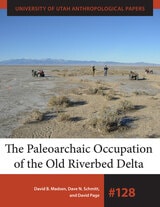
The Paleoarchaic Occupation of the Old River Bed Delta
David B. Madsen, Dave N. Schmitt, and David Page
University of Utah Press, 2015
University of Utah Anthropological Paper No. 128
About 12,000 years ago, a major river ran from the Sevier Basin to the Great Salt Lake, feeding a wetland delta system and creating riparian habitat along its length. But after three thousand years the river dried up and the surrounding lands became more like what we see today. Because the Old River Bed Delta experienced less environmental and human disturbance than other areas, many of the Paleoarchaic sites found there have remained relatively intact—a rare find in the Great Basin. This book presents a comprehensive synthesis of a decade of investigations conducted by research teams working in different parts of the delta and explores questions about how the old riverbed was formed, how its distributary system changed through time, and how these changes affected early foragers. It concludes with an integrated summary and interpretation. Additional material from this study will be available online at UofUpress.com.
Supplementary Material for The Paleoarchaic Occupation of the Old River Bed Delta
Chapter 3 - SDM Trench and Locality Descriptions November
Chapter 3 SDM Individual Channel Images November
Chapter 5 - SDM Additional Lithic Artifact Images
Chapter 6 - SDM Results of XRF and PXRF Analysis
Chapter 6 - SDM Source Assignment Tables