Results by title
10 books match the query 'Mafia'
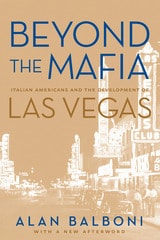
Beyond The Mafia
Italian Americans And The Development Of Las VegasAlan Balboni
University of Nevada Press, 2006
When Beyond the Mafia first appeared in 1996 it was hailed as a significant contribution to the history of Las Vegas and of ethnic minorities in America. Author Alan Balboni traces the history of Italians in Las Vegas from the founding of the city in 1905, recording their activities in the fledgling settlement. As Las Vegas grew, Italian Americans participated in every aspect of the city’s society and economy, including construction, retail establishments, hotels, and—after the statewide legalization of gambling in 1931—the casino industry. Basing his research on well over a hundred interviews, as well as the records of Italian American organizations, public agencies, and other sources, Balboni has produced a sparkling and thoroughly documented account of the history of one of Las Vegas’s most progressive and productive ethnic minorities. This new paperback edition includes an afterword by the author that brings the story of Las Vegas’s Italian Americans up to the present.
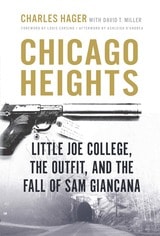
Chicago Heights
Little Joe College, the Outfit, and the Fall of Sam GiancanaCharles Hager with David T. Miller, Foreword by Louis Corsino, Afterword by Ashleigh D'Andrea
Southern Illinois University Press, 2018
In this riveting true story of coming of age in the Chicago Mob, Charles “Charley” Hager is plucked from his rural West Virginia home by an uncle in the 1960s and thrown into an underworld of money, cars, crime, and murder on the streets of Chicago Heights.
Street-smart and good with his hands, Hager is accepted into the working life of a chauffeur and “street tax” collector, earning the moniker “Little Joe College” by notorious mob boss Albert Tocco. But when his childhood friend is gunned down by a hit man, Hager finds himself a bit player in the events surrounding the mysterious, and yet unsolved, murder of mafia chief Sam Giancana.
Chicago Heights is part rags-to-riches story, part murder mystery, and part redemption tale. Hager, with author David T. Miller, juxtaposes his early years in West Virginia with his life in crime, intricately weaving his own experiences into the fabric of mob life, its many characters, and the murder of Giancana.
Fueled by vivid recollections of turf wars and chop shops, of fix-ridden harness racing and the turbulent politics of the 1960s, Chicago Heights reveals similarities between high-level organized crime in the city and the corrupt lawlessness of Appalachia. Hager candidly reveals how he got caught up in a criminal life, what it cost him, and how he rebuilt his life back in West Virginia with a prison record.
Based on interviews with Hager and supplemented by additional interviews and extensive research by Miller, the book also adds Hager’s unique voice to the volumes of speculation about Giancana’s murder, offering a plausible theory of what happened on that June night in 1975.
Crime and Justice, Volume 49
Organizing Crime: Mafias, Markets, and NetworksEdited by Michael Tonry and Peter Reuter
University of Chicago Press Journals, 2021
For most Americans, The Godfather, The Sopranos, and the Cosa Nostra exemplify organized crime. In Asia the term conjures up images of Japanese yakuza and Chinese triads, in Italy the Cosa Nostra and ‘Ndrangheta, in Latin America Mexican narco-gangs and Colombian drug cartels, in the Netherlands transnational drug and human trafficking, and in Scandinavia outlaw motorcycle gangs. Some but not all those organizations are “mafias” with centuries-long histories, distinctive cultures, and complicated relationships with local communities and governments. Others are new, large but transitory and with no purpose other than maximizing profits from illegal markets.
Organized crime organizations have existed for centuries. Serious scholarly, as opposed to journalistic or law enforcement, efforts to understand them, however, date back only a few decades. Authoritative overviews were, until very recently, impossible. Rigorous, analytically acute, and methodologically sophisticated literatures did not exist. They have begun to emerge. They have developed in many countries, involve work in different languages and disciplines, and deploy a wide range of methods.
Organizing Crime: Mafias, Markets, and Networks provides the most exhaustive overview ever published of knowledge about organized crime. It provides intensive accounts of American, Italian, and Dutch developments, covers both national mafias and transnational criminality, and delves in depth into gender, human capital, and money laundering issues. The writers are based in seven countries. To a person they are, or are among, the world’s most distinguished specialists in their subjects. At last, credible explanations and testable hypotheses are available concerning when, why, and under what circumstances mafias and other organized crime organizations come into being, what makes them distinctive, what they do and with what effects, and how to contain them.
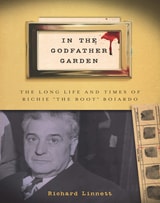
In the Godfather Garden
The Long Life and Times of Richie "the Boot" BoiardoLinnett, Richard
Rutgers University Press, 2013
To the press and the police, this secretive Don insisted he was nothing more than a simple man who enjoyed puttering about in his beloved vegetable garden on his Livingston, New Jersey, estate. In reality, the Boot was a confidante and kingmaker of politicians, a friend of such celebrities as Joe DiMaggio and George Raft, an acquaintance of Joseph Valachi—who informed on the Boot in 1963—and a sworn enemy of J. Edgar Hoover.
The Boot prospered for more than half a century, remaining an active boss until the day he died at the age of ninety-three. Although he operated in the shadow of bigger Mafia names across the Hudson River (think Charles "Lucky" Luciano and Louis “Lepke” Buchalter, a cofounder of the Mafia killer squad Murder Inc. with Jacob “Gurrah” Shapiro), the Boot was equally as brutal and efficient. In fact, there was a mysterious place in the gloomy woods behind his lovely garden—a furnace where many thought the Boot took certain people who were never seen again.
Richard Linnett provides an intimate look inside the Boot’s once-powerful Mafia crew, based on the recollections of a grandson of the Boot himself and complemented by never-before-published family photos. Chronicled here are the Prohibition gang wars in New Jersey as well as the murder of Dutch Schultz, a Mafia conspiracy to assassinate Newark mayor Kenneth Gibson, and the mob connections to several prominent state politicians.
Although the Boot never saw the 1972 release of The Godfather, he appreciated the similarities between the character of Vito Corleone and himself, so much so that he hung a sign in his beloved vegetable garden that read “The Godfather Garden.” There’s no doubt he would have relished David Chase’s admission that his muse in creating the HBO series The Sopranos was none other than “Newark’s erstwhile Boiardo crew.”
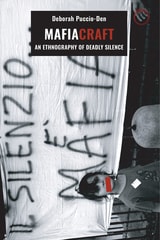
Mafiacraft
An Ethnography of Deadly SilenceDeborah Puccio-Den
HAU, 2021

On the Run in Siberia
Rane Willerslev
University of Minnesota Press, 2012
If I had let myself be ruled by reason alone, I would surely be lying dead somewhere or another in the Siberian frost.
The Siberian taiga: a massive forest region of roughly 4.5 million square miles, stretching from the Ural Mountains to the Bering Sea, breathtakingly beautiful and the coldest inhabited region in the world. Winter temperatures plummet to a bitter 97 degrees below zero, and beneath the permafrost lie the fossilized remains of mammoths, woolly rhinoceroses, and other ice age giants. For the Yukaghir, an indigenous people of the taiga, hunting sable is both an economic necessity and a spiritual experience—where trusting dreams and omens is as necessary as following animal tracks. Since the fall of Communism, a corrupt regional corporation has monopolized the fur trade, forcing the Yukaghir hunters into impoverished servitude.
Enter Rane Willerslev, a young Danish anthropologist who ventures into this frozen land on an idealistic mission to organize a fair-trade fur cooperative with the hunters. From the outset, things go terribly wrong. The regional fur company, with ties to corrupt public officials, proves it will stop at nothing to maintain its monopoly: one of Willerslev’s Yukaghir business partners is arrested on spurious charges of poaching and illegal trading; another drowns mysteriously. When police are sent to arrest him, Willerslev fears for his life, and he and a local hunter flee to a remote hunting lodge even deeper in the icy wilderness. Their situation turns even more desperate right away: they manage to kill a moose but lose the meat to predators and begin to starve, frostbitten and isolated in the frozen taiga.
Thus begins Willerslev’s extraordinary, chilling tale of one year living in exile among Yukaghir hunters in the stark Siberian taiga region. At turns shocking and quietly moving, On the Run in Siberia is a pulse-pounding tale of idealism, political corruption, starvation, and survival (with a timely assist from Vladimir Putin) as well as a striking portrait of the Yukaghirs’ shamanistic tradition and their threatened way of life, a drama unfolding daily in one of the world’s coldest, most enthralling landscapes.
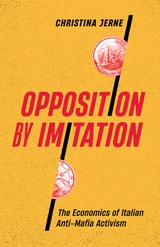
Opposition by Imitation
The Economics of Italian Anti-Mafia ActivismChristina Jerne
University of Minnesota Press, 2025
Defying the mafia with everyday acts of resistance
For more than 150 years, Italy has been home to a resilient and evolving resistance against the pervasive influence of mafias. While these criminal organizations are renowned for their vast international business enterprises, the collective actions taken to oppose them are less known. In Opposition by Imitation, Christina Jerne explores anti-mafia activism, revealing how ordinary people resist, counter, and prevent criminal economies from proliferating.
Drawing on ethnographic fieldwork among anti-mafia alliances in Campania, Sicily, and other parts of Italy, Jerne details a particular aspect of mafia activities: providing cash relief and other forms of patronage to individuals and groups. Her research shows how activism has evolved to imitate this sustaining role. Activists are increasingly challenging mafia control both by creating alternative economies—from producing food that interrupts mafia labor practices to organizing tourism that supports anti-mafia hospitality—and by subversively adopting business tactics similar to the mafia’s to compete with their social influence and legitimacy. Exposing the political implications of this mimetic opposition, Jerne points to its potential impact on crime prevention and criminalization, both in Italy and globally.
Opposition by Imitation shows how these modern-day Robin Hoods are redefining collective action, taking what was controlled by the mafias and returning it to the collective. This contentious economic turn, against the backdrop of broader social movements, reveals significant political possibilities afforded by imitative opposition.
Retail e-book files for this title are screen-reader friendly with images accompanied by short alt text and/or extended descriptions.
Organized Crime in Chicago
Beyond the MafiaRobert M. Lombardo
University of Illinois Press, 2013
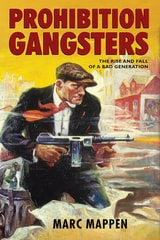
Prohibition Gangsters
The Rise and Fall of a Bad GenerationMappen, Marc
Rutgers University Press, 2013
On January 16, 1920, the Eighteenth Amendment to the Constitution went into effect in the United States, “outlawing the manufacture, sale, or transportation of intoxicating liquors.” A group of young criminals from immigrant backgrounds in cities around the nation stepped forward to disobey the law of the land in order to provide alcohol to thirsty Americans.
Today the names of these young men—Al Capone, Lucky Luciano, Dutch Schultz, Legs Diamond, Nucky Johnson—are more familiar than ever, thanks in part to such cable programs as Boardwalk Empire. Here, Mappen strips way the many myths and legends from television and movies to describe the lives these gangsters lived and the battles they fought. Placing their criminal activities within the context of the issues facing the nation, from the Great Depression, government crackdowns, and politics to sexual morality, immigration, and ethnicity, he also recounts what befell this villainous group as the decades unwound.
Making use of FBI and other government files, trial transcripts, and the latest scholarship, the book provides a lively narrative of shootouts, car chases, courtroom clashes, wire tapping, and rub-outs in the roaring 1920s, the Depression of the 1930s, and beyond. Mappen asserts that Prohibition changed organized crime in America. Although their activities were mercenary and violent, and they often sought to kill one another, the Prohibition generation built partnerships, assigned territories, and negotiated treaties, however short lived. They were able to transform the loosely associated gangs of the pre-Prohibition era into sophisticated, complex syndicates. In doing so, they inspired an enduring icon—the gangster—in American popular culture and demonstrated the nation’s ideals of innovation and initiative.
View a three minute video of Marc Mappen speaking about Prohibition Gangsters.
The Business of Crime
Italians and Syndicate Crime in the United StatesHumbert S. Nelli
University of Chicago Press, 1981
"A definitive history of organized crime in America."—American Historical Review