Results by title
6 books match the query 'Magelssen, Scott'
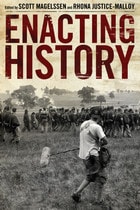
Enacting History
Edited by Scott Magelssen and Rhona Justice-Malloy
University of Alabama Press, 2011
Where performance meets the past: exploring how we stage, shape, and experience history.
Enacting History is a collection of new essays exploring the world of historical performances. The volume focuses on performances outside the traditional sphere of theatre, among them living history museums, battle reenactments, pageants, renaissance festivals, and adventure-tourism destinations. This volume argues that the recent surge in such performances have raised significant questions about the need for, interest in, and value of such nontraditional theater. Many of these performances claim a greater or lesser degree of historical "accuracy" or "authenticity," and the authors tease out the representational and historiographic issues related to these arguments. How, for instance, are issues of race, ethnicity, and gender dealt with at museums that purport to be accurate windows into the past? How are politics and labor issues handled in local- or state-funded institutions that rely on volunteer performers? How do tourists' expectations shape the choices made by would-be purveyors of the past? Where do matters of taste or censorship enter in when reconciling the archival evidence with a family-friendly mission?
Essays in the collection address, among other subjects, reenactments of period cookery and cuisine at a Maryland renaissance festival; the roles of women as represented at Minnesota's premiere living history museum, Historic Fort Snelling; and the Lewis and Clark bicentennial play as cultural commemoration. The editors argue that historical performances like these-regardless of their truth-telling claims-are an important means to communicate, document, and even shape history, and allow for a level of participation and accessibility that is unique to performance. Enacting History is an entertaining and informative account of the public's fascination with acting out and watching history and of the diverse methods of fulfilling this need.
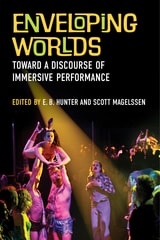
Enveloping Worlds
Toward a Discourse of Immersive PerformanceE.B. Hunter and Scott Magelssen, Editors
University of Michigan Press, 2025
2026 Association for Theatre in Higher Education Edited Works Award Winner
Enveloping Worlds is a collection of essays that analyzes the phenomenon of immersive, participatory performance as it has developed in the US. As this collection demonstrates, immersive performance offers three-dimensional multisensory experiences, inviting audience members to be participants in the unfolding of the story, and challenging pre-existing ideas about the function of performance and entertainment. Enveloping Worlds questions audience agency and choice, the space and boundaries of performance, modes of immersion, empathy and engagement, and ethical considerations through fifteen essays.
Case studies in the volume include the Choctaw Cultural Center in Oklahoma and Choctaw sovereignty; a Black artist’s autoethnographic performance challenging White audiences’ entitlement to full inclusion; Immersive Van Gogh experiences and their scenographers; telephone performance during the COVID-19 lockdowns; Diane Paulus’s The Donkey Show; the Battle of Atlanta panorama; an antebellum-themed department store display from the 1920s; escape rooms; Disney Parks; remotely staged plays about aging and dementia; tiki bars; anachronistic costuming at Renaissance Festivals; the technologies that shape the boundaries of immersive worlds; and tabletop role-playing games. Taken together, these essays contribute a rich discussion of immersive performance across radically different contexts, offering analytical models and terminology with which to clarify and advance this emergent discourse.
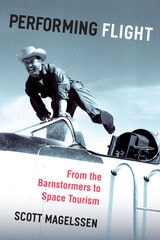
Performing Flight
From the Barnstormers to Space TourismScott Magelssen
University of Michigan Press, 2020
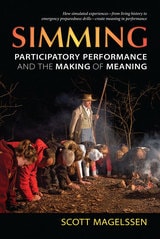
Simming
Participatory Performance and the Making of MeaningScott Magelssen
University of Michigan Press, 2014
At an ecopark in Mexico, tourists pretend to be illegal migrants, braving inhospitable terrain and the U.S. Border Patrol as they attempt to cross the border. At a living history museum in Indiana, daytime visitors return after dark to play fugitive slaves on the Underground Railroad. In the Mojave Desert, the U.S. Army simulates entire provinces of Iraq and Afghanistan, complete with bustling villages, insurgents, and Arabic-speaking townspeople, to train soldiers for deployment to the Middle East. At a nursing home, trainees put on fogged glasses and earplugs, thick bands around their finger joints, and sandbag harnesses to simulate the effects of aging and to gain empathy for their patients.
These immersive environments in which spectator-participants engage in simulations of various kinds—or “simming”—are the subject of Scott Magelssen’s book. His book lays out the ways in which simming can provide efficacy and promote social change through affective, embodied testimony. Using methodology from theater history and performance studies (particularly as these fields intersect with cultural studies, communication, history, popular culture, and American studies), Magelssen explores the ways these representational practices produce, reify, or contest cultural and societal perceptions of identity.
Theater Historiography
Critical InterventionsHenry Bial and Scott Magelssen, editors
University of Michigan Press, 2010
Theatre History Studies 2015, Vol. 34
Elizabeth Reitz Mullenix
University of Alabama Press, 2015
The five essays are arranged chronologically, starting with Alan Sikes’s discussion of the Abydos Passion Play. Sikes challenges the long-held interpretation of that ritualized annual reenactment of the death, dismemberment, and return to life of Egyptian god-king Osiris as the world’s first recorded dramatic production. In analyzing the “Passion Play”—Sikes argues the term is not apt—he applies semiotic theory using "sign and referent" to revise general concepts of mimesis, and in so doing clarifies the fundamental answer to the question, “What is theatre?”
In a pair of essays, Andrew Gibb and Nicole Berkin both explore theatre during America’s antebellum period. Gibb examines minstrelsy in antebellum California, exploding narrow definitions of minstrelsy as a primarily Eastern phenomenon and one reflecting a stark interaction of two races. Following the story of Jewish African Caribbean immigrant William Alexander Leidesdorff, Gibb demonstrates that national forms are always affected by their local productions and audiences. Berkin’s essay focuses on the struggles over cultural power that took place between popular entertainers and theatre managers. She examines how both parties used touring strategically to engage with antebellum notions of deception and fraud.
The last two essays, by Megan Geigner and Heide Nees, present findings from performance studies which, by examining a wide array of dramatic and performative texts, expands the interdisciplinary foundations of theatre history studies. This fascinating collection is rounded out by an expanded selection of insightful reviews of recent literature in the area.