Results by title
5 books match the query 'Major League Baseball (Organization)'
Breaking Babe Ruth
Baseball's Campaign Against Its Biggest StarEdmund F. Wehrle
University of Missouri Press, 2025
Cy Young
An American Baseball HeroScott H. Longert
Ohio University Press, 2020
Cy Young was one of the hardest-throwing pitchers of all time. He recorded three no-hitters—including a perfect game—and accumulated more than 2,800 strikeouts on his way to the National Baseball Hall of Fame. Scott H. Longert uses Young’s life story to introduce middle-grade readers to the game, explaining balls, strikes, and outs in an easy-to-understand way. Longert narrates each season and each milestone game with an enthusiastic play-by-play that is sure to draw readers into the excitement on the field and in the crowd, fostering a better understanding of and a passion for baseball.
Baseball fans today know Cy Young’s name chiefly through the award given in his honor each year to the best pitcher in the National and the American Leagues. Denton True “Cyclone” Young won more than five hundred games over a career that spanned four decades, a record that no other major league pitcher has come close to matching. In addition to being the winningest pitcher in baseball history, he was also a kind, self-effacing, and generous man. Born into a farm family in rural Ohio, he never lost touch with the small-town values he grew up with.
Justice Batted Last
Ernie Banks, Minnie Miñoso, and the Unheralded Players Who Integrated Chicago's Major League TeamsDon Zminda
University of Illinois Press, 2025
Don Zminda’s account looks at these interconnected events alongside the little-known chronicle of Chicago’s slow track to integrating major league baseball. By the early 1950s, the Cubs and White Sox organizations had become rich in Black and Afro-Latino stars and talented prospects. Unlike Miñoso and Banks, however, most of these minor leaguers never advanced to the majors or, if they did, it was for little more than a cup of coffee. Zminda also profiles these players, from Charles Pope, the Cubs’ first Black signee, to larger-than-life fireballer Blood Burns.
Essential and dramatic, Justice Batted Last uses the lives and careers of two Chicago legends to tell a story of integration on and off the diamond.
Team Chemistry
The History of Drugs and Alcohol in Major League BaseballNathan Corzine
University of Illinois Press, 2016
- In 1889, Pud Galvin tried a testosterone-derived "elixir" to help him pile up some of his 646 complete games.
- Sandy Koufax needed Codeine and an anti-inflammatory used on horses to pitch through his late-career elbow woes.
- Players returning from World War II mainstreamed the use of the amphetamines they had used as servicemen.
- Vida Blue invited teammates to cocaine parties, Tim Raines used it to stay awake on the bench, and Will McEnaney snorted it between innings.
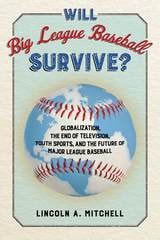
Will Big League Baseball Survive?
Globalization, the End of Television, Youth Sports, and the Future of Major League BaseballLincoln A. Mitchell
Temple University Press, 2016
Major League Baseball is a beloved American institution that has been a product of the economic, social, and media structures that have evolved in the United States over the last century. In his shrewd analysis, Will Big League Baseball Survive?, Lincoln Mitchell asks whether the sport will continue in its current form as a huge, lucrative global business that offers a monopoly in North America—and whether those structures are sustainable.
Mitchell places baseball in the context of the larger, evolving American and global entertainment sector. He examines how both changes directly related to baseball—including youth sports and the increased globalization of the game—as well as broader societal trends such as developments in media consumption and celebrity culture will impact big league baseball over the next few decades.
His book ultimately proposes several possible scenarios for what big league baseball might look like. Will it become more global, smaller, or remain the same, or will it transform into some kind of hybrid of the three?