Results by title
2 books match the query 'Making Americans'
Making Americans
Children's Literature from 1930 to 1960Gary D. Schmidt
University of Iowa Press, 2013
American children need books that draw on their own history and circumstances, not just the classic European fairy tales. They need books that enlist them in the great democratic experiment that is the United States. These were the beliefs of many of the authors, illustrators, editors, librarians, and teachers who expanded and transformed children’s book publishing between the 1930s and the 1960s.
Although some later critics have argued that the books published in this era offered a vision of a safe, secure, simple world without injustice or unhappy endings, Gary D. Schmidt shows that the progressive political agenda shared by many Americans who wrote, illustrated, published, and taught children’s books had a powerful effect. Authors like James Daugherty, Laura Ingalls Wilder, Lois Lenski, Ingri and Edgar Parin D’Aulaire, Virginia Lee Burton, Robert McCloskey, and many others addressed directly and indirectly the major social issues of a turbulent time: racism, immigration and assimilation, sexism, poverty, the Great Depression, World War II, the atomic bomb, and the threat of a global cold war.
The central concern that many children’s book authors and illustrators wrestled with was the meaning of America and democracy itself, especially the tension between individual freedoms and community ties. That process produced a flood of books focused on the American experience and intent on defining it in terms of progress toward inclusivity and social justice. Again and again, children’s books addressed racial discrimination and segregation, gender roles, class differences, the fate of Native Americans, immigration and assimilation, war, and the role of the United States in the world. Fiction and nonfiction for children urged them to see these issues as theirs to understand, and in some ways, theirs to resolve. Making Americans is a study of a time when the authors and illustrators of children’s books consciously set their eyes on national and international sights, with the hope of bringing the next generation into a sense of full citizenship.
[more]
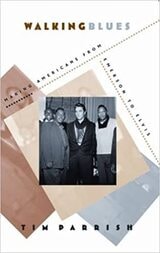
Walking Blues
Making Americans from Emerson to ElvisTimothy Parrish
University of Massachusetts Press, 2009
Who or what is an American? Many scholars have recently argued that in a country of such vast cultural and ethnic diversity as the United States it is not useful or even possible to talk of a single national identity. Are people right to suggest that the very idea of "Americanness" is merely a myth designed to obscure the divisions among us?
This is the central question addressed by Tim Parrish in this imaginative interdisciplinary study. Working in the tradition of the blues, an art form based on the adaptation of cultural past to present, Parrish seeks to show what happens when we think of American identity not as some transcendental entity or essence, but as an ongoing process. At the core of his analysis is an appreciation of the rich legacy of pragmatism, a distinctly American frame of mind that sees truth as an act rather than an object, as a matter of doing rather than being. While the philosophical roots of pragmatism can be found in the writings of Ralph Waldo Emerson, William and Henry James, and Horace Kallen, the same intellectual approach informs the work of writers such as Ralph Ellison, Mary Antin, and Philip Roth as well as creative artists such as Son House, Elvis Presley, and James Brown. What all of these figures share, according to Parrish, is a recognition of the intrinsic connection between thought and action that has allowed Americans to define who they are through what they do.
Walking Blues accounts for our cultural diversity without either insisting that we are all the same or denying that we have anything in common. Far from glossing over difference, Parrish shows how our American social, racial, and ethnic conflicts often mark the starting point for the various acts of creation through which we make—and remake—ourselves as Americans.
[more]