Results by title
2 books match the query 'Making Institutions Work'
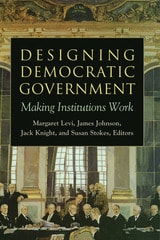
Designing Democratic Government
Making Institutions WorkMargaret Levi
Russell Sage Foundation, 2008
What are the essential elements of a democracy? How can nations ensure a political voice for all citizens, and design a government that will respond to those varied voices? These perennial questions resonate strongly in the midst of ongoing struggles to defend democratic institutions around the world and here at home. In Designing Democratic Government, a group of distinguished political scientists provides a landmark cross-national analysis of the institutions that either facilitate or constrain the healthy development of democracy. The contributors to Designing Democratic Government use the democratic ideals of fairness, competitiveness, and accountability as benchmarks to assess a wide variety of institutions and practices. John Leighly and Jonathan Nagler find that in the U.S., the ability to mobilize voters across socioeconomic lines largely hinges on the work of non-party groups such as civic associations and unions, which are far less likely than political parties to engage in class-biased outreach efforts. Michael McDonald assesses congressional redistricting methods and finds that court-ordered plans and close adherence to the Voting Rights Act effectively increase the number of competitive electoral districts, while politically-drawn maps reduce the number of competitive districts. John Carey and John Polga-Hecimovich challenge the widespread belief that primary elections produce inferior candidates. Analyzing three decades worth of comprehensive data on Latin American presidential campaigns, they find that primaries impart a stamp of legitimacy on candidates, helping to engage voters and mitigate distrust in the democratic process. And Kanchan Chandra proposes a paradigm shift in the way we think about ethnic inclusion in democracies: nations should design institutions that actively promote—rather than merely accommodate—diversity. At a moment when democracy seems vulnerable both at home and abroad, Designing Democratic Government sorts through a complex array of practices and institutions to outline what works and what doesn't in new and established democracies alike. The result is a volume that promises to change the way we look at the ideals of democracy worldwide.
[more]

Making Institutions Work in Peru
Democracy, Development and Inequality Since 1980Edited by John Crabtree
University of London Press, 2006
The 2006 Peruvian elections are an appropriate moment to reflect on Alejandro Toledo's term as president and on the broader agenda for building a more inclusive and democratic government. In a country of extreme social inequality, such an aspiration represents an enormous challenge. The sudden collapse of the which Fujimori regime --which had dominated Peru for the 1990s --and Toledo's election victory in 2001 seemed to provide an opportunity for institutional reform and rebuilding. The impetus proved short-lived, as the new president's popularity sank to unprecedented levels and public support for Peru's democratic institutions continued to hemorrhage. This book suggests that the challenges of institutional development run very deep and are not peculiar to any one government. Institutional change in Peru is part of a much wider process of transformation from an oligarchic society.
Contributors include Paulo Drino (University of Manchester), Cynthia Sanborn (Centro de Investigaciones, Universidad del Pacifico, Lima), Carlos Monge (Participacion Ciudadana, Lima), Fernando Rospigliosi (Instituto de Estudios Peruanos, Lima), Pedro Franck (Departamento de Economia, Universidad Catolica, Lima), Fernando Eguren (Centro Peruano de Ciencias Sociales, Lima), Rosemary Thorp (Queen Elizabeth House/St Antony's College, Oxford), Eduardo Dargent (University of Texas,Austin), Coletta Youngers (Washington Office on Latin America,Washington D.C.), Francisco Durand (University of Texas, San Antonio), Jose Tavara (Departamento de Economia, Universidad Catolica, Lima, and OSIPTEL), and Richard Webb (Instituto Cuanto and Central Bank of Peru).
Contributors include Paulo Drino (University of Manchester), Cynthia Sanborn (Centro de Investigaciones, Universidad del Pacifico, Lima), Carlos Monge (Participacion Ciudadana, Lima), Fernando Rospigliosi (Instituto de Estudios Peruanos, Lima), Pedro Franck (Departamento de Economia, Universidad Catolica, Lima), Fernando Eguren (Centro Peruano de Ciencias Sociales, Lima), Rosemary Thorp (Queen Elizabeth House/St Antony's College, Oxford), Eduardo Dargent (University of Texas,Austin), Coletta Youngers (Washington Office on Latin America,Washington D.C.), Francisco Durand (University of Texas, San Antonio), Jose Tavara (Departamento de Economia, Universidad Catolica, Lima, and OSIPTEL), and Richard Webb (Instituto Cuanto and Central Bank of Peru).
[more]