Results by title
2 books match the query 'Making War'
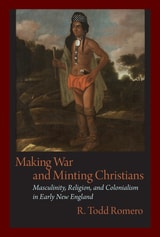
Making War and Minting Christians
Masculinity, Religion, and Colonialism in Early New EnglandR. Todd Romero
University of Massachusetts Press, 2011
In this book, R. Todd Romero traces the interaction of notions of gender, the practice of religion, and the conduct of warfare in colonial America. He shows how Native and Anglo-American ideas of manhood developed in counterpoint, in the context of Christian evangelization, colonial expansion, and recurrent armed conflict.
For the English, the cultivation of manliness became an important aspect of missionary efforts. Conversion demanded that the English “make men” of the Indians before they could “make them Christians,” a process that involved reshaping Native masculinity according to English patriarchal ideals that the colonists themselves rarely matched. For their part, Native Americans held on to older ways of understanding the divine and defining gender even as they entered English “praying towns” and negotiated the steep demands of the missionaries.
Evolving ideas of masculinity resonated with religious significance and shaped the meaning of warfare for Natives and colonists alike. Just as the English believed that their territorial expansion was divinely sanctioned, Indians attributed a string of victories in King Philip's War to “the Great God” and the perception that their enemies “were like women.” Trusting that war and manliness were necessarily linked, both groups engaged in ritual preparations for battle, believed deeply in the efficacy of the supernatural to affect the outcome of combat, and comprehended the meaning of war in distinctly religious ways.
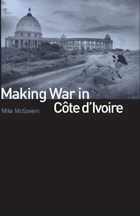
Making War in Côte d'Ivoire
Mike McGovern
University of Chicago Press, 2011
After a brief period of active combat in 2002, the conflict in Côte d’Ivoire settled into a pattern of neither war nor peace until the 2010 elections led to a new phase of direct conflict. During these taut years, short bursts of intense violence alternated with long periods of standoff. When things were peaceful, the Ivorian political elite and the press produced inflammatory rhetoric while soldiers and militias used the state of emergency as an excuse to shake down civilians at roadblocks. What kept this perpetually tense, dismal, and destructive situation simmering? In this groundbreaking book, Mike McGovern suggests the answer lies in understanding war as a process, not a series of events, and that rather than focusing on the role of political institutions, we should be paying attention to the flawed and unpredictable people within them.
McGovern argues that only deep knowledge of a region—its history, languages, literature, and popular culture—can yield meaningful insights into political decision making. Putting this theory into action, he examines an array of issues from the micro to the macro, including land tenure disputes, youth boredom, organized crime, and the international cocoa trade. Drawn from McGovern’s academic research and experience working for a conflict resolution think tank and the political access that position gave him, Making War in Côte D’Ivoire will be the definitive work on the Ivorian conflict and an innovative example of how anthropology can address the complexities of politics.