Results by title
3 books match the query 'Male friendship in literature'

Manly Love
Romantic Friendship in American FictionAxel Nissen
University of Chicago Press, 2009
The modern idea of Victorians is that they were emotionless prudes, imprisoned by sexual repression and suffocating social constraints; they expressed love and affection only within the bounds of matrimony—if at all. And yet, a wealth of evidence contradicting this idea has been hiding in plain sight for close to a century. In Manly Love, Axel Nissen turns to the novels and short stories of Victorian America to uncover the widely overlooked phenomenon of passionate friendships between men.
Nissen’s examination of the literature of the period brings to light a forgotten genre: the fiction of romantic friendship. Delving into works by Mark Twain, Henry James, William Dean Howells, and others, Nissen identifies the genre’s unique features and explores the connections between romantic friendships in literature and in real life. Situating love between men at the heart of Victorian culture, Nissen radically alters our understanding of the American literary canon. And with its deep insights into the emotional and intellectual life of the period, Manly Love also offers a fresh perspective on nineteenth-century America’s attitudes toward love, friendship, marriage, and sex.

Napoleonic Friendship
Military Fraternity, Intimacy, and Sexuality in Nineteenth-Century FranceBrian Joseph Martin
University of New Hampshire Press, 2011
Winner of the Laurence Wylie Prize in French Cultural Studies
One of the first books on “Gays in the Military” published following the historic repeal of “Don't Ask Don't Tell” in 2011, Napoleonic Friendship examines the history of male intimacy in the French military, from Napoleon to the First World War. Echoing the historical record of gay soldiers in the United States, Napoleonic Friendship is the first book-length study on the origin of queer soldiers in modern France. Based on extensive archival research in France, the book traces the development of affectionate friendships in the French Army from 1789 to 1916.
Following the French Revolution, radical military reforms created conditions for new physical and emotional intimacy between soldiers, establishing a model of fraternal affection during the Revolutionary and Napoleonic Wars that would persist amid the ravages of the Franco-Prussian War and World War I. Through readings of Napoleonic military memoirs (and other non-fiction archival material) and French military fiction (from Hugo and Balzac to Zola and Proust), Martin examines a broad range of emotional and erotic relationships, from combat buddies to soldier lovers. He argues that the French Revolution's emphasis on military fraternity evolved into an unprecedented sense of camaraderie in the armies of Napoleon. For many soldiers, the hardships of combat led to intimate friendships. For some, the homosociality of military life inspired mutual affection, lifelong commitment, and homoerotic desire.
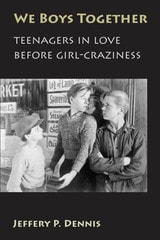
We Boys Together
Teenagers in Love Before Girl-CrazinessJeffery P. Dennis
Vanderbilt University Press, 2007
This book explores romantic relationships between teenage boys as they were portrayed before, during, and immediately after World War II. The author takes the reader through a rich landscape of media -- sci fi pulps, comics, adventure stories, tales of teen sleuths, boys' serial novels, wartime bestsellers, and movies populated by many types of male adolescents: Boys Next Door, Adventure Boys, Jungle Boys, and Lost Boys. In Hollywood movies, Boys Next Door like Jackie Cooper, Ronald Sinclair, and Jimmy Lydon were constantly falling in love, but not with girls. In serial novels, Jungle Boys like Bomba, Sorak, and Og Son of Fire swung through the trees to rescue teenage boys, not teenage girls. In comic strips and on the radio, Adventure Boys like Don Study, Jack Armstrong, and Tim Tyler formed lasting romantic partnerships with other boys or men. Lost Boys like Frankie Darro, Leo Gorcey, and Billy Halop starred in dozens of movies about pairs of poor urban teenagers sticking together, with never a girl in sight.