Results by title
3 books match the query 'Mammal populations'
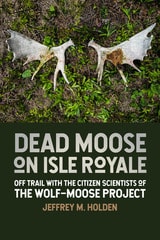
Dead Moose on Isle Royale
Off Trail with the Citizen Scientists of the Wolf-Moose ProjectJeffrey M Holden
Michigan State University Press, 2025
Isle Royale in Michigan is one of the most remote and pristine of all the U.S. national parks, and it is the site of the world’s longest-running predator–prey study. Every summer, Jeffrey M. Holden leads groups of citizen scientists on week-long expeditions to search for dead moose. Those intrepid enough to join him backpacking off trail in Isle Royale’s rugged beauty face challenges from treacherous weather conditions, to wildlife, primitive backcountry camping, traveling through swamps and wetlands, and backpacks that grow heavier with bones every time a new dead moose is found. Sometimes the moose they find are long dead, with only a scattering of bones remaining. Sometimes they are freshly departed, rotted, stinking, and covered with thousands of bloodthirsty ticks. Scientists use the bones, photos, and data they collect to reconstruct the moose population through the years, correlating it against other data on wolves, weather, and ticks. This book provides a fascinating look into the day-to-day realities of backpacking in the wilderness, while featuring the extraordinary scientific discoveries of the Wolf-Moose Project itself and highlighting the role and rewards for volunteers in this extraordinary endeavor. This is a must read for anyone who is interested in off-trail hiking, becoming a citizen scientist, or exploring America’s least-visited national park.
[more]
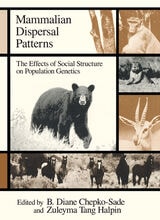
Mammalian Dispersal Patterns
The Effects of Social Structure on Population GeneticsEdited by B. Diane Chepko-Sade and Zuleyma Tang Halpin
University of Chicago Press, 1987
Mammalian Dispersal Patterns examines the ways that social structure affects population genetics and, in turn, rates of evolution, in mammalian groups. It brings together fieldwork in animal behavior and wildlife biology with theoretical work in demography and population genetics. The focus here is dispersal—whether, how, and when individuals leave the areas where they are born.
Theoretical work in population genetics indicates that such social factors as skewed sex ratios, restrictive mating patterns, and delayed age of first reproduction will lower the reproductive variability of a population by reducing the number of genotypes passed from one generation to the next. Field studies have shown that many mammalian species do exhibit many such social characteristics. Among horses, elephant seals, and a number of primates, the majority of females are inseminated by only a fraction of the males. In pacts of wolves and mongooses, usually only the highest-ranking male and female breed in a given season. Although socially restricted mating tends to lower genetic variability in isolated populations, it actually tends to increase genetic variability in subdivided populations with low rates of migration between subunits. Among some species there is little dispersal and thus little gene flow between subpopulations; other species travel far afield before mating.
The contributors to this volume examine actual data from populations of mammals, the way patterns of dispersal correlate with the genetic structure of individuals and populations, and mathematical models of population structure. This interdisciplinary approach has an important bearing on work in conservation of both wildlife and zoo populations, for it shows that the home range and the population size needed to maintain genetic variability can differ greatly from one species to the next. The volume also offers a fruitful model for future research.
[more]
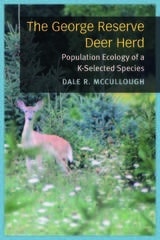
The George Reserve Deer Herd
Population Ecology of a K-Selected SpeciesDale R. McCullough
University of Michigan Press, 1979
A reassessment of the studies done on this deer herd over the years and their implications for state wildlife management agencies.
[more]