Results by title
11 books match the query 'Man-woman relationships in literature'
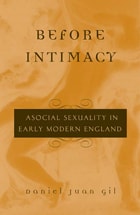
Before Intimacy
Asocial Sexuality in Early Modern EnglandDaniel Juan Gil
University of Minnesota Press, 2006
Engaging the poems of Wyatt, Sidney’s Astrophil and Stella, Spenser’s Amoretti and The Faerie Queene, and Shakespeare’s Troilus and Cressida and the Sonnets, Gil demonstrates how sexuality was conceived as a relationship system inhabited by men and women interchangeably—set apart from the “norm” and not institutionalized in a private or domestic realm. Going beyond the sodomy-as-transgression analytic, he asserts the existence of socially inconsequential sexual bonds while recognizing the pleasurable effects of violating the supposed traditional modes of bonding and ideals of universal humanity and social hierarchy.
Celebrating the ability of corporeal emotions to interpret connections between people who share nothing in terms of societal structure, Before Intimacy shows how these works of early modern literature provide a discourse of sexuality that strives to understand status differences in erotic contexts and thereby question key assumptions of modernity.
Daniel Juan Gil is assistant professor of English at TCU.
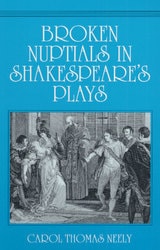
Broken Nuptials in Shakespeare's Plays
Carol Thomas Neely
University of Illinois Press, 1993

Gender and the Gothic in the Fiction of Edith Wharton
Kathy A. Fedorko
University of Alabama Press, 1995
Revealing the Gothic foundations of Edith Wharton's vision of gender and identity.
Gender and the Gothic in the Fiction of Edith Wharton is an innovative study that provides fresh insights into Wharton’s male characters while at the same time showing how Wharton’s imagining of a fe/male self evolves throughout her career. Using feminist archetypal theory and theory of the female Gothic, Kathy A. Fedorko shows how Wharton, in sixteen short stories and six major novels written during four distinct periods of her life, adopts and adapts Gothic elements to explore the nature of feminine and masculine ways of knowing and being and to dramatize the tension between them.
Edith Wharton’s contradictory views of women and men—her attitudes toward the feminine and the masculine—reflect a complicated interweaving of family and social environment, historical time, and individual psychology. Studies of Wharton have exhibited this same kind of contradiction, with some seeing her as disparaging men and the masculine and others depicting her as disparaging women and the feminine. The use of Gothic elements in her fiction provided Wharton, who was often considered the consummate realist, with a way to dramatize the conflict between feminine and masculine selves as she experienced them and to evolve an alternative to the dualism.
Fedorko’s work is unique in its careful consideration of Wharton’s sixteen Gothic works, which are seldom discussed. Further, the revelation of how these Gothic stories are reflected in her major realistic novels. In the novels with Gothic texts, Wharton draws multiple parallels between male and female protagonists, indicating the commonalities between women and men and the potential for a female self. Eventually, in her last completed novel and her last short story, Wharton imagines human beings who are comfortable with both gender selves.
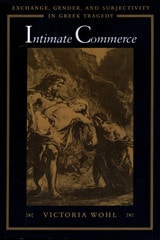
Intimate Commerce
Exchange, Gender, and Subjectivity in Greek TragedyBy Victoria Wohl
University of Texas Press, 1997
Exchanges of women between men occur regularly in Greek tragedy—and almost always with catastrophic results. Instead of cementing bonds between men, such exchanges rend them. They allow women, who should be silent objects, to become monstrous subjects, while men often end up as lifeless corpses. But why do the tragedies always represent the transferal of women as disastrous?
Victoria Wohl offers an illuminating analysis of the exchange of women in Sophocles' Trachiniae, Aeschylus' Agamemnon, and Euripides' Alcestis. She shows how the attempts of women in these plays to become active subjects rather than passive objects of exchange inevitably fail. While these failures seem to validate male hegemony, the women's actions, however futile, blur the distinction between male subject and female object, calling into question the very nature of the tragic self. What the tragedies thus present, Wohl asserts, is not only an affirmation of Athens' reigning ideologies (including its gender hierarchy) but also the possibility of resistance to them and the imagination of alternatives.

Men in Black
John Harvey
University of Chicago Press, 1995
"Why can't we pick out our own color?"
Joe:
"I tried that once, it don't work. You get four guys fighting over who's gonna be Mr. Black."
—Quentin Tarantino, Reservoir Dogs
Men's clothes went black in the nineteenth century. Dickens, Ruskin and Baudelaire all asked why it was, in an age of supreme wealth and power, that men wanted to dress as if going to a funeral. The answer is in this history of the color black. Over the last 1000 years there have been successive expansions in the wearing of black—from the Church to the Court, from the Court to the merchant class. Though black as fashion was often smart and elegant, its growth as a cultural marker was fed by several currents in Europe's history—in politics, asceticism, religious warfare. Only in the nineteenth century, however, did black fully come into its own as fashion, the most telling witnesses constantly saw connections between the taste for black and the forms of constraint with which European society regimented itself.
Concentrating on the general shift away from color that began around 1800, Harvey traces the transition to black from the court of Burgundy in the 15th century, through 16th-century Venice, 17th-century Spain and the Netherlands. He uses paintings from Van Eyck and Degas to Francis Bacon, religious art, period lithographs, wood engravings, costume books, newsphotos, movie stills and related sources in his compelling study of the meaning of color and clothes.
Although in the twentieth century tastes have moved toward new colors, black has retained its authority as well as its associations with strength and cruelty. At the same time black is still smart, and fashion keeps returning to black. It is, perhaps, the color that has come to acquire the greatest, most significant range of meaning in history.

Men without Women
Masculinity and Revolution in Russian Fiction, 1917–1929Eliot Borenstein
Duke University Press, 2001
In such works as Red Cavalry by Isaac Babel, Envy by Yuri Olesha, and Chevengur by Andrei Platonov women are either absent or transformed into bodiless abstractions. Their absence, claims Borenstein, reflects the masculine values that are hallmarks of the post-revolutionary era: production rather than reproduction, participation in history rather than domestic ahistoricity, heavy industry, construction, and struggle. He identifies in this literature groups of “men without women” replacing the family, even while the metaphor of family is used as an organizing feature of their recurring revolutionary missions. With the passage of time, these characters’ relationships—just as those in the Soviet culture of the time—begin to resemble the family structure that was originally rejected and destroyed, with one important exception: the new “families” had no place for women. According to Borenstein, this masculinist myth found its most congenial audience during the early period of communism, but its hostility to women and family ties could not survive into the Stalinist era when women, home, and family were no longer seen as antithetical to socialism.
Drawing on the theory and writings of Levi-Strauss, Girard, Sedgwick, and others, Men Without Women will be of interest to students and scholars of Slavic literature and history as well as specialists in literary theory and gender studies.

New World Courtships
Transatlantic Alternatives to Companionate MarriageMelissa M. Adams-Campbell
Dartmouth College Press, 2015
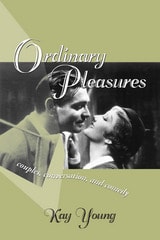
ORDINARY PLEASURES
COUPLES, CONVERSATION, AND COMEDYKAY YOUNG
The Ohio State University Press, 2001
Siren Songs
Gender, Audiences, and Narrators in the OdysseyLillian Eileen Doherty
University of Michigan Press, 1995
Siren Songs synthesizes audience-oriented and narratological approaches, and examines the relationships among three kinds of audiences: internal, implied, and actual. The author prefaces her own reading of the Odyssey with an analysis of the issues posed by the earlier feminist readings on which she builds. Should the Odyssey be read as a "closed" text, that is, as one whose meaning is highly determined, or as an "open" text whose contradictions and ambiguities undercut its overt meanings?
Siren Songs presents a feminist critique of the Odyssey in an accessible manner aimed at a more general audience. All Greek is translated, and critical terminology is clearly defined.
Lillian Eileen Doherty is Associate Professor of Classics, University of Maryland, College Park.

The Subversion of Romance in the Novels of Barbara Pym
University of Wisconsin Press, 1998
This book seeks to explore how Barbara Pym subverts the discourse of the romance novel through her use of food, clothes, heroine and hero characterizations, and marriage customs.

The TESTED WOMAN PLOT
Women’s Choices, Men’s Judgments, and the Shaping of StoriesLois E. Bueler
The Ohio State University Press, 2001