Results by title
3 books match the query 'Man-woman relationships in motion pictures'
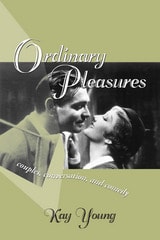
ORDINARY PLEASURES
COUPLES, CONVERSATION, AND COMEDYKAY YOUNG
The Ohio State University Press, 2001
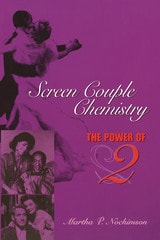
Screen Couple Chemistry
The Power of 2By Martha P. Nochimson
University of Texas Press, 2002
Astaire and Rogers, Tracy and Hepburn. Just the mention of their names evokes the powerful chemistry between these screen couples, which utterly transcended the often formulaic films in which they appeared together. Indeed, watching the synergistic flow of energy between charismatic screen partners is one of the great pleasures of cinema and television, as well as an important vehicle for thinking through issues of intimacy and gender relations.
In this book, Martha P. Nochimson engages in a groundbreaking study of screen couple chemistry. She begins by classifying various types of couples to define what sets the synergistic couple apart from other onscreen pairings. Then she moves into extended discussions of four enduring screen couples—Maureen O'Sullivan/Johnny Weissmuller, Myrna Loy/William Powell, Fred Astaire/Ginger Rogers, and Katharine Hepburn/Spencer Tracy. Using theories of neuroscience, she demonstrates that their onscreen chemistry is a very real phenomenon, powerful enough to subvert conventional formulations of male/female relations. Material she has uncovered in the infamous Production Code Administration files illuminates the historical context of her contentions. Finally, Nochimson traces the screen couple to its present-day incarnation in such pairs as Woody Allen/Diane Keaton, Scully/Mulder of The X-Files, and Cliff/Claire Huxtable of The Cosby Show.

The Battle of the Sexes in French Cinema, 1930–1956
Noël Burch and Geneviève Sellier
Duke University Press, 2013
Citing more than 300 films and providing many in-depth interpretations, Burch and Sellier argue that films made in France between 1930 and 1956 created a national imaginary that equated masculinity with French identity. They track the changing representations of masculinity, explaining how the strong patriarch who saved fallen or troubled women from themselves in prewar films gave way to the impotent, unworthy, or incapable father figure of the Occupation. After the Liberation, the patriarch reemerged as protector and provider alongside assertive women who figured as threats not only to themselves but to society as a whole.