Results by title
4 books match the query 'Mankind'
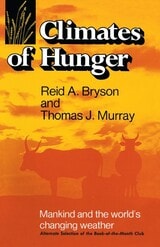
Climates of Hunger
Mankind and the World's Changing WeatherReid A. Bryson
University of Wisconsin Press, 1979
In recent years, world climate changes have drawn more attention than at any other time in history. What we once called "crazy weather," just a few years ago, is now beginning to be seen as a part of a logical and, in part, predictable pattern, an awesome natural force that we must deal with if man is to avoid disaster of unprecedented proportions.
Climates of Hunger is a book of paramount importance for our time. It will be essential reading not only for professionals in the field—including agricultural meteorologists, political scientists, geographers, sociologists, and business counselors—but for all who are concerned in any way with environmental trends, world and domestic food supplies, and their effects on human institutions.

Journey toward the Cradle of Mankind
Guido Gozzano
Northwestern University Press, 1996
The extent of Gozzano's travels--to Ceylon, Goa, Agra, Jaipur--makes one wonder how the writer could visit all or even most of the places he so vividly describes. "I did not honestly think I would find so much of it intact," the spellbound Gozzano repeats to himself, before what he must shortly recognize as prodigious evidence of decay.

Races of Mankind
The Sculptures of Malvina HoffmanMarianne Kinkel
University of Illinois Press, 2011
A fascinating cultural history, Races of Mankind examines how we continually re-negotiate the veracity of race through collaborative processes involved in the production, display, and circulation of visual representations.
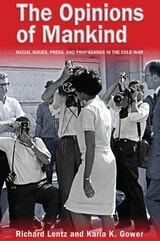
The Opinions of Mankind
Racial Issues, Press, and Propaganda in the Cold WarRichard Lentz and Karla K. Gower
University of Missouri Press, 2011
Throughout this period, the American press provided the foreign media with information about racially charged events in the United States. Such news coverage sometimes put Washington at a disadvantage, making it difficult for government officials to assuage foreign reactions to the injustices occurring on U.S. soil. Yet in other instances, the domestic press helped to promote favorable opinions abroad by articulating themes of racial progress. While still acknowledging racial abuses, these press spokesmen asserted that the situation in America was improving. Such paradoxical messages, both aiding and thwarting the efforts of the U.S. government, are the subject of The Opinions of Mankind: Racial Issues, Press, and Propaganda in the Cold War.
The study, by scholars Richard Lentz and Karla K. Gower, describes and analyzes the news discourse regarding U.S. racial issues from 1946 to 1965. The Opinions of Mankindnot only delves into the dissemination of race-related news to foreign outlets but also explores the impact foreign perceptions of domestic racism had on the U.S. government and its handling of foreign relations during the period. What emerges is an original, insightful contribution to Cold War studies. While other books examine race and foreign affairs during this period of American history, The Opinions of Mankind is the first to approach the subject from the standpoint of press coverage and its impact on world public opinion.
This exhaustively researched and compellingly written volume will appeal to media scholars, political historians, and general readers alike. By taking a unique approach to the study of this period, The Opinions of Mankind presents the workings behind the battles for public opinion that took place between 1946 and 1965.