Results by title
4 books match the query 'Mansbridge, Jane J.'
Beyond Adversary Democracy
Jane J. Mansbridge
University of Chicago Press, 1983
"Beyond Adversary Democracy should be read by everyone concerned with democratic theory and practice."—Carol Pateman, Politics
"Sociologists recurrently complain about how seldom it is that we produce books that combine serious theorizing about important issues of public policy with original and sensitive field research. Several rounds of enthusiastic applause, then, are due Jane Mansbridge . . . for having produced a dense and well written book whose subject is nothing less ambitious than the theory of democracy and its problems of equality, solidarity, and consensus. Beyond Adversary Democracy, however, is not simply a work of political theory; Mansbridge explores her abstract subject matter by close studies (using ethnographic, documentary, and questionnaire methods) of two small actual democracies operating at their most elemental American levels (1) a New England town meeting ("Selby," Vermont) and (2) an urban crisis center ("Helpline"), whose 41 employees shared a New Left-Counterculture belief in participatory democracy and consensual decision-making. [Mansbridge] is a force to contend with. It is in our common interest that she be widely read."—Bennett M. Berger, Contemporary Sociology
"Sociologists recurrently complain about how seldom it is that we produce books that combine serious theorizing about important issues of public policy with original and sensitive field research. Several rounds of enthusiastic applause, then, are due Jane Mansbridge . . . for having produced a dense and well written book whose subject is nothing less ambitious than the theory of democracy and its problems of equality, solidarity, and consensus. Beyond Adversary Democracy, however, is not simply a work of political theory; Mansbridge explores her abstract subject matter by close studies (using ethnographic, documentary, and questionnaire methods) of two small actual democracies operating at their most elemental American levels (1) a New England town meeting ("Selby," Vermont) and (2) an urban crisis center ("Helpline"), whose 41 employees shared a New Left-Counterculture belief in participatory democracy and consensual decision-making. [Mansbridge] is a force to contend with. It is in our common interest that she be widely read."—Bennett M. Berger, Contemporary Sociology
[more]

Beyond Self-Interest
Edited by Jane J. Mansbridge
University of Chicago Press, 1990
A dramatic transformation has begun in the way scholars think about human nature. Political scientists, psychologists, economists, and evolutionary biologists are beginning to reject the view that human affairs are shaped almost exclusively by self-interest—a view that came to dominate social science in the last three decades.
In Beyond Self-Interest, leading social scientists argue for a view of individuals behavior and social organization that takes into account the powerful motivations of duty, love, and malevolence. Economists who go beyond "economic man," psychologists who go beyond stimulus-response, evolutionary biologists who go beyond the "selfish gene," and political scientists who go beyond the quest for power come together in this provocative and important manifesto.
The essays trace, from the ancient Greeks to the present, the use of self-interest to explain political life. They investigate the differences between self-interest and the motivations of duty and love, showing how these motivations affect behavior in "prisoners' dilemma" interactions. They generate evolutionary models that explain how altruistic motivations escape extinction.
They suggest ways to model within one individual the separate motivations of public spirit and self-interest, investigate public spirit and self-interest, investigate public spirit in citizen and legislative behavior, and demonstrate that the view of democracy in existing Constitutional interpretations is not based on self-interest. They advance both human evil and mothering as alternatives to self-interest, this last in a penetrating feminist critique of the "contract" model of human interaction.
[more]
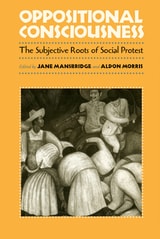
Oppositional Consciousness
The Subjective Roots of Social ProtestEdited by Jane J. Mansbridge and Aldon Morris
University of Chicago Press, 2001
How can human beings be induced to sacrifice their lives—even one minute of their lives-for the sake of their group? This question, central to understanding the dynamics of social movements, is at the heart of this collection of original essays. The book is the first to conceptualize and illustrate the complex patterns of negotiation, struggle, borrowing, and crafting that characterize what the editors term "oppositional consciousness"—an empowering mental state that prepares members of an oppressed group to undermine, reform, or overthrow a dominant system.
Each essay employs a recent historical case to demonstrate how oppositional consciousness actually worked in the experience of a subordinate group. Based on participant observation and interviews, chapters focus on the successful social movements of groups such as African Americans, people with disabilities, sexually harassed women, Chicano workers, and AIDS activists. Ultimately, Oppositional Consciousness sheds new light on the intricate mechanisms that drive the important social movements of our time.
Contributors: Naomi Braine, Sharon Groch, Fredrick C. Harris, Jane Mansbridge, Anna-Maria Marshall, Aldon Morris, Marc Simon Rodriguez, Brett C. Stockdill, Lori G. Waite
[more]
Why We Lost the ERA
Jane J. Mansbridge
University of Chicago Press, 1986
The classic account of how the Equal Rights Amendment failed, and what that means for democratic politics and equality.
In March 1972 the Equal Rights Amendment to the United States Constitution-the ERA-passed the Senate of the United States with a vote of 84 to 8, seventeen votes more than the two-thirds required for constitutional amendments. In the ensuing ten years, a majority of Americans consistently told interviewers that they favored this amendment to the Constitution. Yet on June 30, 1982, the deadline for ratifying the amendment passed with only thirty-five of the required thirty-eight states having ratified.
How did this happen? In How We Lost the ERA, political scientist Jane J. Mansbridge tells the story of the ERA's rise and fall, revealing self-defeating, contradictory forces within the movement supporting the amendment and how those contributed to its demise. The surprising challenges Mansbridge uncovers here remain salient to political struggles and democratic theory today.
[more]