Results by title

3 books match the query 'Mansoor, Jaleh'
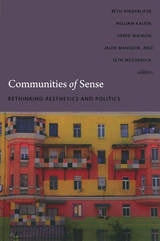
cover of Communities of Sense: Rethinking Aesthetics and Politics

Communities of Sense

Rethinking Aesthetics and Politics

Beth Hinderliter, William Kaizen, Vered Maimon, Jaleh Mansoor, and Seth McCormick, eds.

Duke University Press, 2009

Communities of Sense argues for a new understanding of the relation between politics and aesthetics in today’s globalized and image-saturated world. Established and emerging scholars of art and culture draw on Jacques Rancière’s theorization of democratic politics to suggest that aesthetics, traditionally defined as the “science of the sensible,” is not a depoliticized discourse or theory of art, but instead part of a historically specific organization of social roles and communality. Rather than formulating aesthetics as the Other to politics, the contributors show that aesthetics and politics are mutually implicated in the construction of communities of visibility and sensation through which political orders emerge.

The first of the collection’s three sections explicitly examines the links between aesthetics and social and political experience. Here a new essay by Rancière posits art as a key site where disagreement can be staged in order to produce new communities of sense. In the second section, contributors investigate how sense was constructed in the past by the European avant-garde and how it is mobilized in today’s global visual and political culture. Exploring the viability of various models of artistic and political critique in the context of globalization, the authors of the essays in the volume’s final section suggest a shift from identity politics and preconstituted collectivities toward processes of identification and disidentification. Topics discussed in the volume vary from digital architecture to a makeshift museum in a Paris suburb, and from romantic art theory in the wake of Hegel to the history of the group-subject in political art and performance since 1968. An interview with Étienne Balibar rounds out the collection.

Contributors. Emily Apter, Étienne Balibar, Carlos Basualdo, T. J. Demos, Rachel Haidu, Beth Hinderliter, David Joselit, William Kaizen, Ranjanna Khanna, Reinaldo Laddaga, Vered Maimon, Jaleh Mansoor, Reinhold Martin, Seth McCormick, Yates McKee, Alexander Potts, Jacques Rancière, Toni Ross
[more]
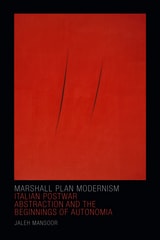
cover of Marshall Plan Modernism: Italian Postwar Abstraction and the Beginnings of Autonomia

Marshall Plan Modernism

Italian Postwar Abstraction and the Beginnings of Autonomia

Jaleh Mansoor

Duke University Press, 2016
Focusing on artwork by Lucio Fontana, Alberto Burri, and Piero Manzoni, Jaleh Mansoor demonstrates and reveals how abstract painting, especially the monochrome, broke with fascist-associated futurism and functioned as an index of social transition in postwar Italy. Mansoor refuses to read the singularly striking formal and procedural violence of Fontana's slit canvasses, Burri's burnt and exploded plastics, and Manzoni's "achromes" as metaphors of traumatic memories of World War II. Rather, she locates the motivation for this violence in the history of the medium of painting and in the economic history of postwar Italy. Reconfiguring the relationship between politics and aesthetics, Mansoor illuminates how the monochrome's reemergence reflected Fontana, Burri, and Manzoni's aesthetic and political critique of the Marshall Plan's economic warfare and growing American hegemony. It also anticipated the struggles in Italy's factories, classrooms, and streets that gave rise to Autonomia in the 1960s. Marshall Plan Modernism refigures our understanding of modernist painting as a project about labor and the geopolitics of postwar reconstruction during the Italian Miracle.
[more]
cover of Universal Prostitution and Modernist Abstraction: A Counterhistory

Universal Prostitution and Modernist Abstraction

A Counterhistory

Jaleh Mansoor

Duke University Press, 2025

In Universal Prostitution and Modernist Abstraction, Jaleh Mansoor provides a counternarrative of modernism and abstraction and a reexamination of Marxist aesthetics. Mansoor draws on Marx’s concept of prostitution—a conceptual device through which Marx allegorized modern labor—to think about the confluences of generalized and gendered labor in modern art. Analyzing works ranging from Édouard Manet’s Olympia and Georges Seurat’s The Models to contemporary work by Hito Steyerl and Hannah Black, she shows how avant-garde artists can detect changing modes of production and capitalist and biopolitical processes of abstraction that assign identities to subjects in the interest of value’s impersonal circulation. She demonstrates that art and abstraction resist modes of production and subjugation at the level of process and form rather than through referential representation. By studying gendered and generalized labor, abstraction, automation, and the worker, Mansoor shifts focus away from ideology, superstructure, and culture toward the ways art indexes crisis and transformation in the political economic base. Ultimately, she traces the outlines of a counterpraxis to capital while demonstrating how artworks give us a way to see through the abstractions of everyday life.
[more]