Results by title
4 books match the query 'Maoz, Zeev'

Bound by Struggle
The Strategic Evolution of Enduring International RivalriesZeev Maoz and Ben D. Mor
University of Michigan Press, 2002
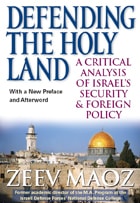
Defending the Holy Land
A Critical Analysis of Israel's Security and Foreign PolicyZeev Maoz
University of Michigan Press, 2008
Most of the wars in which Israel was involved, Maoz shows, were entirely avoidable, the result of deliberate Israeli aggression, flawed decision-making, and misguided conflict management strategies. None, with the possible exception of the 1948 War of Independence, were what Israelis call "wars of necessity." They were all wars of choice-or, worse, folly.
Demonstrating that Israel's national security policy rested on the shaky pairing of a trigger-happy approach to the use of force with a hesitant and reactive peace diplomacy, Defending the Holy Land recounts in minute-by-minute detail how the ascendancy of Israel's security establishment over its foreign policy apparatus led to unnecessary wars and missed opportunites for peace.
A scathing and brilliant revisionist history, Defending the Holy Land calls for sweeping reform of Israel's foreign policy and national security establishments. This book will fundamentally transform the way readers think about Israel's troubled history.

Ecofeminist Literary Criticism
Theory, Interpretation, PedagogyEdited by Greta Gaard and Patrick D. Murphy
University of Illinois Press, 1998
Ecofeminism is a practical movement for social change that discerns interconnections among all forms of oppression: the exploitation of nature, the oppression of women, class exploitation, racism, colonialism. Against binary divisions such as self/other, culture/nature, man/woman, humans/animals, and white/non-white, ecofeminist theory asserts that human identity is shaped by more fluid relationships and by an acknowledgment of both connection and difference.
Once considered the province of philosophy and women's studies, ecofeminism in recent years has been incorporated into a broader spectrum of academic discourse. Ecofeminist Literary Criticism assembles some of the most insightful advocates of this perspective to illuminate ecofeminism as a valuable component of literary criticism.
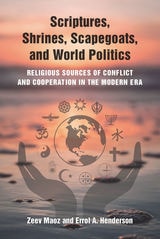
Scriptures, Shrines, Scapegoats, and World Politics
Religious Sources of Conflict and Cooperation in the Modern EraZeev Maoz and Errol A. Henderson
University of Michigan Press, 2021
The effect of religious factors on politics has been a key issue since the end of the Cold War and the subsequent rise of religious terrorism. However, the systematic investigations of these topics have focused primarily on the effects of religion on domestic and international conflict. Scriptures, Shrines, Scapegoats, and World Politics offers a comprehensive evaluation of the role of religion in international relations, broadening the scope of investigation to such topics as the relationship between religion and cooperation, religion and conflict, and the relationship between religion and the quality of life. Religion is often manipulated by political elites to advance their principal goal of political survival. Zeev Maoz and Errol A. Henderson find that no specific religion is either consistently more bellicose or consistently more cooperative than other religions. However, religious similarity between states tends to reduce the propensity of conflict and increase the opportunity for security cooperation. The authors find a significant relationship between secularism and human security.