Results by title
4 books match the query 'March'
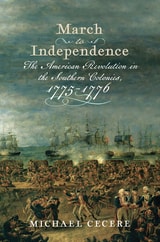
March to Independence
The Revolutionary War in the Southern Colonies, 1775–1776Michael Cecere
Westholme Publishing, 2027
The Independence Trilogy
The American Revolutionary War began when Massachusetts militiamen and British troops clashed at Lexington and Concord on April 19, 1775. Two months later, a much larger engagement occurred at Bunker Hill in Boston. The conflict then expanded into a continent-wide war for independence from Great Britain. Or so we are taught. A closer look at events in the South in the eighteen months following Lexington and Concord tells different story. The practice of teaching the Revolutionary War as one generalized conflict between the American colonies and Great Britain assumes the South’s support for the Revolutionary War was a foregone conclusion. However, once shots were fired, it was not certain that the southern colonies would support the independence movement. What is clear is that both the fledgling American republic and the British knew that the southern colonies were critical to any successful prosecution of the war by either side.
In March to Independence: The American Revolution in the Southern Colonies, 1775–1776, historian Michael Cecere, consulting primary source documents, examines how Virginia, North Carolina, South Carolina, and Georgia ended up supporting the colonies to the north, while East Florida remained within the British sphere. South Carolina, Georgia, and East Florida all retained their royal governors through the summer of 1775, and no military engagements occurred in any of the southern colonies in the six months following the battles in Massachusetts. The situation changed significantly in the fall, however, with armed clashes in Virginia and South Carolina; by early 1776 the war had spread to all of the southern colonies except East Florida. Although their march to independence did not follow the exact route as the colonies to the north, events in the South pulled the southern colonists in the same direction, culminating with a united Declaration of Independence on July 4, 1776. This book explores the crucial events in the southern colonies that led all but East Florida to support the American cause.
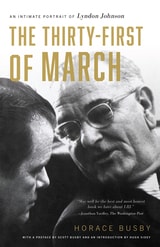
The Thirty-first of March
An Intimate Portrait of Lyndon JohnsonHorace Busby, with a Preface by Scott Busby and an Introduction by Hugh Sidey
University of Texas Press, 2023
An intimate retelling of Lyndon B. Johnson’s politics and presidency by one of his closest advisors.
Horace Busby was one of LBJ’s most trusted advisors; their close working and personal relationship spanned twenty years. In The Thirty-First of March he offers an indelible portrait of a president and a presidency at a time of crisis. From the aftereffects of the Kennedy assassination, when Busby was asked by the newly sworn-in president to sit by his bedside during his first troubled nights in office, to the concerns that defined the Great Society—civil rights, the economy, social legislation, housing, and the Vietnam War—Busby not only articulated and refined Johnson's political thinking, he also helped shape the most ambitious, far-reaching legislative agenda since FDR's New Deal.
Here is Johnson the politician, Johnson the schemer, Johnson who advised against JFK’s choice of an open limousine that fateful day in Dallas, and Johnson the father, sickened by the deaths of young men fighting and dying in Vietnam on his orders. The Thirty-first of March is a rare glimpse into the inner sanctum of Johnson's presidency, as seen through the eyes of one of the people who understood him best.
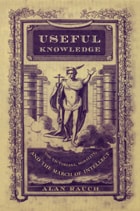
Useful Knowledge
The Victorians, Morality, and the March of IntellectAlan Rauch
Duke University Press, 2001
Rauch discusses both the influence and the ideology of knowledge in terms of how it affected nineteenth-century anxieties about moral responsibility and religious beliefs. Drawing on a wide array of literary, scientific, and popular works of the period, the book focusses on the growing importance of scientific knowledge and its impact on Victorian culture. From discussions of Jane Webb Loudon’s The Mummy! and Mary Shelley’s Frankenstein, to Charlotte Brontë’s The Professor, Charles Kingsley’s Alton Locke, and George Eliot’s Mill on the Floss, Rauch paints a fascinating picture of nineteenth-century culture and addresses issues related to the proliferation of knowledge and the moral issues of this time period. Useful Knowledge touches on social and cultural anxieties that offer both historical and contemporary insights on our ongoing preoccupation with knowledge.
Useful Knowledge will appeal to readers interested in nineteenth century history, literature, culture, the mediation of knowledge, and the history of science.
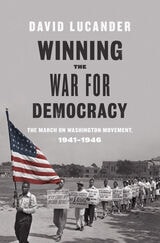
Winning the War for Democracy
The March on Washington Movement, 1941-1946David Lucander
University of Illinois Press, 2014
Winning the War for Democracy: The March on Washington Movement, 1941-1946 recalls that triumph, but also looks beyond Randolph and the MOWM's national leadership to focus on the organization's evolution and actions at the local level. Using the personal papers of previously unheralded MOWM members such as T.D. McNeal, internal government documents from the Roosevelt administration, and other primary sources, David Lucander highlights how local affiliates fighting for a double victory against fascism and racism helped the national MOWM accrue the political capital it needed to effect change.
Lucander details the efforts of grassroots organizers to implement MOWM's program of empowering African Americans via meetings and marches at defense plants and government buildings and, in particular, focuses on the contributions of women activists like Layle Lane, E. Pauline Myers, and Anna Arnold Hedgeman. Throughout he shows how local activities often diverged from policies laid out at MOWM's national office, and how grassroots participants on both sides ignored the rivalry between Randolph and the leadership of the NAACP to align with one another on the ground.