Results by title
8 books match the query 'March, William'
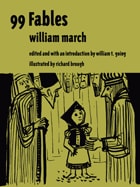
99 Fables
William March
University of Alabama Press, 2011
At the time of his death, the longest manuscript still in William March's possession was a collection of fables, which he had completed for the first time in 1938. While Company K, The Tallons, The Bad Seed, and all the rest were in progress, March culled and rewrote, polished and revised these fables, always finding them “too good to destroy,” yet never finding them a good venture for a commercial publisher. Now, posthumously, the collection appears in this book, and readers can enjoy the fabulous world of William March.
This is not to imply that it is a “pretty world.” The fables themselves are an immediate delight, and everyone will find many favorites among the 99. But in the end, March's view of the world is a hard one, and the morals, however charmingly expressed are bitter enough to rival the themes of his novels.
Come in at the Door
William March
University of Alabama Press, 1934
Come in at the Door is the first in March’s “Pearl County” collection, and it tells the story of Chester, a boy who lives with his withholding, widowed father, and Mitty, who keeps house and serves as a surrogate wife to Chester’s father and a mother to Chester. One morning before dawn, Mitty takes Chester to the Athlestan courthouse to watch the hanging of a man who’d killed “a grotesque, dwarflike creature” he thought had “laid a conjure” on him.
Throughout Chester’s rambunctious young manhood, the gruesome memory hovers just below the surface of his mind, recalled in detail only at his father’s death, when the book sweeps forward to its shattering denouement. A classic of Southern Gothic that illuminates family, class, race, and gender, Come in at the Door marks the homecoming of a Southern storyteller at the peak of his craft.
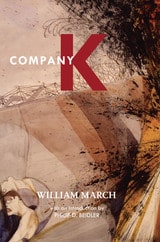
Company K
William March
University of Alabama Press, 1989
Through fragmented testimonies of Marines, the novel exposes the psychological and moral wreckage left in the wake of modern warfare.
This book was originally published in 1933. It is the first novel by William March, pen name for William Edward Campbell. Stemming directly from the author's experiences with the US Marines in France during World War I, the book consists of 113 sketches, or chapters, tracing the fictional Company K's war exploits and providing an emotional history of the men of the company that extends beyond the boundaries of the war itself.
William Edward Campbell served courageously in France as evidenced by his chestful of medals and certificates, including the Croix de Guerre, the Distinguished Service Cross, and the Navy Cross. However, without the medals and citations we would know of his bravery. For it is clear in the pages of Company K that this book was written by a man who had been to war, who had clearly seen his share of the worst of it, who had somehow survived, and who had committed himself afterward to the new bravery of sense-making embodied in the creation of major literary art. It is of that bravery that we still have the record of magnificent achievement, the brave terrible gift of Company K.
The Looking-Glass
William March
University of Alabama Press, 1943
Third in the "Pearl County" series, The Looking-Glass is March's story of a small Alabama town in the early days of the twentieth century. Connected by relationships that bind, support, and strangle, the citizens of Reedyville are drawn ineluctably toward a single climactic night. March's skillful blend of humor and pathos evinces his deep insights and empathy into the problems of the mind and heart that are both peculiar to Reedyville yet found in every town and family.
The Tallons
William March
University of Alabama Press, 1964
In The Tallons, the second novel in the "Pearl County" series, March tells the story of two farm boys, Andrew and Jim Tallon. Their placid and predictable life is upended by a girl from Georgia, Myrtle Bickerstaff. The conflict which engulfs these three arises from a series of carefully chosen and extraordinarily telling incidents to a dramatic climax which will be remembered long after the book is set aside. March framed the novel as "a study in paranoia" and to the end of his life considered it one of his strongest works.

The Two Worlds of William March
Roy S. Simmonds
University of Alabama Press, 1984
In the work of literary resurrection there is always a small act of defiance. The Two Worlds of William March by Roy S. Simmonds restores to view one of the most remarkable and least celebrated American writers of the twentieth century. With intelligence, restraint, and a keen eye for contradiction, Simmonds traces March’s path from Alabama beginnings through war, business success, and literary achievement. The result is more than a biography. It is an inquiry into the making of a writer whose novels continue to unsettle, disturb, and illuminate long after the fashions of his age have passed.
What lingers is the paradox of William March himself. He was a man of outward accomplishment who remained drawn to the hidden regions of experience. He wrote memorably of war without glamorizing it, and of evil without simplifying it. Unlike so many public literary figures, he seemed to cultivate disappearance rather than celebrity. The silence around him became part of the story. Simmonds treats that silence not as a void but as evidence, revealing a complex and deeply observant mind at work beneath an unusually quiet life.
The questions that occupied March remain with us. How well do we know ourselves? What lies beneath ordinary behavior? How does experience become art? For readers of Southern literature, literary biography, American history, war literature, psychology, Alabama culture, and twentieth-century fiction, this book offers both discovery and reconsideration. It will especially appeal to those who suspect that the most revealing stories are often hidden in plain sight.
Trial Balance
The Collected Short Stories of William MarchWilliam March
University of Alabama Press, 2011
The Collected Short Stories of William March
William March
An Annotated ChecklistRoy S. Simmonds
University of Alabama Press, 1988
This deeply researched reference includes both primary materials, an exhaustive checklist of the forms and editions of each of March’s works, and secondary materials, which include plays and films adapted from March’s writing, biographical and critical articles, doctoral dissertations, and contemporary reviews of March’s work.
The reissue in 2015 of the novels in his Pearl County series—Come in at the Door, The Tallons, and The Looking-Glass—is part of a fresh wave of interest in March, one of the most influential American writers from the mid-1930s until his death in 1954.