Results by title
16 books match the query 'Marcus, George E.'
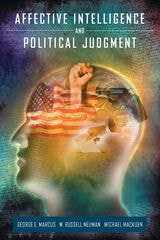
Affective Intelligence and Political Judgment
George E. Marcus, W. Russell Neuman, and Michael MacKuen
University of Chicago Press, 2000
The authors draw on research in neuroscience, physiology, and experimental psychology to conceptualize habit and reason as two mental states that interact in a delicate, highly functional balance controlled by emotion. Applying this approach to more than fifteen years of election results, they shed light on a wide range of political behavior, including party identification, symbolic politics, and negative campaigning.
Remarkably accessible, Affective Intelligence and Political Judgment urges social scientists to move beyond the idealistic notion of the purely rational citizen to form a more complete, realistic model that includes the emotional side of human judgment.
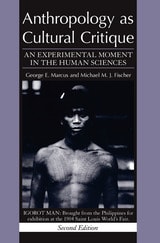
Anthropology as Cultural Critique
An Experimental Moment in the Human SciencesGeorge E. Marcus and Michael M. J. Fischer
University of Chicago Press, 1999
Connected
Engagements with MediaEdited by George E. Marcus
University of Chicago Press, 1996
Connected, the third volume in the groundbreaking and highly acclaimed Late Editions series, confronts these provocative questions through unique experiments with the interview format. It explores both the new pathways being forged through media and the predicaments of those struggling to find their way in the twilight of the twentieth century.
Corporate Futures
The Diffusion of the Culturally Sensitive Corporate FormEdited by George E. Marcus
University of Chicago Press, 1998
Late Editions 5, Corporate Futures, questions this idea of a "cultural landscape" by focusing on the the marked investment of corporations in the concept of culture, long the purview of anthropologists and, more recently, those involved in the humanistic disciplines. Emerging in the discourse of the workplace—and traveling beyond it to traditionally alternative associations—is the idea of a "corporate culture" with its own organization, management policies and practices, and ethos. How can we understand this culture of corporations, and to what extent does it reflect self-contained communities or fragmented human existence in groups under conditions of postmodernity? Corporate Futures tackles these issues and questions through conversations with managers, financial and risk analysts, and other participants in national and international organizations.
The results—engaging, intriguing, speculative, current—continue the work begun in earlier volumes to map the terrain of the present and navigate the uncertain future.
Praise for Late Editions: "If the succeeding volumes are as compassionate and informed as the first, this series could become an essential postmodern guidebook to the world's changing cultural terrain. I plan on letting it ease me into the next century."—Catherine Gysin, Utne Reader

Cultural Producers In Perilous States
Editing Events, Documenting ChangeEdited by George E. Marcus
University of Chicago Press, 1996
We meet a South African playwright who is shaping a distinctive form of activist journalism; a New Guinean producer who manages several media careers; Polish and German filmmakers developing critical documentaries on compromised new orders; a Columbian artist who provides powerful representations of endemic violence in her society; and writers from Martinique and Argentina with varied careers in the arts, media, and politics who provide tragicomic accounts of the marginal situations of their societies.
Cynical, hopeful, ambivalent all at once, these cultural producers in perilous states share a keen awareness of the marginality of their societies in the broader context of global change, and associate integrity in the reporting of local events with a critical politics of representation.
Designs for an Anthropology of the Contemporary
Paul Rabinow, George E. Marcus with James D. Faubion and Tobias Rees
Duke University Press, 2008
Both Rabinow and Marcus participated in the milestone collection Writing Culture: The Poetics and Politics of Ethnography. Published in 1986, Writing Culture catalyzed a reassessment of how ethnographers encountered, studied, and wrote about their subjects. In the opening conversations of Designs for an Anthropology of the Contemporary, Rabinow and Marcus take stock of anthropology’s recent past by discussing the intellectual scene in which Writing Culture intervened, the book’s contributions, and its conceptual limitations. Considering how the field has developed since the publication of that volume, they address topics including ethnography’s self-reflexive turn, scholars’ increased focus on questions of identity, the Public Culture project, science and technology studies, and the changing interests and goals of students. Designs for an Anthropology of the Contemporary allows readers to eavesdrop on lively conversations between anthropologists who have helped to shape their field’s recent past and are deeply invested in its future.
Frontiers of Capital
Ethnographic Reflections on the New EconomyMelissa S. Fisher and Greg Downey, eds.
Duke University Press, 2006
Some contributors highlight how expedited flows of information allow business professionals to develop new knowledge practices. They analyze dynamics ranging from the decision-making processes of the Federal Reserve Board to the legal maneuvering necessary to buttress a nascent Japanese market in over-the-counter derivatives. Others focus on the social consequences of globalization and new modes of communication, evaluating the introduction of new information technologies into African communities and the collaborative practices of open-source computer programmers. Together the essays suggest that social relations, rather than becoming less relevant in the high-tech age, have become more important than ever. This finding dovetails with the thinking of many corporations, which increasingly employ anthropologists to study and explain the “local” cultural practices of their own workers and consumers. Frontiers of Capital signals the wide-ranging role of anthropology in explaining the social and cultural contours of the New Economy.
Contributors. Jean Comaroff, John L. Comaroff, Greg Downey, Melissa S. Fisher, Douglas R. Holmes, George E. Marcus, Siobhán O’Mahony, Aihwa Ong, Annelise Riles, Saskia Sassen, Paul A. Silverstein, AbdouMaliq Simone, Neil Smith, Caitlin Zaloom
Going to War in Iraq
When Citizens and the Press MatterStanley Feldman, Leonie Huddy, and George E. Marcus
University of Chicago Press, 2015
Drawing on the most comprehensive survey of public reactions to the war, Stanley Feldman, Leonie Huddy, and George E. Marcus revisit this critical period and come back with a very different story. Polling data from that critical period shows that the Bush administration’s carefully orchestrated campaign not only failed to raise Republican support for the war but, surprisingly, led Democrats and political independents to increasingly oppose the war at odds with most prominent Democratic leaders. More importantly, the research shows that what constitutes the news matters. People who read the newspaper were more likely to reject the claims coming out of Washington because they were exposed to the sort of high-quality investigative journalism still being written at traditional newspapers. That was not the case for those who got their news from television. Making a case for the crucial role of a press that lives up to the best norms and practices of print journalism, the book lays bare what is at stake for the functioning of democracy—especially in times of crisis—as newspapers increasingly become an endangered species.

Para-Sites
A Casebook against Cynical ReasonEdited by George E. Marcus
University of Chicago Press, 2000
These cases challenge the condition of cynicism that has been the favored mode of characterizing the mind-set of intellectuals and professionals, comfortable in their lives of middle-class consumption and work. In their effort to establish para-sites of critical awareness parallel to the levels of political and economic power at which they function, these subjects suggest that those who lead ordinary lives of modest power and privilege might not be parasites in relation to the systems they serve, but may be creating unique and independent critical perspectives.
Paranoia within Reason
A Casebook on Conspiracy as ExplanationEdited by George E. Marcus
University of Chicago Press, 1999
Some pieces develop conversations that reveal the post-Cold War situations of countries such as Italy, Russia, Slovenia, and the United States where conspiratorial explanations of national dramas seem to make sense. Other pieces tackle paranoia as a style of debate in such diverse realms as science, psychotherapy, and popular entertainment, where conspiracy theories emerge as a compelling way to address the inadequacies of rational expertise and organization in the face of immense changes that undermine them. Like all of the volumes in the Late Edition series, Paranoia Within Reason offers a provocative challenge to our ways of understanding the ongoing watershed changes that face us.
Perilous States
Conversations on Culture, Politics, and NationEdited by George E. Marcus
University of Chicago Press, 1993
politics, history, comparative literature, and
philosophy—the unprecedented annual publication Late
Editions exposes unsettling dilemmas and unprecedented
challenges facing cultural studies on the brink of the
twenty-first century. Successive volumes will appear
annually until the year 2000, each engaging the predicaments
of particular institutions, nations, and persons at this
point of social, cultural, and political change. The
project will test the limits of scholarly conventions by
finding new ways to expose cultural formations emerging from
the maturation or exhaustion of once-powerful ideas whose
validity is now deeply in question.
Perilous States, the first volume of Late
Editions, presents conversations between American
scholars, most of whom are anthropologists, and individuals
situated amidst political and social upheaval. Pimarily but
not exclusively from Eastern Europe, the cast includes
Russian writers, Hungarian scientists and academics, Armenian
politicians, Siberian religious and medical leaders, a Gypsy
leader, a Polish poet, a French politician, and a white South
African musician who is a self-styled Zulu. Their voices
unite around themes of democracy, market economy, individual
rights, and the reawakened force of suppressed ethnic and
racial identities.
To obtain fresh perspectives on these cultural and social
transformations, the volumes will consist of in-depth
conversations, relayed in essay form, between scholars and
individuals in other cultures with whom they share
affinities. This novel approach blends the immediacy of
interviews, the objectivity of journalism, and the
intellectual rigor of scholarship.
Contributors to this volume are Marjorie Balzer, Sam
Beck, David B. Coplan, Michael M. J. Fischer, Nia Georges,
Bruce Grant, Douglas R. Holmes, Stella Gregorian, George E.
Marcus, Kathryn Milun, Eleni Papagaroufali, Paul Rabinow,
Julie Taylor, and Tom White.
Political Tolerance and American Democracy
John L. Sullivan, James Piereson, and George E. Marcus
University of Chicago Press, 1982
Rereading Cultural Anthropology
George E. Marcus, ed.
Duke University Press, 1992
Drawing together work by both younger and well-established scholars, this volume reveals various influences in the remaking of traditions of ethnographic work in anthropology; feminist studies, poststructuralism, cultural critiques, and disciplinary challenges to established boundaries between the social sciences and humanities. Moving from critiques of anthropological representation and practices to modes of political awareness and experiments in writing, this collection offers systematic access to what is now understood to be a fundamental shift (still ongoing) in anthropology toward engagement with the broader interdisciplinary stream of cultural studies.
Contributors. Arjun Appadurai, Keith H. Basso, David B. Coplan, Vincent Crapanzano, Faye Ginsburg, George E. Marcus, Enrique Mayer, Fred Meyers, Alcida R. Ramos, John Russell, Orin Starn, Kathleen Stewart, Melford E. Spiro, Ted Swedenburg, Michael Taussig, Julie Taylor, Robert Thornton, Stephen A. Tyler, Geoffrey M. White
Technoscientific Imaginaries
Conversations, Profiles, and MemoirsEdited by George E. Marcus
University of Chicago Press, 1995
In these penetrating essays, twenty-four distinguished contributors from a broad range of fields present the voices of the scientists themselves—through interviews, conversations, and memoirs. We hear from Lithuanian physicists who discuss science after Communism and their own fantasies about what Western science is; a Japanese-American woman struggling with her ambivalence over designing nuclear weapons; political activists in India who examine relations among science, environmental politics, and government ideology in the aftermath of the Bhopal disaster; and many others, including biologists, physicians, corporate researchers, and scientists working with virtual reality and other cutting-edge technologies.
The contributors to this volume are Mario Biagioli, Maria E. Carson, Gary Lee Downey, Joseph Dumit, Michael M. J. Fischer, Mary-Jo DelVecchio Good, Hugh Gusterson, Diana L. L. Hill, James Holston, Herbert C. Hoover, Jr., Gudrun Klein, Leszek Koczanowicz, Irene Kuter, Kim Laughlin, Rita Linggood, George E. Marcus, Kathryn Milun, Livia Polanyi, Christopher Pound, Simon Powell, Paul Rabinow, Kathleen Stewart, Allucquere Rosanne Stone, and Sharon Traweek.
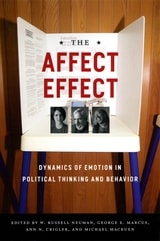
The Affect Effect
Dynamics of Emotion in Political Thinking and BehaviorEdited by W. Russell Neuman, George E. Marcus, Michael MacKuen, and Ann N. Crigler
University of Chicago Press, 2007
In sixteen seamlessly integrated essays, thirty top scholars approach this topic from a broad array of angles that address four major themes. The first section outlines the philosophical and neuroscientific foundations of emotion in politics, while the second focuses on how emotions function within and among individuals. The final two sections branch out to explore how politics work at the societal level and suggest the next steps in modeling, research, and political activity itself. Opening up new paths of inquiry in an exciting new field, this volume will appeal not only to scholars of American politics and political behavior, but also to anyone interested in political psychology and sociology.

Zeroing In on the Year 2000
The Final EditionEdited by George E. Marcus
University of Chicago Press, 2000
The book begins with a fascinating, at times poignant, look back at the inception and progress of the series, in which the contributors reflect on how the shifting contexts for the production and reception of the series has been a reliable barometer of the profound ways in which traditional forms of knowledge about society are changing. Then, appropriate to the end of the century and of the series, the focus turns to pieces that deal with social phenomena that evoke the value of zero. They explore the idea of a zero state as it relates to artificial intelligence, euthanasia, cryonics, money, and the disappearing idea of society itself in the discourse of contemporary politics.
Far from being the loss of meaning, the consideration of zero entails the proliferation of meaning in the face of voids, absences, and ultimately, of puzzles like the contemplation of death in life. In this way, so many of the fin-de-siècle conditions that have been documented in this series have exemplified precisely this quest for meaning at or near zero points of change, of ends and beginnings, in social life.