Results by title
7 books match the query 'Marine ecology'
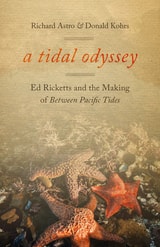
A Tidal Odyssey
Ed Ricketts and the Making of Between Pacific TidesRichard Astro
Oregon State University Press, 2021
In A Tidal Odyssey, literary scholar Richard Astro and archivist Donald Kohrs explore how Between Pacific Tides came to be, covering both the writing process and the long journey to publication. They tell three interwoven stories: the development of ecology as a valuable new approach to the study of marine life in the intertidal zone; a case study of how new and dynamic science is published and reaches a larger audience; and the intellectual development of Ed Ricketts.
Not only a scientist but also an expert in music, philosophy, history, and literature, Ricketts and his work impacted a broad range of writers and scholars. A number of these intellectual figures appear in A Tidal Odyssey, including Ricketts’s co-author, Jack Calvin, and illustrator, Ritch Lovejoy; mythologist Joseph Campbell; novelist Henry Miller; composer John Cage; and of course John Steinbeck. The authors have drawn extensively from Ricketts’s archive, including previously unpublished letters, memoranda, notebooks, and photographs.
A Tidal Odyssey is for anyone interested in the world of Ed Ricketts as well as marine biology, intertidal ecology, and how ecological studies underpin our understanding of the impact of environmental change on the well-being of our planet.
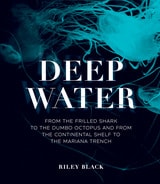
Deep Water
From the Frilled Shark to the Dumbo Octopus and from the Continental Shelf to the Mariana TrenchRiley Black
University of Chicago Press, 2023
What lies beneath the surface of the ocean has mystified humankind for millennia. Today, we have explored more of the surface of the Moon than we have the deep sea. What thrives in these mysterious depths, how did these life-forms evolve from ancient life, and how has this environment changed over time as our planet has developed?
Introducing us to the ancient, complex, and fascinating life-forms that have evolved into the marine life we recognize today—from stromatolites, structures created by some of the earliest life billions of years ago and still found today, to yeti crabs, bioluminescent firefly squid, and giant jellyfish—Deep Water is an eye-opening journey into the world far beneath the waves. Our guide, brilliant science communicator and self-described “fossil fanatic” Riley Black, has studied marine biology and paleontology, and she brings her vast knowledge and inimitable voice to our voyage. Through text and image, Black leads us further and further into the depths to reveal how this unique and largely unexplored habitat came into being, what lives there and why, how it has evolved, and what the future will bring in this dark and mysterious environment.
Environmental Studies of a Marine Ecosystem
South Texas Outer Continental ShelfEdited by R. Warren Flint and Nancy N. Rabalais
University of Texas Press, 1981
Environmental Studies of a Marine Ecosystem reports the temporal and spatial variation of both the living and nonliving resources of the south Texas outer continental shelf. As the last major study to have been conducted before the Ixtoc oil spill in 1979, it is of great importance as a record of the baseline conditions and ecosystem characteristics for both biologists and chemists studying the effects of the Campeche disaster on the marine environment. The book is the culmination of three years of field studies conducted for the Bureau of Land Management and contains information on the climatology, hydrology, and sedimentology of the region as well as data on the pelagic and benthic biota, environmental hydrocarbons and trace metals, and the microbiology of the area. In addition to the ecosystem description, the data are integrated to expose ecological relationships that exist and to identify those specific variables which are most important for the assessment and management of environmentally damaging impacts to the area.
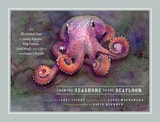
From the Seashore to the Seafloor
An Illustrated Tour of Sandy Beaches, Kelp Forests, Coral Reefs, and Life in the Ocean's DepthsJanet Voight and Peggy Macnamara
University of Chicago Press, 2022
Have you ever walked along the beach and wondered what kind of creatures can be found beneath the waves? Have you pictured what it would be like to see the ocean not from the shore but from its depths? These questions drive Janet Voight, an expert on mollusks who has explored the seas in the submersible Alvin that can dive some 14,000 feet below the water’s surface. In this book, she partners with artist Peggy Macnamara to invite readers to share her undersea journeys of discovery.
With accessible scientific descriptions, Voight introduces the animals that inhabit rocky and sandy shores, explains the fragility of coral reefs, and honors the extraordinary creatures that must search for food in the ocean’s depths, where light and heat are rare. These fascinating insights are accompanied by Macnamara’s stunning watercolors, which illuminate these ecosystems and other scenes from Voight’s research. Together, they show connections between life at every depth—and warn of the threats these beguiling places and their eccentric denizens face.
Marine Macroecology
Edited by Jon D. Witman and Kaustuv Roy
University of Chicago Press, 2009
Pioneered in the late 1980s, the concept of macroecology—a framework for studying ecological communities with a focus on patterns and processes—revolutionized the field. Although this approach has been applied mainly to terrestrial ecosystems, there is increasing interest in quantifying macroecological patterns in the sea and understanding the processes that generate them. Taking stock of the current work in the field and advocating a research agenda for the decades ahead, Marine Macroecology draws together insights and approaches from a diverse group of scientists to show how marine ecology can benefit from the adoption of macroecological approaches.
Divided into three parts, Marine Macroecology first provides an overview of marine diversity patterns and offers case studies of specific habitats and taxonomic groups. In the second part, contributors focus on process-based explanations for marine ecological patterns. The third part presents new approaches to understanding processes driving the macroecolgical patterns in the sea. Uniting unique insights from different perspectives with the common goal of identifying and understanding large-scale biodiversity patterns, Marine Macroecology will inspire the next wave of marine ecologists to approach their research from a macroecological perspective.
Stung!
On Jellyfish Blooms and the Future of the OceanLisa-ann Gershwin
University of Chicago Press, 2013
The Atlas of Coasts and Oceans
Ecosystems, Threatened Resources, Marine ConservationDon Hinrichsen
University of Chicago Press, 2011
Oceans drive the world’s climate, nurture marine ecosystems full of aquatic life, and provide shipping lanes that have defined the global economy for centuries. And few realize that half of the world’s population lives in a coastal region within easy reach of one. Yet human activities such as commercial fishing, coastal real estate development, and industrial pollution have taken their toll on the seas. The first book of its kind, The Atlas of Coasts and Oceans documents the fraught relationship between humans and the earth’s largest bodies of water—and outlines the conservation steps needed to protect the marine environment for generations to come.
The Atlas offers a fascinating and often sobering account of how urbanization, climate change, offshore oil drilling, shipping routes, global tourism, and maritime conflict have had a profound impact on the world’s oceans and coasts. Combining text and images in visually engaging, thematically organized map spreads, this volume addresses the ecological, environmental, and economic importance of marine phenomena such as coral reefs, eroding shorelines, hurricanes, and fish populations—and how development threatens to destroy the ultimate source of all life on the “blue planet.” Lavishly illustrated with global and regional maps, from the Arabian Gulf to the Great Barrier Reef, from the Black Sea to the Mediterranean, and all the other major global waterways, The Atlas of Coasts and Oceans will be the definitive companion to any study of its subject for years to come.