Results by title
6 books match the query 'Marital violence'
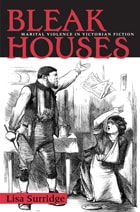
Bleak Houses
Marital Violence in Victorian FictionLisa Surridge
Ohio University Press, 2005
The Offenses Against the Person Act of 1828 opened magistrates' courts to abused working-class wives. Newspapers in turn reported on these proceedings, and in this way the Victorian scrutiny of domestic conduct began. But how did popular fiction treat “private” family violence? Bleak Houses: Marital Violence in Victorian Fiction traces novelists' engagement with the wife-assault debates in the public press between 1828 and the turn of the century.
Lisa Surridge examines the early works of Charles Dickens and reads Dombey and Son and Anne Brontë's The Tenant of Wildfell Hall in the context of the intense debates on wife assault and manliness in the late 1840s and early 1850s. Surridge explores George Eliot's Janet's Repentance in light of the parliamentary debates on the 1857 Divorce Act. Marital cruelty trials provide the structure for both Wilkie Collins's The Woman in White and Anthony Trollope's He Knew He Was Right.
Locating the New Woman fiction of Mona Caird and the reassuring detective investigations of Sherlock Holmes in the context of late-Victorian feminism and the great marriage debate in the Daily Telegraph, Surridge illustrates how fin-de-siècle fiction brought male sexual violence and the viability of marriage itself under public scrutiny. Bleak Houses thus demonstrates how Victorian fiction was concerned about the wife-assault debates of the nineteenth century, debates which both constructed and invaded the privacy of the middle-class home.
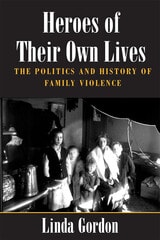
Heroes of Their Own Lives
The Politics and History of Family Violence--Boston, 1880-1960Linda Gordon
University of Illinois Press, 2002
Powerful and moving, Heroes of Their Own Lives offers an honest understanding of a persistent problem and a realistic view of the difficulties in stopping it.

Living Between Danger and Love
The Limits of ChoiceJones, Kathleen B.
Rutgers University Press, 1999
Speaking the Unspeakable
Marital Violence among South Asian Immigrants in the United StatesAbraham, Margaret
Rutgers University Press, 2000
Over the past 20 years, much work has focused on domestic violence, yet little attention has been paid to the causes, manifestations, and resolutions to marital violence among ethnic minorities, especially recent immigrants. Margaret Abraham’s Speaking the Unspeakable is the first book to focus on South Asian women’s experiences of domestic violence, defined by the author as physical, sexual, verbal, mental, or economic coercion, power, or control perpetrated on a woman by her spouse or extended kin. Abraham explains how immigration issues, cultural assumptions, and unfamiliarity with American social, legal, economic, and other institutional systems, coupled with stereotyping, make these women especially vulnerable to domestic violence.
Abraham lets readers hear the voices of abused South Asian women. Through their stories, we learn of their weaknesses and strengths, and of their experiences of domestic violence within the larger cultural, social, economic, and political context. We see both the individual strategies of resistance against their abusers as well as the pivotal role South Asian organizations play in helping these women escape abusive relationships.
Abraham also describes the central role played by South Asian activism as it emerged in the 1980s in the United States, and addresses the ideas and practices both within and outside of the South Asian community that stereotype, discriminate, and oppress South Asians in their everyday lives.
Thirsty
A NovelKristin Bair O’Keeffe
Ohio University Press, 2009
It is 1883, and all of Klara Bozic’s girlish dreams have come crashing down as she arrives in Thirsty, a gritty steel town carved into the slopes above the Monongahela River just outside of Pittsburgh. She has made a heartbreaking discovery. Her new husband Drago is as abusive as the father she left behind in Croatia.
In Kristin Bair O’Keeffe’s debut novel, Klara’s life unfolds over forty years as she struggles to find her place in a new country where her survival depends on the friends who nurture her: gutsy, funny Katherine Zupanovic, who isn‘t afraid of Drago’s fist; BenJo, the only black man in Thirsty to have his own shop; and strangely enough, Old Man Rupert, the town drunk.
Thirsty follows a chain of unlikely events that keep Klara’s spirit aloft: a flock of angelic butterflies descends on Thirsty; Klara gives birth to her first child in Old Man Rupert’s pumpkin patch; and BenJo gives her a talking bird. When Klara’s daughter marries a man even more brutal than Drago, Klara is forced to act. If she doesn’t finally break the cycle of violence in her family, her granddaughters will one day walk the same road, broken and bruised. As the threads that hold her family together fray and come undone, Klara has to decide if she has the courage to carve out a peaceful spot in the world for herself and her girls.
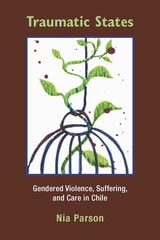
Traumatic States
Gendered Violence, Suffering, and Care in ChileNia Parson
Vanderbilt University Press, 2013
In Traumatic States, anthropologist Nia Parson explores the development of methods of care and recovery from domestic violence. She interviews and contextualizes the lives of numerous individuals who have confronted these acts, as victims, authorities, and activists. Ultimately, Traumatic States argues that facing the challenges of healing both body and mind, and addressing the fundamental inequalities that make those challenges even more formidable, are part of the same battle.