Results by title

3 books match the query 'Marriage (Islamic law)'
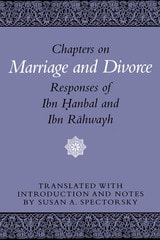
cover of Chapters on Marriage and Divorce: Responses of Ibn Hanbal and Ibn Rahwayh

Chapters on Marriage and Divorce

Responses of Ibn Hanbal and Ibn Rahwayh

Translated with introduction and notes by Susan A. Spectorsky

University of Texas Press, 1993

While western-derived legal codes have superseded Islamic law in many parts of the Muslim world, Islamic, Koran-based law still retains its force in the area of marriage and family relations, the area that is key to the status of women. This work makes available for the first time in English three compilations of responses to questions about family law given by two prominent Muslim jurists of the ninth century (third century of Islam)—Ahmad b. Hanbal, the eponymous founder of the Hanbali rite of Sunni Islam (the one dominant in Saudi Arabia), and Ishaq b. Rahwayh. These compilations are basic sources for the study of the development of legal thinking in Islam.

The introduction to the translation locates the compilations in a historical context and elucidates how the various issues of family law are treated. An appendix contains a collation of the significant variants among the manuscripts and printed versions of the Arabic texts. The volume concludes with a topical index and an index of names.
[more]
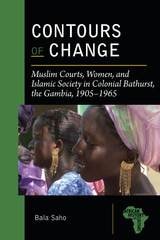
cover of Contours of Change: Muslim Courts, Women, and Islamic Society in Colonial Bathurst, the Gambia, 1905-1965

Contours of Change

Muslim Courts, Women, and Islamic Society in Colonial Bathurst, the Gambia, 1905-1965

Bala Saho

Michigan State University Press, 2018
Based on a previously unexamined body of qadi court records as well as two hundred oral interviews in Wolof and Mandinka, Contours of Change: Muslim Courts, Women, and Islamic Society in Colonial Bathurst, the Gambia, 1905–1965, offers a new perspective on the impact of British rule in West Africa. It focuses on the formation of present-day Banjul and the role of law, religion, and gender relations. Specifically, this volume explores how colonization affected the evolution of women’s understanding of the importance of law in securing their rights, and how urban women used the new qadi court system to fight for greater rights in the domestic sphere. The fascinating cases discussed in the text show that male Muslim judges often were sympathetic to women’s claims, and that, as a result, the qadi court created opportunities for women to acquire property rights and negotiate patriarchal relationships. Contours of Change sheds light on African subjectivities and the broader social, economic, and political changes taking place in colonial Gambian society during the first half of the twentieth century. This text breaks new ground in Senegambian history and makes a significant contribution to British colonial studies, African legal studies, Islam in Africa studies, and women’s history studies.
[more]
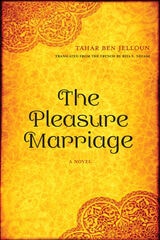
cover of The Pleasure Marriage: A Novel

The Pleasure Marriage

A Novel

Tahar Ben Jelloun; Translated from the French by Rita S. Nezami

Northwestern University Press, 2021

In The Pleasure Marriage, Tahar Ben Jelloun tells the epic story of a romance that explores desire and the intolerance for interracial marriage in Moroccan society. Amir is a prosperous merchant based in Fez, where he has a wife and four children. On one of his annual business trips to Senegal, he enters into a “pleasure marriage”—a temporary union permitted by Islamic law—with the alluring Nabou. Overcome by her passion and sensuality, he falls in love, with repercussions for three generations scarred by racism, immigration, and deportation.
 
Nabou returns to Fez as Amir’s second wife, weathering the jealous cruelty of Lalla Fatma, his first partner. Isolated within her new home, Nabou gives birth to twin sons, one black and one white, who come of age on the opposite sides of racial, social, and political chasms and who chart vastly different courses. The Pleasure Marriage showcases Ben Jelloun’s mastery of metaphor and lyrical narrative as he continues to take us into the worlds of Moroccan culture through his exquisite language and literary genius.
 
[more]