Results by title
9 books match the query 'Mars'

Dying Planet
Mars in Science and the ImaginationRobert Markley
Duke University Press, 2005
Markley interweaves chapters on science and science fiction, enabling him to illuminate each arena and to explore the ways their concerns overlap and influence one another. He tracks all the major scientific developments, from observations through primitive telescopes in the seventeenth century to data returned by the rovers that landed on Mars in 2004. Markley describes how major science fiction writers—H. G. Wells, Kim Stanley Robinson, Philip K. Dick, Edgar Rice Burroughs, Ray Bradbury, Robert Heinlein, and Judith Merril—responded to new theories and new controversies. He also considers representations of Mars in film, on the radio, and in the popular press. In its comprehensive study of both science and science fiction, Dying Planet reveals how changing conceptions of Mars have had crucial consequences for understanding ecology on Earth.
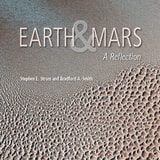
Earth and Mars
A ReflectionStephen E. Strom and Bradford A. Smith
University of Arizona Press, 2015
Earth and Mars is a fusion of art and science, a blend of images and essays celebrating the successful creation of our life-sustaining planet and the beauty and mystery of Mars. Through images of terrestrial landscapes and photographs selected from recent NASA and European Space Agency missions to Mars, Earth and Mars reveals the profound beauty resulting from the action of volcanism, wind, and water. The accompanying text provides a context for appreciating the role of these elemental forces in shaping the surfaces of each planet, as well as the divergent evolutionary paths that led to an Earth that is teeming with life, and Mars that is seemingly lifeless.
Earth and Mars inspires reflection on the extraordinarily delicate balance of forces that has resulted in our good fortune: to be alive and sentient on a bountiful blue world.

For the Love of Mars
A Human History of the Red PlanetMatthew Shindell
University of Chicago Press, 2023
Mars and its secrets have fascinated and mystified humans since ancient times. For the Love of Mars surveys the red planet’s place in the human imagination, beginning with ancient astrologers and skywatchers and ending in our present moment of exploration and virtual engagement.
National Air and Space Museum curator Matthew Shindell describes how historical figures across eras and around the world have made sense of this mysterious planet. We meet Mayan astrologer priests who incorporated Mars into seasonal calendars and religious ceremonies, Babylonian astrologers who discerned bad omens, figures of the Scientific Revolution who struggled to comprehend Mars as a world, Victorian astronomers who sought signs of intelligent life, and twentieth- and twenty-first-century scientists who have established a technological presence on the planet’s surface. Along the way, we encounter writers and artists from each of these periods who took readers and viewers along on imagined journeys to Mars.
By focusing on the diverse human stories behind the telescopes and behind the robots we know and love, Shindell shows how Mars exploration has evolved in ways that have also expanded knowledge about other facets of the universe. Captained by an engaging and erudite expert, For the Love of Mars is a captivating voyage through time and space for anyone curious about Curiosity and the red planet.
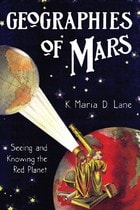
Geographies of Mars
Seeing and Knowing the Red PlanetK. Maria D. Lane
University of Chicago Press, 2011
A highly original exploration of geography’s spatial dimensions at the beginning of the twentieth century, offering a new view of the mapping of far-off worlds.
One of the first maps of Mars, published by an Italian astronomer in 1877, with its pattern of canals, fueled belief in intelligent life forms on the distant red planet—a hope that continued into the 1960s. Although the Martian canals have long since been dismissed as a famous error in the history of science, K. Maria D. Lane argues that there was nothing accidental about these early interpretations. Indeed, she argues, the construction of Mars as an incomprehensibly complex and engineered world both reflected and challenged dominant geopolitical themes during a time of major cultural, intellectual, political, and economic transition in the Western world.
Geographies of Mars telescopes in on a critical period in the development of the geographical imagination, when European imperialism was at its zenith and American expansionism had begun in earnest. Astronomers working in the new observatories of the American Southwest or in the remote heights of the South American Andes were inspired, Lane finds, by their own physical surroundings and used representations of the Earth’s arid landscapes to establish credibility for their observations of Mars. With this simple shift to the geographer’s point of view, Lane deftly explains some of the most perplexing stances on Mars taken by familiar protagonists such as Percival Lowell, Alfred Russel Wallace, and Lester Frank Ward.
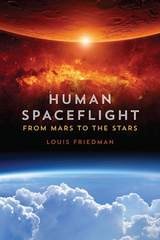
Human Spaceflight
From Mars to the StarsLouis Friedman
University of Arizona Press, 2015
Far from diminishing our future in space, Human Spaceflight lays out a provocative future for human space travel. The noted aerospace engineer and scientist says that human space exploration will continue well into the future, but space travel by humans will stop at Mars. Instead, nanotechnology, space sails, robotics, biomolecular engineering, and artificial intelligence will provide the vehicles of the future for an exciting evolution not just of space travel but of humankind.
Friedman has worked with agencies around the globe on space exploration projects to extend human presence beyond Mars and beyond the solar system. He writes that once we accept Mars as the only viable destination for humans, our space program on planet Earth can become more exciting and more relevant. Mars, he writes, will take hundreds, even thousands, of years to settle. During that time, humans and all our supporting technologies will evolve, allowing our minds to be present throughout the universe while our bodies stay home on Earth and Mars.
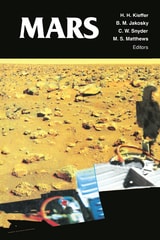
Mars
Edited by H. H. Kieffer, B. M. Jakosky, C. W. Snyder, and M. S. Matthews
University of Arizona Press, 1992
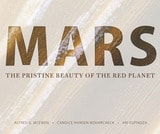
Mars
The Pristine Beauty of the Red PlanetAlfred S. McEwen, Candice Hansen-Koharcheck, and Ari Espinoza
University of Arizona Press, 2017
Mars enthusiasts will appreciate these perfect snapshots of our current understanding of Mars, with soon-to-be classic pictures that have come to define our vision of the Red Planet. These images and their interpretations will be held as a yardstick for future exploration as we learn more about the surface and geologic processes of the fourth planet from the Sun.
With tantalizing and artistic glimpses at actively eroding slopes, impact craters, strange polar landscapes, avalanches, and even spectacular descent pictures of probes like the Phoenix Lander and the Mars Science Laboratory, we see what researchers are seeing.
Through vivid and beautiful images, this book underscores the need for such a camera on future orbiters, especially as more landing missions are planned. Mars: The Pristine Beauty of the Red Planet provides a stunning keepsake of one of humanity’s greatest accomplishments in space travel.
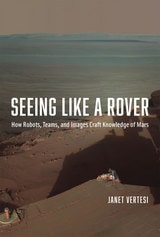
Seeing Like a Rover
How Robots, Teams, and Images Craft Knowledge of MarsJanet Vertesi
University of Chicago Press, 2015
With Seeing Like a Rover, Janet Vertesi takes us behind the scenes to reveal the work that goes into creating our knowledge of Mars. Every photograph that the Rovers take, she shows, must be processed, manipulated, and interpreted—and all that comes after team members negotiate with each other about what they should even be taking photographs of in the first place. Vertesi’s account of the inspiringly successful Rover project reveals science in action, a world where digital processing uncovers scientific truths, where images are used to craft consensus, and where team members develop an uncanny intimacy with the sensory apparatus of a robot that is millions of miles away. Ultimately, Vertesi shows, every image taken by the Mars Rovers is not merely a picture of Mars—it’s a portrait of the whole Rover team, as well.

The Canals of Mars
A MemoirGary Fincke
Michigan State University Press, 2010
The Canals of Mars is a memoir that explores and ponders "weakness," which in Gary Fincke's family was the catch-all term for every possible human flaw-physical, psychological, or spiritual. Fincke grew up near Pittsburgh during the 1950s and 1960s, raised by blue-collar parents for whom the problems that beset people-from alcoholism to nearsightedness to asthma to fear of heights-were nothing but weaknesses.
In a highly engaging style, Fincke meditates on the disappointments he suffered-in his body, his mind, his work-because he was convinced that he had to be "perfect." Anything less than perfection was weakness and no one, he understood from an early age, wants to be weak.
Six of the chapters in the book have been cited in Best American Essays. The chapter that provides the book's title, The Canals of Mars, won a Pushcart Prize and was included in The Pushcart Book of Essays: The Best Essays from a Quarter Century of the Pushcart Prize.