Results by title
4 books match the query 'Marshall, Helaine W.'
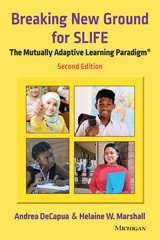
Breaking New Ground for SLIFE
The Mutually Adaptive Learning ParadigmAndrea DeCapua and Helaine W. Marshall
University of Michigan Press, 2023
In its second edition, Breaking New Ground for SLIFE builds on its model for supporting students who are new to English and may have experienced a disruption in their schooling. The practices presented in this book emerge from the belief that education for students with limited or interrupted formal education, also known as SLIFE, should not be remedial but should build on the students’ prior learning experiences and existing areas of knowledge. This second edition has been significantly updated, informed by recent research in the field, feedback from teachers, and new scholarly treatments of the topic. Breaking New Ground for SLIFE, second edition, explores the MALP approach, highlights how technology can be incorporated into classroom activities, and includes actual MALP projects implemented by MALP-trained teachers of both young and adolescent learners. In addition, the authors provide a newly revised MALP Teacher Planning Checklist.
By reading Breaking New Ground for SLIFE, educators will:
- Learn about the Mutually Adaptive Learning Paradigm (MALP) and how to integrate it into their classrooms
- Discover and learn about the MALP instructional approach and how to use it to develop a project-based curriculum using examples from teachers in the field
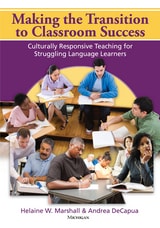
Making the Transition to Classroom Success
Culturally Responsive Teaching for Struggling Language LearnersHelaine W. Marshall and Andrea DeCapua
University of Michigan Press, 2013
Features a chapter on flipped classrooms!
Learners with no, minimal, or limited exposure to formal education generally do not share the expectations and assumptions of their new setting; as a result, they are likely to find themselves confounded by the ways in which the language and content are presented, practiced, and assessed in Western-style educational settings. Institutions and teachers must tailor therefore their instruction to this population. Making the Transition to Classroom Success: Culturally Responsive Teaching for Struggling Language Learners examines how understanding secondary and adult L2 learners’ educational paradigm, rooted deeply in their past experiences and cultural orientations, provides a key to the solution to a lack of progress.
Making the Transition to Classroom Success builds on and expands on two earlier books, Meeting the Needs of Students with Limited or Interrupted Formal Schooling and Breaking New Ground: Teaching Students with Limited or Interrupted Formal Education in U.S. Secondary Schools. These previous books focused specifically on a subset of struggling L2 learners--those with limited or interrupted formal education (SLIFE) in U.S. secondary schools—and detailed the instructional model (MALP). Making the Transition broadens the applications of the MALP model to include academic thinking tasks, flipped classrooms, project design, and rubrics.
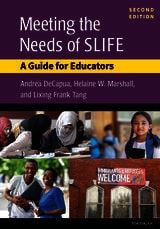
Meeting the Needs of SLIFE, Second Ed.
A Guide for EducatorsAndrea DeCapua, Helaine W. Marshall, and Lixing Frank Tang
University of Michigan Press, 2020
Like its predecessor, this book is grounded in research and is designed to be an accessible and practical resource for teachers, staff, and administrators who work with students with limited or interrupted formal education. Chapters 3-5 focus on classroom instruction, but others address issues of concern to administrators and staff too. For example, Chapter 6 explores different program models for SLIFE instruction, but the planning and commitment to creating a successful program require the involvement of many across the school community, not just teachers.
This edition features case studies, model programs, and teaching techniques and tips; also included is a new chapter focused on the Mutually Adaptive Learning Paradigm (MALP (R)). A major theme of this new edition is moving school personnel away from a deficit perspective, when it comes to teaching SLIFE, and toward one of difference. The goal is to help all stakeholders in the school community create and foster inclusion of, and equity for, a population that is all too often marginalized, ignored, and underserved.
SOFLA®
The Synchronous Online Flipped Learning ApproachHelaine W. Marshall and Ilka Kostka
University of Michigan Press, 2026