Results by title
5 books match the query 'Martín-Estudillo, Luis'

Goya and the Mystery of Reading
Luis Martín-Estudillo
Vanderbilt University Press, 2023
Spanish artist Francisco de Goya (1746–1828) lived through an era of profound societal change. One of the transformations that he engaged passionately was the unprecedented growth both in the number of readers and in the quantity and diversity of texts available. He documented and questioned this reading revolution in some of his most captivating paintings, prints, and drawings.
Goya and the Mystery of Reading explores the critical impact this transition had on the work of an artist who aimed not to copy the world around him, but to see it anew—to read it. Goya's creations offer a sustained reflection on the implications of reading, which he depicted as an ambiguous, often mysterious activity: one which could lead to knowledge or ecstasy, to self-fulfillment or self-destruction, to piety or perdition. At the same time, he used reading to elicit new possibilities of interpretation. This book reveals for the first time the historical, intellectual, and artistic underpinnings of reading as one of the pillars of his art.
This book is the recipient of the 2023 Norman L. and Roselea J. Goldberg Prize from Vanderbilt University Press for the best book in the area of art or medicine.
[more]
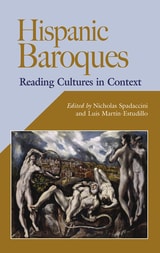
Hispanic Baroques
Reading Cultures in ContextNicholas Spadaccini
Vanderbilt University Press, 2005
Essays focus on Baroque as a concept and category of analysis which has been central to an understanding of Hispanic cultures during the last several hundred years
[more]
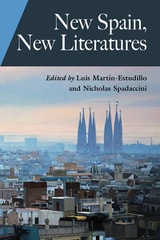
New Spain, New Literatures
Luis Martín-Estudillo
Vanderbilt University Press, 2010
This volume, which includes essays on Catalonia, the Basque country, Galicia, and literature written by African immigrants, focuses on issues of "difference" that are at the center of current debates in Spain and elsewhere--the emergence of minoritized literatures, multilingualism and identity, new relationships between culture and institutions, the negotiation of historical memories, the connections between migrations and the redefinition of nationhood, and the impact of global trends on local symbolic systems.
[more]
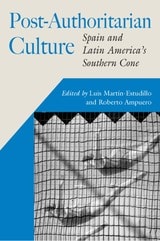
Post-Authoritarian Cultures
Spain and Latin America's Southern ConeLuis Martín-Estudillo
Vanderbilt University Press, 2008
This volume explores the role played by culture in the transition to democracy in Latin America's Southern Cone (Argentina, Uruguay, Chile) and Spain, with a focus on opposing stances of acceptance and defiance by artists and intellectuals in post-authoritarian regimes.
[more]
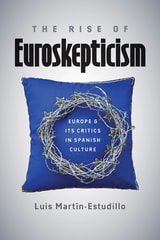
The Rise of Euroskepticism
Europe and Its Critics in Spanish CultureLuis Martín-Estudillo
Vanderbilt University Press, 2018
Electronic open-access edition funded by the National Endowment for the Humanities.
Covering from 1915 to the present, this book deals with the role that artists and intellectuals have played regarding projects of European integration. Consciously or not, they partake of a tradition of Euroskepticism. Because Euroskepticism is often associated with the discourse of political elites, its literary and artistic expressions have gone largely unnoticed. This book addresses that gap.
Taking Spain as a case study, author Luis Martín-Estudillo analyzes its conflict over its own Europeanness or exceptionalism, as well as the European view of Spain. He ranges from canonical writers like Unamuno, Ortega y Gasset, and Zambrano to new media artists like Valeriano López, Carlos Spottorno, and Santiago Sierra. Martín-Estudillo provides a new context for the current refugee crisis, the North-South divide among EU countries, and the generalized disaffection toward the project of European integration.
The eclipsed critical tradition he discusses contributes to a deeper understanding of the notion of Europe and its institutional embodiments. It gives resonance to the intellectual and cultural history of Europe's "peripheries" and re-evaluates Euroskeptic contributions as one of the few hopes left to imagine ways to renew the promise of a union of the European nations.
[more]