Results by title
3 books match the query 'Martínez, Demetria'
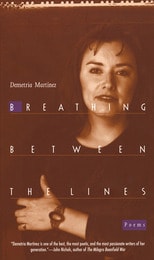
Breathing Between the Lines
PoemsDemetria Martínez
University of Arizona Press, 1997
Weaving together threads of love and family, social conviction and activism, loss and renewal, Breathing between the Lines carries the reader deep inside the head and heart of a talented Chicana writer. Page by page, the journey is an exhilarating one. What we find at the end is up to us.
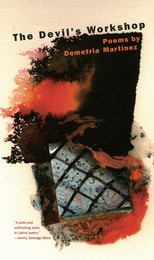
The Devil's Workshop
PoemsDemetria Martínez
University of Arizona Press, 2002
Don't believe it for a minute. In this collection of fifty-three poems, the author of the award-winning novel Mother Tongue explores the themes that have long characterized her writing: the creative and destructive powers of romantic love, the failure of political systems, the spiritual life, and the need to forgive oneself in order to move on with the work of transformation, both social and personal. Through poems that confront mortality even as they demand social justice, Martínez writes of surviving in a culture where traditional values often get lost in the complexities of everyday life. Of nurturing relationships with nieces, nephews, and parents while pondering questions of life and death, love and loss. Of caring for one's own body when "each cough is an underground nuclear explosion, / Unraveling your body’s hard-won peace accord." Martínez cauterizes old wounds inflicted by various agents: death, political repression, betrayal, and of course failed romance: "Don’t bother, I did it / First. Broke my own / Damn heart." Here are "kernels of loneliness too stubborn to grind / Down to blue meal," and the struggle for a renewed sense of self as middle age approaches:
At this age you touch what little sanctity you can muster.
The yearning burns to do more, to do more by hand.
To thread your very life through a needle's eye.
Martínez serves up a heady blend of political and sensual imagery. Her keen observations and compassionate voice lead the reader on a journey of self-exploration, of coping with life's mundanities as well as its heartaches: "I could use a loving word, / A loaf of bread, a rose, / Help with the laundry." Through her unquenchable passion for life, Demetria Martínez leaves the devil’s workshop and brings us closer to an understanding of what is real.
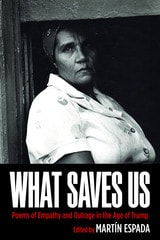
What Saves Us
Poems of Empathy and Outrage in the Age of TrumpEdited by Martín Espada
Northwestern University Press, 2019
This is an anthology of poems in the Age of Trump—and much more than Trump. These are poems that either embody or express a sense of empathy or outrage, both prior to and following his election, since it is empathy the president lacks and outrage he provokes.
There is an extraordinary diversity of voices here. The ninety-three poets featured include Elizabeth Alexander, Julia Alvarez, Richard Blanco, Carolyn Forché, Aracelis Girmay, Donald Hall, Juan Felipe Herrera, Yusef Komunyakaa, Naomi Shihab Nye, Marge Piercy, Robert Pinsky, Danez Smith, Patricia Smith, Brian Turner, Ocean Vuong, Bruce Weigl, and Eleanor Wilner. They speak of persecuted and scapegoated immigrants. They bear witness to violence: police brutality against African Americans, mass shootings in a school or synagogue, the rage inflicted on women everywhere. They testify to poverty: the waitress surviving on leftovers at the restaurant, the battles of a teacher in a shelter for homeless mothers, the emergency-room doctor listening to the heartbeats of his patients. There are voices of labor, in the factory and the fields. There are prophetic voices, imploring us to imagine the world we will leave behind in ruins lest we speak and act.
However, this is not merely a collection of grievances. The poets build bridges. One poet steps up to translate in Arabic at the airport; another walks through the city and sees her immigrant past in the immigrant present; another declaims a musical manifesto after the hurricane that devastated his island; another evokes a demonstration in the street, shouting in an ecstasy of defiance. The poets take back the language, resisting the demagogic corruption of words themselves. They assert our common humanity in the face of dehumanization.