Results by title
2 books match the query 'Martin, Philip'

Artificial Southerner
Equivocations and Love SongsPhilip Martin
University of Arkansas Press, 2001
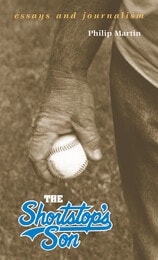
The Shortstop’s Son
Essays and JournalismPhilip Martin
University of Arkansas Press, 1997
Through these varied essays on politics, ethics, music, race, and culture Philip Martin admits “a minor obsession” with what he calls “the American Frolic”—the essential lack of seriousness with which many of us approach the questions inherent in living in a free society. He observes that Americans have been conditioned to react, not to consider; that while we are very good at ripostes and snappy comebacks, at cracking wise and looking smart, we often fail to authentically engage the issues with which we pretend to be most concerned. We inadvertently talk past one another, he says, resorting to cant and partisan boilerplate.
In the essays presented in The Shortstop’s Son, Philip Martin rigorously resists easy labels and rote ideological truths. He pursues more subtle meanings with a commonsense lucidity and a fundamental compassion for humanity. Whether writing about the mythos built upon Bonnie and Clyde’s bullet-ridden Ford or the ignoble death and burial of blues legend Blind Lemon Jefferson, Martin strikes the chord that both moves and informs.
Martin is our critic at large. Deeply engaged in the world of thought and experience, he applies his nimble mind and very human heart to those things which should concern us most. He allows us, through his “obsession” and the clarity of his prose, to experience a new vision, one based in our desire for rich life.