Results by title
4 books match the query 'Martin Heidegger'
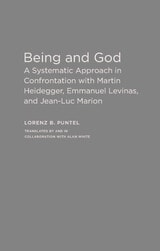
Being and God
A Systematic Approach in Confrontation with Martin Heidegger, Emmanuel Levinas, and Jean-Luc MarionLorenz B. Puntel and Alan White
Northwestern University Press, 2011

Encounters and Dialogues with Martin Heidegger, 1929-1976
Heinrich Wiegand Petzet
University of Chicago Press, 1993
A well-known art historian and an intimate friend of Heidegger's, Heinrich Wiegand Petzet provides a rich portrait of Heidegger that is part memoir, part biography, and part cultural history. By recounting chronologically a series of encounters between the two friends from their meeting in 1929 until the philosopher's death in 1976, as well as between Heidegger and other contemporaries, Petzet reveals not only new aspects of Heidegger's thought and attitudes toward the historical and intellectual events of his time but also the greater cultural and social context in which he articulated his thought.

Martin Heidegger
George Steiner
University of Chicago Press, 1987
Acquaintance with the work of Martin Heidegger is indispensable to an understanding of contemporary thought and culture. His work has had a profound influence on a number of disciplines, including theology, Sartrean existentialism, linguistics, Hellenic studies, the structuralist and hermeneutic schools of textual interpretation, literary theory, and literature itself. With characterisitc lucidity and style, George Steiner makes this philosopher’s immensely difficult body of work accessible to the general reader. The breadth of Steiner’s learning and interests also allows him to place Heidegger in a broader Continental literary-cultural context. In a new Introduction, Steiner addresses language and philosophy and the rise of Nazism

The Forgetting of Air in Martin Heidegger
By Luce Irigaray
University of Texas Press, 1999
French philosopher Luce Irigaray has become one of the twentieth century's most influential feminist thinkers. Among her many writings are three books (with a projected fourth) in which she challenges the Western tradition's construals of human beings' relations to the four elements—earth, air, fire, and water—and to nature. In answer to Heidegger's undoing of Western metaphysics as a "forgetting of Being," Irigaray seeks in this work to begin to think out the Being of sexedness and the sexedness of Being.
This volume is the first English translation of L'oubli de l'air chez Martin Heidegger (1983). In this complex, lyrical, meditative engagement with the later work of the eminent German philosopher, Irigaray critiques Heidegger's emphasis on the element of earth as the ground of life and speech and his "oblivion" or forgetting of air.
With the other volumes (Elemental Passions and Marine Lover of Friedrich Nietzsche, published elsewhere) in Irigaray's "elemental" series, The Forgetting of Air offers a fundamental rereading of basic tenets in Western metaphysics. And with its emphasis on dwelling and human habitation, it will be important reading not only in the humanities but also in architecture and the environmental sciences.