Results by title

2 books match the query 'Marx, Leo'
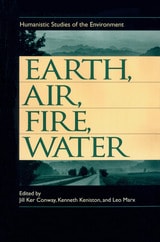
cover of Earth, Air, Fire, Water: Humanistic Studies of the Environment

Earth, Air, Fire, Water

Humanistic Studies of the Environment

Jill Ker Conway

University of Massachusetts Press, 1999

Written in a clear, accessible style with a general audience in mind, the essays in this volume offer fresh approaches to thinking about environmental issues. When we consider the forms of environmental decline most urgently in need of attention—eroding soils, shrinking forests, expanding deserts, acid rain, ozone depletion, air pollution, poisoned water supplies, the loss of biological diversity—it may seem logical that scientists should be the people mobilized to tackle these problems. Yet to devise effective solutions for today's environmental threats, we must situate them within their larger historical, societal, and cultural settings. Amelioration does not require exclusively scientific knowledge, but also changes based upon law and public policy, on institutional structures and practices, on habits of consumption, and on countless other facets of daily life. Earth, Air, Fire, Water seeks to redirect our thinking about environmental issues by locating them in the behavior of human beings—in the institutions, beliefs, and practices that mediate between people and that obscure but beautiful nonhuman world we refer to as “nature.” The book opens with a section on the elements and the ways humans have understood them in the past. There follows a section devoted to social institutions and the ways in which we can learn from current and past efforts to study the interaction between people and nature. The concluding section analyzes the culture of modernity and the ways in which the human imagination has changed in response to the arrival of modern technology. In addition to the editors, contributors include Gregory Nagy, Donald Worster, Stephen J. Pyne, John F. Richards, Richard White, Terence Turner, Barbara Epstein, Oleg N. Yanitsky, Bina Agarwal, Anton Struchkov, Yaakov Garb, and Louis Menand.
[more]
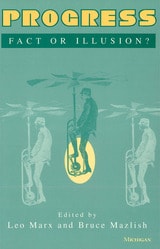
cover of Progress: Fact or Illusion?

Progress

Fact or Illusion?

Leo Marx and Bruce Mazlish, Editors

University of Michigan Press, 1996

Progress, perhaps the fundamental secular belief of modern Western society, has come under heavy fire recently because, after three centuries, advances in science and technology seem increasingly to bring problems in their wake: alienation, environmental degradation, the threat of nuclear destruction. The idea of progress is brought into question by postmodern critique, attacking the notion of science as truth. Yet no other meaningful organization of humankind's sense of time looms on the horizon. This volume seeks to reassess the meaning and prospects of the idea of progress. Looking toward the millennium, the volume seeks to evaluate the idea's worth both in theory--is it intellectually viable and defensible today?--and practice--even if theoretically defensible, is the idea undermined in actual life? Approaching these questions from the perspectives of science, anthropology, economics, religion, political philosophy, feminism, medicine, environmental studies, and the Third World, the contributors, all distinguished scholars, provide a unique and critical balance. Ultimately, the contributors find that progress is both a fact and an illusion: it does occur in certain areas, but it does not sweep all before it as its Enlightenment votaries thought it would. This foundational idea permeates discourse in the natural and social sciences as well as the humanities and will engage historians, students of the history of science and technology, sociologists, political scientists, philosophers, literary scholars, and art critics, as well as those interested in civilization in general. Contributors include: Jill Ker Conway, Zhiyuan Cui, Leon Eisenberg, Robert Heilbroner, Gerald Holton, Leo Marx, Bruce Mazlish, Ali A. Mazrui, Alan Ryan, John M. Staudenmaier, George W. Stocking, Jr., and Richard White. "A discerning reconsideration of the idea of 'progress' in a variety of carefully defined theoretical and empirical-historical contexts." --David Hollinger, University of California, Berkeley Leo Marx is Professor of American Cultural History, Emeritus, Massachusetts Institute of Technology. Bruce Mazlish is Professor of History, Massachusetts Institute of Technology.
[more]