Results by title
6 books match the query 'Marxian school of sociology'
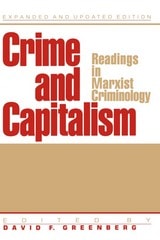
Crime And Capitalism
Readings in Marxist Crimonologyedited by David F. Greenberg
Temple University Press, 1993
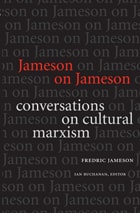
Jameson on Jameson
Conversations on Cultural MarxismFredric Jameson
Duke University Press, 2007
Jameson on Jameson displays Jameson’s extraordinary grasp of contemporary culture—architecture, art, cinema, literature, philosophy, politics, psychoanalysis, and urban geography—as well as the challenge that the geographic reach of his thinking poses to the Eurocentricity of the West. Conducted by accomplished scholars from United States, Egypt, Korea, China, Sweden, and England, the interviews elicit Jameson’s reflections on the broad international significance of his ideas and their applicability and implications in different cultural and political contexts, including the present phase of globalization.
The volume includes an introduction by Jameson and a comprehensive bibliography of his publications in all languages.
Interviewers: Mona Abousenna, Abbas Al-Tonsi, Srinivas Aravamudan, Jonathan Culler, Sara Danius, Leonard Green, Sabry Hafez, Stuart Hall, Stefan Jonsson, Ranjana Khanna, Richard Klein, Horacio Machin, Paik Nak-chung, Michael Speaks, Anders Stephanson, Xudong Zhang
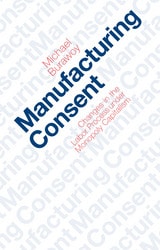
Manufacturing Consent
Changes in the Labor Process Under Monopoly CapitalismMichael Burawoy
University of Chicago Press, 1982
Manufacturing Consent, the result of Burawoy's research, combines rich ethnographical description with an original Marxist theory of the capitalist labor process. Manufacturing Consent is unique among studies of this kind because Burawoy has been able to analyze his own experiences in relation to those of Donald Roy, who studied the same factory thirty years earlier. Burawoy traces the technical, political, and ideological changes in factory life to the transformations of the market relations of the plant (it is now part of a multinational corporation) and to broader movements, since World War II, in industrial relations.

Periodizing Jameson
Dialectics, the University, and the Desire for NarrativePhillip E. Wegner
Northwestern University Press, 2014
For a half century, the American intellectual Fredric Jameson has been a driving force in literary and cultural theory. In Periodizing Jameson, Phillip E. Wegner builds upon Jameson’s unique dialectical method to demonstrate the value of Jameson’s tools—periodization, the fourfold hermeneutic, and the Greimasian semiotic square, among others—and to develop virtuoso readings of Jameson’s own work and the history of the contemporary American university in which it unfolds.
Wegner shows how Jameson’s work intervenes in particular social, cultural, and political situations, using his scholarship both to develop original explorations of nineteenth-century fiction, popular films, and other promiment theorists, and to examine the changing fortunes of theory itself. In this way, Periodizing Jameson casts new light on the potential of and challenges to humanist intellectual work in the present.

Society and Nature
Towards a Green Social TheoryPeter Dickens
Temple University Press, 1992

We Make Our Own History
Marxism and Social Movements in the Twilight of NeoliberalismLaurence Cox and Alf Gunvald Nilsen
Pluto Press, 2014
We live in the twilight of neoliberalism: the ruling classes can no longer rule as before, and ordinary people are no longer willing to be ruled in the old way. Pursued by global elites since the 1970s, neoliberalism is defined by dispossession and ever-increasing inequality. The refusal to continue to be ruled like this - "ya basta!" - appears in an arc of resistance stretching from rural India to the cities of the global North.
From this network of movements, new visions are emerging of a future beyond neoliberalism. We make our own History responds to these visions by reclaiming Marxism as a theory born from activist experience and practice.
This book marks a break both with established social movement theory, and with those forms of Marxism which treat the practice of social movement organising as an unproblematic process. It shows how movements can develop from local conflicts to global struggles; how neoliberalism operates as a social movement from above, and how popular struggles can create new worlds from below.