Results by title

18 books match the query 'Marxism'
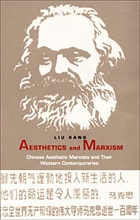
cover of Aesthetics and Marxism: Chinese Aesthetic Marxists and Their Western Contemporaries

Aesthetics and Marxism

Chinese Aesthetic Marxists and Their Western Contemporaries

Kang Liu

Duke University Press, 2000

Although Chinese Marxism—primarily represented by Maoism—is generally seen by Western intellectuals as monolithic, Liu Kang argues that its practices and projects are as diverse as those in Western Marxism, particularly in the area of aesthetics. In this comparative study of European and Chinese Marxist traditions, Liu reveals the extent to which Chinese Marxists incorporate ideas about aesthetics and culture in their theories and practices. In doing so, he constructs a wholly new understanding of Chinese Marxism.

Far from being secondary considerations in Chinese Marxism, aesthetics and culture are in fact principal concerns. In this respect, such Marxists are similar to their Western counterparts, although Europeans have had little understanding of the Chinese experience. Liu traces the genealogy of aesthetic discourse in both modern China and the West since the era of classical German thought, showing where conceptual modifications and divergences have occurred in the two traditions. He examines the work of Mao Zedong, Lu Xun, Li Zehou, Qu Qiubai, and others in China, and from the West he discusses Kant, Schiller, Schopenhauer, and Marxist theorists including Horkheimer, Adorno, Benjamin, and Marcuse. While stressing the diversity of Marxist positions within China as well as in the West, Liu explains how ideas of culture and aesthetics have offered a constructive vision for a postrevolutionary society and have affected a wide field of issues involving the problems of modernity.

Forcefully argued and theoretically sophisticated, this book will appeal to students and scholars of contemporary Marxism, cultural studies, aesthetics, and modern Chinese culture, politics, and ideology.
[more]
cover of An Anthropology of Marxism

An Anthropology of Marxism

Pluto Press, 2019
[more]
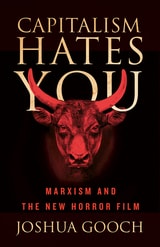
cover of Capitalism Hates You: Marxism and the New Horror Film

Capitalism Hates You

Marxism and the New Horror Film

Joshua Gooch

University of Minnesota Press, 2025

What contemporary horror films teach us about the cruelties of capitalist society

Capitalism Hates You uses the horror film genre as a tool to diagnose and expose the hostile conditions of life under capitalism. Through incisive critical analyses of popular films such as Get Out, Drag Me to Hell, Hereditary, The Babadook, and many others, Joshua Gooch draws connections between Marxist theory and contemporary narratives of psychological unease.

Gooch highlights the work of women, trans, and nonwhite filmmakers to show how the remarkable diversity of twenty-first-century horror cinema can provide an expansive catalog of capitalism’s varying forms of oppression. Studying films that interrogate such urgent topics as gentrification, climate change, and reproductive labor, he demonstrates how contemporary horror films give affective shape to the negative undercurrents of our present socioeconomic system.

Capitalism Hates You argues that these films and their material conditions can deepen our understanding of essential concepts in contemporary Marxism, from the theory of value and changing forms of commodification to the labor of social reproduction, the abolition of the family, and the necessity of ecosocialism. Synthesizing various strands of Marxist thought, Gooch sheds light on the growing field of socially conscious horror films, examining how they pinpoint and exaggerate latent feelings of dread and discomfort to reflect the ills of society.

Retail e-book files for this title are screen-reader friendly with images accompanied by short alt text and/or extended descriptions.

[more]
cover of Fredric Jameson and Film Theory: Marxism, Allegory, and Geopolitics in World Cinema

Fredric Jameson and Film Theory

Marxism, Allegory, and Geopolitics in World Cinema

Keith B. Wagner

Rutgers University Press, 2022
Frederic Jameson and Film Theory is the first collection of its kind, it assesses and critically responds to Fredric Jameson’s remarkable contribution to film theory. The essays assembled explore key Jamesonian concepts—such as totality, national allegory, geopolitics, globalization, representation, and pastiche—and his historical schema of realism, modernism, and postmodernism, considering, in both cases, how these can be applied, revised, expanded and challenged within film studies. Featuring essays by leading and emerging voices in the field, the volume probes the contours and complexities of neoliberal capitalism across the globe and explores world cinema's situation within these forces by deploying and adapting Jamesonian concepts, and placing them in dialogue with other theoretical paradigms. The result is an innovative and rigorously analytical effort that offers a range of Marxist-inspired approaches towards cinemas from Asia, Latin America, Europe, and North America in the spirit of Jameson's famous rallying cry: 'always historicize!'.  
[more]
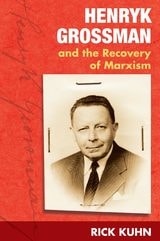
cover of Henryk Grossman and the Recovery of Marxism

Henryk Grossman and the Recovery of Marxism

Rick Kuhn

University of Illinois Press, 2006

Rick Kuhn’s Henryk Grossman and the Recovery of Marxism is the definitive study of the life and work of this renowned economist, activist, and intellectual. As a young man, Grossman joined the socialist movement and participated in Jewish workers' strikes and demonstrations, as well as in boycotts against employers and the Austro-Hungarian state. He moved to Vienna, but was driven back to Poland by the Austrian state's racist citizenship policies. A member of the illegal Polish Communist Party, Grossman was frequently arrested and jailed, finally leaving Poland for a post at the Institute for Social Research in Frankfurt am Main, which gave rise to the famous 'Frankfurt School'. 

Grossman published his best known work in Frankfurt, including studies of Marx's method in Capital and theories of economic crisis that remain influential today. In tracing Grossman's experiences, from Kraków to New York, and offering a detailed account of his ideas, the biography provides an intimate account of key events in twentieth century history, including the politicization of east European Jewry, the World Wars, the rise of Stalinism and Nazism, and the cold war.

[more]
cover of Law and Marxism: A General Theory

Law and Marxism

A General Theory

Evgeny Pashukanis

Pluto Press, 1987

[more]
cover of Marxism and Media Studies: Key Concepts and Contemporary Trends

Marxism and Media Studies

Key Concepts and Contemporary Trends

Mike Wayne

Pluto Press, 2003

[more]
cover of Marxism and the History of Art: From William Morris to the New Left

Marxism and the History of Art

From William Morris to the New Left

Edited by Andrew Hemingway

Pluto Press, 2006

This unique book is the first comprehensive introduction to Marxist approaches to art history. Although the aesthetic was a crucial part of Marx and Engels's thought, they left no programmatic statements on the arts. In meeting this gap, succeeding Marxists have inevitably devised a wide variety of approaches to both aesthetics and the writing of art's history. Although there is an abundant scholarship on Marxist approaches to literature, the historiography of the visual arts from a Marxist perspective has been largely neglected despite the large impact it has had within academic art history since 1970.


This book encompasses a range of influential thinkers and historians from the period of the Second and Third Internationals down to the heyday of the New Left. Among the individuals it covers are William Morris, Mikhail Lifshits, Frederick Antal, Francis Klingender, Max Raphael, Meyer Schapiro, Walter Benjamin, Henri Lefebvre, and Arnold Hauser. It also includes three essays addressing the heritage of the New Left. In the spirit of Marxism itself, the authors interpret the achievements and limitations of Marxist art history in relation to the historical and political circumstances of its production and provide an indispensable and lucid introduction to contemporary radical practices in the field.
[more]
cover of Marxism and the Interpretation of Culture

Marxism and the Interpretation of Culture

Edited by Cary Nelson and Lawrence Grossberg

University of Illinois Press, 1988

[more]
cover of Marxism, Colonialism, and Cricket: C. L. R. James's Beyond a Boundary

Marxism, Colonialism, and Cricket

C. L. R. James's Beyond a Boundary

David Featherstone, Christopher Gair, Christian Høgsbjerg and Andrew Smith, editors

Duke University Press, 2018

Widely regarded as one of the most important and influential sports books of all time, C. L. R. James's Beyond a Boundary is—among other things—a pioneering study of popular culture, an analysis of resistance to empire and racism, and a personal reflection on the history of colonialism and its effects in the Caribbean. More than fifty years after the publication of James's classic text, the contributors to Marxism, Colonialism, and Cricket investigate Beyond a Boundary's production and reception and its implication for debates about sports, gender, aesthetics, race, popular culture, politics, imperialism, and English and Caribbean identity. Including a previously unseen first draft of Beyond a Boundary's conclusion alongside contributions from James's key collaborator Selma James and from Michael Brearley, former captain of the English Test cricket team, Marxism, Colonialism, and Cricket provides a thorough and nuanced examination of James's groundbreaking work and its lasting impact.

Contributors. Anima Adjepong, David Austin, Hilary McD. Beckles, Michael Brearley, Selwyn R. Cudjoe, David Featherstone, Christopher Gair, Paget Henry, Christian Høgsbjerg, C. L. R. James, Selma James, Roy McCree, Minkah Makalani, Clem Seecharan, Andrew Smith, Neil Washbourne, Claire Westall

[more]
cover of Red Planets: Marxism and Science Fiction

Red Planets

Marxism and Science Fiction

Edited by Mark Bould and China Mielville

Pluto Press, 2009

As a genre, sf is ideally suited to critiquing the present through its explorations of the social and political possibilities of the future. This is the first collection to combine analyses of sf literature and films within a broader overview of Marxist theory and critical perspectives on the genre.

Covering a rich variety of examples from Weimar cinema to mainstream Hollywood films, and novelists from Jules Verne and H.G. Wells to Kim Stanley Robinson, Ken MacLeod and Charles Stross, this is an indespensible insight into how Marxism and science fiction go hand-in-hand.

[more]
cover of Selected Writings on Marxism

Selected Writings on Marxism

Stuart Hall

Duke University Press, 2021
Throughout his career Stuart Hall engaged with Marxism in varying ways, actively rethinking it to address the political and cultural exigencies of the moment. This collection of Hall's key writings on Marxism surveys the questions central to his interpretations of and investments in Marxist theory and practice. It includes Hall's readings of canonical texts by Marx and Engels, Gramsci, and Althusser; his exchanges with other prominent thinkers about Marxism; his use of Marxist frameworks to theorize specific cultural phenomena and discourses; and some of his later work in which he distanced himself from his earlier attachments to Marxism. In addition, editor Gregor McLennan's introduction and commentary offer in-depth context and fresh interpretations of Hall's thought. Selected Writings on Marxism demonstrates that grasping Hall's complex relationship to Marxism is central to understanding the corpus of his work.
[more]
cover of The Abyss of Representation: Marxism and the Postmodern Sublime

The Abyss of Representation

Marxism and the Postmodern Sublime

George Hartley

Duke University Press, 2003

From the Copernican revolution of Immanuel Kant to the cognitive mapping of Fredric Jameson to the postcolonial politics of Gayatri Chakravorty Spivak, representation has been posed as both indispensable and impossible. In his pathbreaking work, The Abyss of Representation, George Hartley traces the development of this impossible necessity from its German Idealist roots through Marxist theories of postmodernism, arguing that in this period of skepticism and globalization we are still grappling with issues brought forth during the age of romanticism and revolution. Hartley shows how the modern problem of representation—the inability of a figure to do justice to its object—still haunts today's postmodern philosophy and politics. He reveals the ways the sublime abyss that opened up in Idealist epistemology and aesthetics resurfaces in recent theories of ideology and subjectivity.

Hartley describes how modern theory from Kant through Lacan attempts to come to terms with the sublime limits of representation and how ideas developed with the Marxist tradition—such as Marx’s theory of value, Althusser’s theory of structural causality, or Zizek’s theory of ideological enjoyment—can be seen as variants of the sublime object. Representation, he argues, is ultimately a political problem. Whether that problem be a Marxist representation of global capitalism, a deconstructive representation of subaltern women, or a Chicano self-representation opposing Anglo-American images of Mexican Americans, it is only through this grappling with the negative, Hartley explains, that a Marxist theory of postmodernism can begin to address the challenges of global capitalism and resurgent imperialism.

[more]
cover of The Russian Revolution and Leninism or Marxism?

The Russian Revolution and Leninism or Marxism?

Rosa Luxemburg

University of Michigan Press, 1961

Rosa Luxemburg (1870-1919), one of the most remarkable and controversial personalities in the Marxist movement, opposes in this book not the Bolshevik’s quest for power but the way they took power, the way they held power, the way they justified themselves in doing both. In the light of the soviet collapse her penetrating but not unsympathetic criticism becomes a grave indictment and her fears for the Communists uncannily prophetic of events to come.
 
[more]
cover of The Specter of Materialism: Queer Theory and Marxism in the Age of the Beijing Consensus

The Specter of Materialism

Queer Theory and Marxism in the Age of the Beijing Consensus

Petrus Liu

Duke University Press, 2023

In recent years, queer theory appears to have made a materialist turn away from questions of representation and performativity to those of dispossession, precarity, and the differential distribution of life chances. Despite this shift, queer theory finds itself constantly reabsorbed into the liberal project of diversity management. This theoretical and political weakness, Petrus Liu argues, stems from an incomplete understanding of capitalism’s contemporary transformations, of which China has been at the center. In The Specter of Materialism Liu challenges key premises of classic queer theory and Marxism, turning to an analysis of the Beijing Consensus—global capitalism’s latest mutation—to develop a new theory of the political economy of sexuality. Liu explores how relations of gender and sexuality get reconfigured to meet the needs of capital in new regimes of accumulation and dispossession, demonstrating that evolving US-Asian economic relations shape the emergence of new queer identities and academic theories. In so doing, he offers a new history of collective struggles that provides a transnational framework for understanding the nexus between queerness and material life.
[more]
cover of The Strange Death of Marxism: The European Left in the New Millennium

The Strange Death of Marxism

The European Left in the New Millennium

Paul Edward Gottrfied

University of Missouri Press, 2005

The Strange Death of Marxism seeks to refute certain misconceptions about the current European Left and its relation to Marxist and Marxist-Leninist parties that existed in the recent past. Among the misconceptions that the book treats critically and in detail is that the Post-Marxist Left (a term the book uses to describe this phenomenon) springs from a distinctly Marxist tradition of thought and that it represents an unqualified rejection of American capitalist values and practices.
            Three distinctive features of the book are the attempts to dissociate the present European Left from Marxism, the presentation of this Left as something that developed independently of the fall of the Soviet empire, and the emphasis on the specifically American roots of the European Left. Gottfried examines the multicultural orientation of this Left and concludes that it has little or nothing to do with Marxism as an economic-historical theory. It does, however, owe a great deal to American social engineering and pluralist ideology and to the spread of American thought and political culture to Europe.           
            American culture and American political reform have foreshadowed related developments in Europe by years or even whole decades. Contrary to the impression that the United States has taken antibourgeois attitudes from Europeans, the author argues exactly the opposite. Since the end of World War II, Europe has lived in the shadow of an American empire that has affected the Old World, including its self-described anti-Americans. Gottfried believes that this influence goes back to who reads or watches whom more than to economic and military disparities. It is the awareness of American cultural as well as material dominance that fuels the anti-Americanism that is particularly strong on the European Left. That part of the European spectrum has, however, reproduced in a more extreme form what began as an American leap into multiculturalism. Hostility toward America, however, can be transformed quickly into extreme affection for the United States, which occurred during the Clinton administration and during the international efforts to bring a multicultural society to the Balkans.
            Clearly written and well conceived, The Strange Death of Marxism will be of special interest to political scientists, historians of contemporary Europe, and those critical of multicultural trends, particularly among Euro-American conservatives.
[more]
cover of The Treadmill Affect: Marxism, Subjectivity, and the Present

The Treadmill Affect

Marxism, Subjectivity, and the Present

Benjamin Lee

Prickly Paradigm Press, 2025

A critical synthesis of the work of Lauren Berlant, Moishe Postone, and Michael Silverstein.

The Treadmill Affect draws upon the work of three University of Chicago professors, each a former program director at the Center for Transcultural Studies: literary and cultural critic Lauren Berlant, historian and social theorist Moishe Postone, and linguist Michael Silverstein. Through this intellectual synthesis, Benjamin Lee demonstrates the critical possibilities of uniting a revived linguistic turn with Marxist accounts of affect and subjectivity, adding new dimensions to the "treadmill" affective structure of cruel optimism.
[more]
cover of We Make Our Own History: Marxism and Social Movements in the Twilight of Neoliberalism

We Make Our Own History

Marxism and Social Movements in the Twilight of Neoliberalism

Laurence Cox and Alf Gunvald Nilsen

Pluto Press, 2014

We live in the twilight of neoliberalism: the ruling classes can no longer rule as before, and ordinary people are no longer willing to be ruled in the old way. Pursued by global elites since the 1970s, neoliberalism is defined by dispossession and ever-increasing inequality. The refusal to continue to be ruled like this - "ya basta!" - appears in an arc of resistance stretching from rural India to the cities of the global North.

From this network of movements, new visions are emerging of a future beyond neoliberalism. We make our own History responds to these visions by reclaiming Marxism as a theory born from activist experience and practice.

This book marks a break both with established social movement theory, and with those forms of Marxism which treat the practice of social movement organising as an unproblematic process. It shows how movements can develop from local conflicts to global struggles; how neoliberalism operates as a social movement from above, and how popular struggles can create new worlds from below.

[more]