Results by title
2 books match the query 'Masochism in literature'
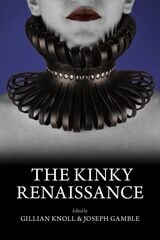
The Kinky Renaissance
Edited by Gillian Knoll and Joseph Gamble
Arizona Center for Medieval and Renaissance Studies, 2024
A provocative essay collection that theorizes the Renaissance through the lens of kink.
The Kinky Renaissance is a groundbreaking collection of essays that explore kink as a theoretical analytic, a historical formation, and an aesthetic mode. The essays in this work expand the sexual archive and its lexicon by introducing new vocabularies to familiar sexual scenes in early modern literature and culture and by bringing lesser-known scenes to bear on the study of sexuality in the period. Providing a capacious theory of sexuality and historical precedents for contemporary kinky practices, The Kinky Renaissance explores the erotic potential of early modern literature and pauses over various kinks nestled between and beside them. The collection boldly argues for a broader concept of a kinky Renaissance—one which reorients the terms of both the history of sexuality and queer theory more broadly.
The Kinky Renaissance is a groundbreaking collection of essays that explore kink as a theoretical analytic, a historical formation, and an aesthetic mode. The essays in this work expand the sexual archive and its lexicon by introducing new vocabularies to familiar sexual scenes in early modern literature and culture and by bringing lesser-known scenes to bear on the study of sexuality in the period. Providing a capacious theory of sexuality and historical precedents for contemporary kinky practices, The Kinky Renaissance explores the erotic potential of early modern literature and pauses over various kinks nestled between and beside them. The collection boldly argues for a broader concept of a kinky Renaissance—one which reorients the terms of both the history of sexuality and queer theory more broadly.
[more]
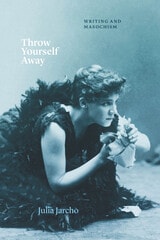
Throw Yourself Away
Writing and MasochismJulia Jarcho
University of Chicago Press, 2024
Proposes that we can best understand literature’s relationship to sex through a renewed focus on masochism.
In a series of readings that engage American and European works of fiction, drama, and theory from the late nineteenth through the early twenty-first centuries, critic and playwright Julia Jarcho argues that these works conceive writing itself as masochistic, and masochism as sexuality enacted in writing. Throw Yourself Away is distinctive in its sustained focus on masochism as an engine of literary production across multiple authors and genres. In particular, Jarcho shows that theater has played a central role in modern erotic fantasies of the literary.
Jarcho foregrounds writing as a project of distressed subjects: When masochistic writing is examined as a strategy of response to injurious social systems, it yields a surprisingly feminized—and less uniformly white—image of both masochism and authorship. Ultimately, Jarcho argues that a retheorized concept of masochism helps us understand literature itself as a sex act and shows us how writing can tend to our burdened, desirous bodies. With startling insights into such writers as Henry James, Henrik Ibsen, Mary Gaitskill, and Adrienne Kennedy, Throw Yourself Away furnishes a new masochistic theory of literature itself.
[more]