Results by title
5 books match the query 'Masquerades'
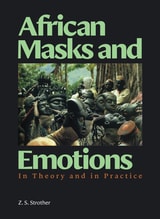
African Masks and Emotions
In Theory and in PracticeZ. S. Strother
J. Paul Getty Trust, The, 0
In this groundbreaking book, Z. S. Strother, inspired by dialogues with African masquerade patrons and performers, disputes assumptions that masks universally hide, reveal, or transform.
In Western European languages, the word mask exerts a powerful presence as a figure of speech. To masquerade is to pretend to be someone or something one is not. By extension, unmasking is a heroic metaphor for exposing a hidden truth. In this volume, art historian Z. S. Strother counters that narrative, using African case studies to offer an alternative vision of masquerading. She explores the aesthetic emotions aroused by masks, or more precisely, by “dances of masks”: joy, wonder, awe, fear, and the release of laughing out loud. She also investigates the uncanny—a sensation of “delicious shiveriness” triggered when familiar spaces and individuals become strange and changeable. Inspired by Strother’s studies in DR Congo, African Masks and Emotions takes a comparative perspective and moves emotion from the periphery to the center of analysis.
Reflecting Getty's commitment to open content, African Masks and Emotions is available for free download in ePub and PDF formats at: https://www.getty.edu/publications-reports/item/2F27A4. This paperback edition is available for sale for readers who wish to have a bound reference copy.
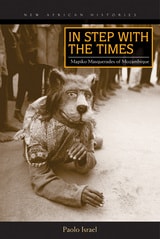
In Step with the Times
Mapiko Masquerades of MozambiquePaolo Israel
Ohio University Press, 2014
The helmet-shaped mapiko masks of Mozambique have garnered admiration from African art scholars and collectors alike, due to their striking aesthetics and their grotesque allure. This book restores to mapiko its historic and artistic context, charting in detail the transformations of this masquerading tradition throughout the twentieth century.
Based on field research spanning seven years, this study shows how mapiko has undergone continuous reinvention by visionary individuals, has diversified into genres with broad generational appeal, and has enacted historical events and political engagements. This dense history of creativity and change has been sustained by a culture of competition deeply ingrained within the logic of ritual itself. The desire to outshine rivals on the dance ground drives performers to search for the new, the astonishing, and the topical. It is this spirit of rivalry and one-upmanship that keeps mapiko attuned to the times that it traverses.
In Step with the Times is illustrated with vibrant photographs of mapiko masks and performances. It marks the most radical attempt to date to historicize an African performative tradition.
Inventing Masks
Agency and History in the Art of the Central PendeZ. S. Strother
University of Chicago Press, 1998
"Its presentation, its exceptionally lively style, the perfection of its illustrations make this a stunning book, perfectly fitting for the study of a performing art and its content is indeed seminal. . . . A breakthrough."—Jan Vansina, African Studies Review

Masking And Power
Carnival And Popular Culture In The CaribbeanGerard Aching
University of Minnesota Press, 2002
An ambitious reassessment of the political uses of masking.
Does the mask reveal more than it conceals? What, this book asks, becomes visible and invisible in the masking practiced in Caribbean cultures-not only in the familiar milieu of the carnival but in political language, social conduct, and cultural expressions that mimic, misrepresent, and mislead? Focusing on masking as a socially significant practice in Caribbean cultures, Gerard Aching’s analysis articulates masking, mimicry, and misrecognition as a means of describing and interrogating strategies of visibility and invisibility in Cuba, Trinidad and Tobago, Martinique, and beyond.
Masking and Power uses ethnographic fieldwork, psychoanalysis, and close literary readings to examine encounters between cultural insiders as these locals mask themselves and one another either to counter the social invisibility imposed on them or to maintain their socioeconomic privileges. Aching exposes the ways in which strategies of masking and mimicry, once employed to negotiate subjectivities within colonial regimes, have been appropriated for state purposes and have become, with the arrival of self-government in the islands, the means by which certain privileged locals make a show of national and cultural unity even as they engage in the privatization of popular culture and its public performances.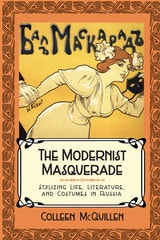
The Modernist Masquerade
Stylizing Life, Literature, and Costumes in RussiaColleen McQuillen
University of Wisconsin Press, 2013