Results by title

3 books match the query 'Mass Publicity'
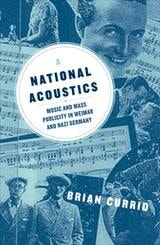
cover of A National Acoustics: Music and Mass Publicity in Weimar and Nazi Germany

A National Acoustics

Music and Mass Publicity in Weimar and Nazi Germany

Brian Currid

University of Minnesota Press, 2006

A sound track of Germany in the early twentieth century might conjure military music and the voice of Adolf Hitler rising above a cheering crowd. In A National Acoustics, Brian Currid challenges this reductive characterization by investigating the transformations of music in mass culture from the Weimar Republic to the end of the Nazi regime. 

Offering a nuanced analysis of how publicity was constructed through radio programming, print media, popular song, and film, Currid examines how German citizens developed an emotional investment in the nation and other forms of collectivity that were tied to the sonic experience. Reading in detail popular genres of music—the Schlager (or “hit”), so-called gypsy music, and jazz—he offers a complex view of how they played a part in the creation of German culture. 

A National Acoustics contributes to a new understanding of what constitutes the public sphere. In doing so, it illustrates the contradictions between Germany’s social and cultural histories and how the technologies of recording not only were vital to the emergence of a national imaginary but also exposed the fault lines in the contested terrain of mass communication. 

Brian Currid is an independent scholar who lives in Berlin.
[more]
cover of Censorium: Cinema and the Open Edge of Mass Publicity

Censorium

Cinema and the Open Edge of Mass Publicity

William Mazzarella

Duke University Press, 2013

In the world of globalized media, provocative images trigger culture wars between traditionalists and cosmopolitans, between censors and defenders of free expression. But are images censored because of what they mean, what they do, or what they might become? And must audiences be protected because of what they understand, what they feel, or what they might imagine?

At the intersection of anthropology, media studies, and critical theory, Censorium is a pathbreaking analysis of Indian film censorship. The book encompasses two moments of moral panic: the consolidation of the cinema in the 1910s and 1920s, and the global avalanche of images unleashed by liberalization since the early 1990s. Exploring breaks and continuities in film censorship across colonial and postcolonial moments, William Mazzarella argues that the censors' obsessive focus on the unacceptable content of certain images and the unruly behavior of particular audiences displaces a problem that they constantly confront yet cannot directly acknowledge: the volatile relation between mass affect and collective meaning. Grounded in a close analysis of cinema regulation in the world's largest democracy, Censorium ultimately brings light to the elusive foundations of political and cultural sovereignty in mass-mediated societies.
[more]
cover of MUSE IN THE MACHINE: AMERICAN FICTION AND MASS PUBLICITY

MUSE IN THE MACHINE

AMERICAN FICTION AND MASS PUBLICITY

MARK CONROY

The Ohio State University Press, 2004

A writer who simply panders to the public is seldom taken for an artist. An artist who cannot publish is seldom granted a career. This dilemma, the subject of Muse in the Machine, has been home to many authors of serious fiction since the eighteenth century. But it is especially pointed for American writers, since the United States never fostered a sustainable elite culture readership. Its writers have always been reliant on mass publicity’s machinery to survive; and when they depict that machinery, they also depict that reliance and the desire to transcend its banal formulas. This book looks at artist tales from Henry James to Don DeLillo’s Mao II, but also engages more indirect expressions of this tension between Romantic individualism and commercial requirements in Nathanael West, Vladimir Nabokov, and Thomas Pynchon. It covers the twentieth century, but its focus is not another rehearsal of “media theory” or word versus image. Rather, it aims to show how various novels “about” publicity culture also enact their authors’ own dramas: how they both need and try to critique the “machine.” In subject as well as approach, this study questions the current impasse between those who say that the aesthetic aspires to its own pure realm, and those who insist that it partakes of everyday practicality. Both sides are right; this book examines the consequences of that reality.
[more]