Results by title
5 books match the query 'Mass media and history'
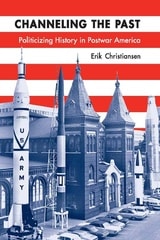
Channeling the Past
Politicizing History in Postwar AmericaErik Christiansen
University of Wisconsin Press, 2013
With insight and wit, Erik Christiansen uncovers in Channeling the Past the ways that powerful corporations rewrote history to strengthen the postwar corporate state, while progressives, communists, and other leftists vied to make their own versions of the past more popular. Christiansen looks closely at several notable initiatives—CBS’s flashback You Are There program; the Smithsonian Museum of American History, constructed in the late 1950s; the Cavalcade of America program sponsored by the Du Pont Company; the History Book Club; and the Freedom Train, a museum on rails that traveled the country from 1947 to 1949 exhibiting historic documents and flags, including original copies of the U.S. Constitution and the Magna Carta.
It is often said that history is written by the victors, but Christiansen offers a more nuanced perspective: history is constantly remade to suit the objectives of those with the resources to do it. He provides dramatic evidence of sophisticated calculations that influenced both public opinion and historical memory, and shows that Americans’ relationships with the past changed as a result.
Happy Days
Images of the Pre-Sixties Past in Seventies AmericaBenjamin L. Alpers
Rutgers University Press, 2024
Happy Days investigates how 1970s popular culture was obsessed with America’s past but often offered radically different interpretations of the same historical events and icons. Even the figure of the greaser, once an icon of juvenile delinquency, was made family-friendly by Henry Winkler’s Fonzie at the same time that he was being appropriated in more threatening ways by punk and gay subcultures. The cultural historian Benjamin Alpers discovers similar levels of ambivalence toward the past in 1970s neo-noir films, representations of America’s founding, and neo-slave narratives by Alex Haley and Octavia Butler. By exploring how Americans used the 1970s to construct divergent representations of their shared history, he identifies it as a pivotal moment in the nation’s ideological fracturing.
In Pursuit of German Memory
History, Television, and Politics after AuschwitzWulf Kansteiner
Ohio University Press, 2006
The collective memories of Nazism that developed in postwar Germany have helped define a new paradigm of memory politics. From Europe to South Africa and from Latin America to Iraq, scholars have studied the German case to learn how to overcome internal division and regain international recognition.
In Pursuit of German Memory: History, Television, and Politics after Auschwitz examines three arenas of German memory politics—professional historiography, national politics, and national public television—that have played key roles in the reinvention of the Nazi past in the last sixty years. Wulf Kansteiner shows that the interpretations of the past proposed by historians, politicians, and television producers reflect political and generational divisions and an extraordinary concern for Germany's image abroad. At the same time, each of these theaters of memory has developed its own dynamics and formats of historical reflection.
Kansteiner’s analysis of the German scene reveals a complex social geography of collective memory. In Pursuit of German Memory underscores the fact that German memories of Nazism, like many other collective memories, combine two seemingly contradictory qualities: They are highly mediated and part of a global exchange of images and story fragments but, at the same time, they can be reproduced only locally, in narrowly circumscribed networks of communication.
Technologies of History
Visual Media and the Eccentricity of the PastSteve F. Anderson
Dartmouth College Press, 2011
The American Historical Imaginary
Contested Narratives of the PastCaroline Guthrie
Rutgers University Press, 2023