Results by title
11 books match the query 'Mass media and technology'
Citizen Science in the Digital Age
Rhetoric, Science, and Public EngagementJames Wynn
University of Alabama Press, 2016
James Wynn’s timely investigation highlights scientific studies grounded in publicly gathered data and probes the rhetoric these studies employ. Many of these endeavors, such as the widely used SETI@home project, simply draw on the processing power of participants’ home computers; others, like the protein-folding game FoldIt, ask users to take a more active role in solving scientific problems. In Citizen Science in the Digital Age: Rhetoric, Science, and Public Engagement, Wynn analyzes the discourse that enables these scientific ventures, as well as the difficulties that arise in communication between scientists and lay people and the potential for misuse of publicly gathered data.
Wynn puzzles out the intricacies of these exciting new research developments by focusing on various case studies. He explores the Safecast project, which originated from crowd-sourced mapping for Fukushima radiation dispersal, arguing that evolving technologies enable public volunteers to make concrete, sound, science-based arguments. Additionally, he considers the potential use of citizen science as a method of increasing the public’s identification with the scientific community, and contemplates how more collaborative rhetoric might deepen these opportunities for interaction and alignment. Furthermore, he examines ways in which the lived experience of volunteers may be integrated with expert scientific knowledge, and also how this same personal involvement can be used to further policy agendas.
Precious few texts explore the intersection of rhetoric, science, and the Internet. Citizen Science in the Digital Age fills this gap, offering a clear, intelligent overview of the topic intended for rhetoric and communication scholars as well as practitioners and administrators in a number of science-based disciplines. With the expanded availability of once inaccessible technologies and computing power to laypeople, the practice of citizen science will only continue to grow. This study offers insight into how—given prudent application and the clear articulation of common goals—citizen science might strengthen the relationships between scientists and laypeople.
Electronic Eros
Bodies and Desire in the Postindustrial AgeBy Claudia Springer
University of Texas Press, 1996
The love affair between humans and the machines that have made us faster and more powerful has expanded into cyberspace, where computer technology seems to offer both the promise of heightened erotic fulfillment and the threat of human obsolescence. In this pathfinding study, Claudia Springer explores the techno-erotic imagery in recent films, cyberpunk fiction, comic books, television, software, and writing on virtual reality and artificial intelligence to reveal how these futuristic images actually encode current debates concerning gender roles and sexuality.
Drawing on psychoanalytical and film theory, as well as the history of technology, Springer offers the first sustained analysis of eroticism and gender in such films as RoboCop, The Terminator, Eve of Destruction, and Lawnmower Man; cyberpunk books such as Neuromancer, Count Zero, Virtual Light, A Fire in the Sun, and Lady El; the comic books Cyberpunk and Interface, among others; and the television series Mann and Machine. Her analysis demonstrates that while new electronic technologies have inspired changes in some pop culture texts, others stubbornly recycle conventions from the past, refusing to come to terms with the new postmodern social order.
Written to be accessible and entertaining for students and general readers as well as scholars, Electronic Eros will be of interest to a wide interdisciplinary audience.
Global Currents
Media and Technology NowOren, Tasha G
Rutgers University Press, 2004
Rhetoric about media technology tends to fall into two extreme categories: unequivocal celebration or blanket condemnation. This is particularly true in debate over the clash of values when first world media infiltrate third world audiences.
Bringing together the best new work on contemporary media practices, technologies, and policies, the essayists in Global Currents argue that neither of these extreme views accurately represents the role of media technology today. New ways of thinking about film, television, music, and the internet demonstrate that it is not only media technologies that affect the cultures into which they are introduced—it is just as likely that the receiving culture will change the media.
Topics covered in the volume include copyright law and surveillance technology, cyber activism in the African Diaspora, transnational monopolies and local television industries, the marketing and consumption of “global music,” “click politics” and the war on Afghanistan, the techno-politics of distance education, artificial intelligence and global legal institutions, and traveling and “squatting” in digital space. Balanced between major theoretical positions and original field research, the selections address the political and cultural meanings that surround and configure new technologies.
How Machines Came to Speak
Media Technologies and Freedom of SpeechJennifer Petersen
Duke University Press, 2022
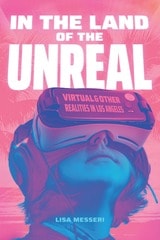
In the Land of the Unreal
Virtual and Other Realities in Los AngelesLisa Messeri
Duke University Press, 2024
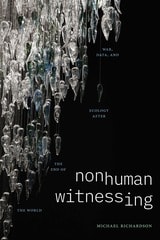
Nonhuman Witnessing
War, Data, and Ecology after the End of the WorldMichael Richardson
Duke University Press, 2024
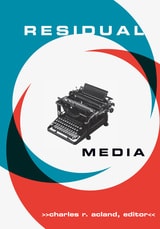
Residual Media
Charles R. Acland
University of Minnesota Press, 2006
Residual Media grapples with these questions and more in a wide-ranging and eclectic collection of essays. Beginning with how cultural change bumps along unevenly, dragging the familiar into novel contexts, the contributors examine how leftover artifacts can be rediscovered occupying space in storage sheds, traveling the globe, converting to alternative uses, and accumulating in landfills. By exploring reconfigured, renewed, recycled, neglected, abandoned, and trashed media, the essays here combine theoretical challenges to media history with ideas, technology, and uses that have been left behind.
From player pianos to vinyl records, and from the typewriter to the telephone, Residual Media is an innovative approach to the aging of culture and reveals that, ultimately, new cultural phenomena rely on encounters with the old.
Contributors: Jennifer Adams, DePauw U; Jody Berland, York U; Sue Currell, U of Sussex; Maria DiCenzo, Wilfrid Laurier U; Kate Egan, U of Wales; Lisa Gitelman, Catholic U; Alison Griffiths, CUNY; James Hamilton, U of Georgia; James Hay, U of Illinois—Champaign-Urbana; Michelle Henning, U of the West of England; Lisa Parks, UC Santa Barbara; Hillegonda C. Rietveld, South Bank U; Leila Ryan, McMaster U; John Davis, Alfred U; Collette Snowden, U of South Australia; Jonathan Sterne, McGill U; JoAnne Stober, National Archives, Canada; Will Straw, McGill U; Haidee Wasson, Concordia U.
Charles R. Acland is Professor and holds the Concordia University Research Chair in communications studies at Concordia University, Montreal.
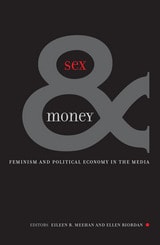
Sex And Money
Feminism and Political Economy in the MediaEileen R. Meehan
University of Minnesota Press, 2001
A revelatory look at the ways that gender, power, and the media are intertwined.
It all comes down to sex and money: how the media are organized, how they work, what they say, who gets to say it and to whom. That is the message this book delivers—and then parses for its meaning to society and culture. Forcefully and persuasively, this groundbreaking volume uses the media to show how questions of gender and economics are inextricably linked to issues of power in Western capitalist societies. Integrating political economy and feminism, it offers a new understanding of communication at the personal, experiential, institutional, and structural levels-and exposes all the subtle and complex ways in which sex and money are sutured into individuals’ daily lives.
Contributors: Robin Andersen, Fordham U; Ellen Balka, Simon Fraser U; Amy Beer; Carolyn M. Byerly, Ithaca College; Ramona Curry, U of Illinois; Fred Fejes, Florida Atlantic U; Nancy Hauserman, U of Iowa; Michèle Martin, Carleton U, Canada; Stana Martin, Central Missouri State U; Lisa McLaughlin, Miami U, Ohio; Roopali Mukherjee, Indiana U; Angela R. Record; Karen Ross, Coventry U; H. Leslie Steeves, U of Oregon; Angharad N. Valdivia, U of Illinois; Janet Wasko, U of Oregon; and Justin Wyatt.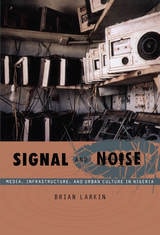
Signal and Noise
Media, Infrastructure, and Urban Culture in NigeriaBrian Larkin
Duke University Press, 2008
Media technologies were introduced to Nigeria by colonial regimes as part of an attempt to shape political subjects and create modern, urban Africans. Larkin considers the introduction of media along with electric plants and railroads as part of the wider infrastructural project of colonial and postcolonial urbanism. Focusing on radio networks, mobile cinema units, and the building of cinema theaters, he argues that what media come to be in Kano is the outcome of technology’s encounter with the social formations of northern Nigeria and with norms shaped by colonialism, postcolonial nationalism, and Islam. Larkin examines how media technologies produce the modes of leisure and cultural forms of urban Africa by analyzing the circulation of Hindi films to Muslim Nigeria, the leisure practices of Hausa cinemagoers in Kano, and the dynamic emergence of Nigerian video films. His analysis highlights the diverse, unexpected media forms and practices that thrive in urban Africa. Signal and Noise brings anthropology and media together in an original analysis of media’s place in urban life.
The New Real
Media and Mimesis in Japan from Stereographs to EmojiJonathan E. Abel
University of Minnesota Press, 2022
Unlocking a vital understanding of how literary studies and media studies overlap and are bound together
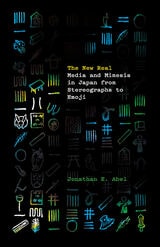
A synthetic history of new media reception in modern and contemporary Japan, The New Real positions mimesis at the heart of the media concept. Considering both mimicry and representation as the core functions of mediation and remediation, Jonathan E. Abel offers a new model for media studies while explaining the deep and ongoing imbrication of Japan in the history of new media.
From stereoscopy in the late nineteenth century to emoji at the dawn of the twenty-first, Abel presents a pioneering history of new media reception in Japan across the analog and digital divide. He argues that there are two realities created by new media: one marketed to us through advertising that proclaims better, faster, and higher-resolution connections to the real; and the other experienced by users whose daily lives and behaviors are subtly transformed by the presence and penetration of the content carried through new media. Intervening in contemporary conversations about virtuality, copyright, copycat violence, and social media, each chapter unfolds with a focus on a single medium or technology, including 3D photographs, the phonograph, television, videogames, and emoji.
By highlighting the tendency of the mediated to copy the world and the world to copy the mediated, The New Real provides a new path for analysis of media, culture, and their function in the world.
Word Toys
Poetry and TechnicsBrian Kim Stefans
University of Alabama Press, 2017
With the ascent of digital culture, new forms of literature and literary production are thriving that include multimedia, networked, conceptual, and other as-yet-unnamed genres while traditional genres and media—the lyric, the novel, the book—have been transformed. Word Toys: Poetry and Technics is an engaging and thought-provoking volume that speculates on a range of poetic, novelistic, and programmed works that lie beyond the language of the literary and which views them instead as technical objects.
Brian Kim Stefans considers the problems that arise when discussing these progressive texts in relation to more traditional print-based poetic texts. He questions the influence of game theory and digital humanities rhetoric on poetic production, and how non-digital works, such as contemporary works of lyric poetry, are influenced by the recent ubiquity of social media, the power of search engines, and the public perceptions of language in a time of nearly universal surveillance.
Word Toys offers new readings of canonical avant-garde writers such as Ezra Pound and Charles Olson, major successors such as Charles Bernstein, Alice Notley, and Wanda Coleman, mixed-genre artists including Caroline Bergvall, Tan Lin, and William Poundstone, and lyric poets such as Harryette Mullen and Ben Lerner. Writers that trouble the poetry/science divide such as Christian Bök, and novelists who have embraced digital technology such as Mark Z. Danielewski and the elusive Toadex Hobogrammathon, anchor reflections on the nature of creativity in a world where authors collaborate, even if unwittingly, with machines and networks. In addition, Stefans names provocative new genres—among them the nearly formless “undigest” and the transpacific “miscegenated script”—arguing by example that interdisciplinary discourse is crucial to the development of scholarship about experimental work.