Results by title

8 books match the query 'Mass media and the environment'
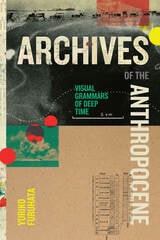
cover of Archives of the Anthropocene: Visual Grammars of Deep Time

Archives of the Anthropocene

Visual Grammars of Deep Time

Yuriko Furuhata

Duke University Press, 2026

From geological maps to photographs and films of snow, ice, clouds, and coral reefs, visual inscriptions mediate the construction and codification of extractive modes of seeing Earth’s subterranean depths and aerial heights. Tracing the territorial ambitions of the archipelagic empires of Japan and the United States in the twentieth century, Archives of the Anthropocene explores crucial moments of overlap between the geoscientific history of studying Earth’s deep time and the geopolitical history of territorialization, militarization, and extraction in the Pacific and polar regions. By engaging with contemporary critiques of settler colonialism, liberal humanism, and nonhuman labor from the perspective of environmental media studies, Yuriko Furuhata unsettles the universalist narrative of the Anthropocene, calling us to instead imagine an anticolonial and anti-imperial future for the planet.
[more]
cover of China's Environment and China's Environment Journalists: A Study

China's Environment and China's Environment Journalists

A Study

Hugo de Burgh and Zeng Rong

Intellect Books, 2012
Environmental issues are of growing concern in China, with numerous initiatives aimed at encouraging dialogue and increasing awareness. And key to these initiatives is the environmental journalist. The first English-language study of this burgeoning field, this book investigates Chinese environmental journalists—their methodologies, their attitudes toward the environment, and their views on the significance of their work—and concludes that most respond enthusiastically to government promptings to report on the environment and climate change. Additional chapters demonstrate journalists’ impact in helping to shape governmental decision making.
[more]
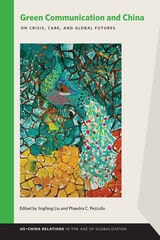
cover of Green Communication and China: On Crisis, Care, and Global Futures

Green Communication and China

On Crisis, Care, and Global Futures

Jingfang Liu

Michigan State University Press, 2020

How does China speak for nature? How are the pollution and climate change crises being addressed? What are the possibilities and limitations of mobilizing publics to care about the environment through new media, tourism, and government policy? Green Communication and China is the first volume to identify the importance of studying environmental communication in, about, and with China, a rising global environmental leader whose ecological and political controversies often make international headlines. Organized into three sections on communicating crisis, communicating care, and environmental futurity, these essays span multimodal communication practices and methods in green public culture and address topics ranging from The North Face advertisements to NGO advocacy to global governmental policy. The volume showcases the work of leading scholars, all of them deeply intimate with China, in disciplines ranging from cultural studies and rhetoric to public opinion polling, discourse analysis, ethnic studies, and sociology. These complex projects engage transnational and national politics, ecological and economic challenges, media saturation, and government control. Holding these tensions together without glossing over differences, Green Communication and China will inform new agendas for environmental communication in China, the United States, and beyond.
[more]
cover of Intersectional Activism in Environmental Communication: Changemakers Respond to Ecological Crises

Intersectional Activism in Environmental Communication

Changemakers Respond to Ecological Crises

Emma Frances Bloomfield

Michigan State University Press, 2025
Intersectional Activism in Environmental Communication explores the representation of environmental activism around the world. Exploring issues from Indigenous women’s activism in Brazil and India to energy protests in South Korea, to the Dakota Access pipeline construction on Standing Rock Sioux territory, to the contours of the internet, this collection offers critical reflection points for the representation of environmental activism and theorizes the various channels and audiences for embodied and mediated environmental communication. The intersectional approach reflected in this work explores circumstances where powerful interests distract, dissuade, and undermine emergent voices and the ecological values they articulate. This volume addresses how intersectional environmental activism can effectively challenge systems and practices that perpetuate ecological degradation and environmental injustices.
[more]
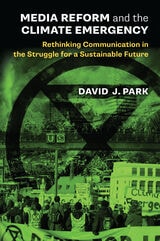
cover of Media Reform and the Climate Emergency: Rethinking Communication in the Struggle for a Sustainable Future

Media Reform and the Climate Emergency

Rethinking Communication in the Struggle for a Sustainable Future

David J. Park

University of Michigan Press, 2021

Award-winning author David J. Park argues that the battle against global warming is also a fight for media reform. With his new book Media Reform and the Climate Emergency: Rethinking Communication in the Struggle for a Sustainable Future, he critically examines how advertising, the digital infrastructure, and journalism advance the climate emergency and lays out a path of reform to help create a more sustainable world. The production and consumption of goods and services within consumer societies lead to unsustainable greenhouse gas emissions, and Park finds that much of mass communication is either dependent upon or closely tied to the success of this social organization. As a result, he suggests successful environmental movements creatively dismantle or reform institutional infrastructures that extend the planetary global warming crisis and the unsustainable consumption of nature.

Communication policies and industries are part of these infrastructures. Advertising evolved to propel a new consumer society that would encourage the over-consumption of goods and services with harmful and unsustainable production processes. Our digital infrastructure is largely premised upon the surveillance of online consumer habits and preferences, with the goal to create individualized messages to more effectively persuade people to increase their consumption habits. Much of commercial journalism resists the drastic and immediate regulatory changes necessary to address the worst aspects of this crisis. This is because so many of the needed changes challenge the media’s source of income, their libertarian philosophy, and the general status quo, which is preferred by elites. Bound to foster conversations among scholars, activists, politicians, and those who work in the communication industries, this book rethinks mass communication and highlights how immediate reform is needed in the struggle for a sustainable planet.
[more]
cover of Saturation: An Elemental Politics

Saturation

An Elemental Politics

Melody Jue and Rafico Ruiz, editors

Duke University Press, 2021

Bringing together media studies and environmental humanities, the contributors to Saturation develop saturation as a heuristic to analyze phenomena in which the elements involved are difficult or impossible to separate. In ordinary language, saturation describes the condition of being thoroughly soaked, while in chemistry it is the threshold at which something can be maximally dissolved or absorbed in a solution. Contributors to this collection expand notions of saturation beyond water to consider saturation in sound, infrastructure, media, Big Data, capitalism, and visual culture. Essays include analyses of the thresholds of HIV detectability in bloodwork, militarism's saturation of oceans, and the deleterious effects of the saturation of cellphone and wi-fi signals into the human body. By channeling saturation to explore the relationship between media, the environment, technology, capital, and the legacies of settler colonialism, Saturation illuminates how elements, the natural world, and anthropogenic infrastructures, politics, and processes exist in and through each other.

Contributors. Marija Cetinić, Jeff Diamanti, Bishnupriya Ghosh, Lisa Yin Han, Stefan Helmreich, Mél Hogan, Melody Jue, Rahul Mukherjee, Max Ritts, Rafico Ruiz, Bhaskar Sarkar, John Shiga, Avery Slater, Janet Walker, Joanna Zylinska
[more]
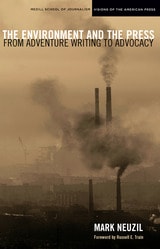
cover of The Environment and the Press: From Adventure Writing to Advocacy

The Environment and the Press

From Adventure Writing to Advocacy

Mark Neuzil

Northwestern University Press, 2008

This history of environmental journalism looks at how the practice now defines issues and sets the public agenda evolving from a tradition that includes the works of authors such as Pliny the Elder, John Muir, and Rachel Carson. It makes the case that the relationship between the media and its audience is an ongoing conversation between society and the media on what matters and what should matter.
[more]
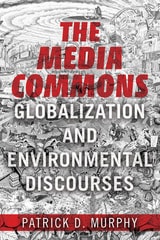
cover of The Media Commons: Globalization and Environmental Discourses

The Media Commons

Globalization and Environmental Discourses

Patrick D Murphy

University of Illinois Press, 2017

Today's global media sustains a potent new environmental consciousness. Paradoxically, it also serves as a far-reaching platform that promotes the unsustainable consumption ravaging our planet. Patrick Murphy musters theory, fieldwork, and empirical research to map how the media communicates today's many distinct, competing, and even antagonistic environmental discourses.

The media draws the cultural boundaries of our environmental imagination--and influences just who benefits. Murphy's analysis emphasizes social context, institutional alignments, and commercial media's ways of rendering discussion. He identifies and examines key terms, phrases, and metaphors as well as the ways consumers are presented with ideas like agency and the place of nature. What emerges is the link between pervasive messaging and an "environment" conjured by our media-saturated social imagination. As the author shows, today's complex, integrated media networks shape, frame, and deliver many of our underlying ideas about the environment. Increasingly--and ominously--individuals and communities experience these ideas not only in the developed world but in the increasingly consumption-oriented Global South.

[more]