Results by title
12 books match the query 'Mass murder'
A Sniper in the Tower
The Charles Whitman MurdersGary M. Lavergne
University of North Texas Press, 1997
Death on Base
The Fort Hood MassacreAnita Belles Porterfield
University of North Texas Press, 2015
In Pursuit
The Hunt for the Beltway SnipersDavid Reichenbaugh
University Press of New England, 2018

Man with the Killer Smile
The Life and Crimes of a Serial Mass MurdererMitchel P. Roth
University of North Texas Press, 2022
Survived by One
The Life and Mind of a Family Mass MurdererRobert E. Hanlon, PhD with Thomas V. Odle
Southern Illinois University Press, 2013
On November 8, 1985, 18-year-old Tom Odle brutally murdered his parents and three siblings in the small southern Illinois town of Mount Vernon, sending shockwaves throughout the nation. The murder of the Odle family remains one of the most horrific family mass murders in U.S. history. Odle was sentenced to death and, after seventeen years on death row, expected a lethal injection to end his life. However, Illinois governor George Ryan’s moratorium on the death penalty in 2000, and later commutation of all death sentences in 2003, changed Odle’s sentence to natural life.
The commutation of his death sentence was an epiphany for Odle. Prior to the commutation of his death sentence, Odle lived in denial, repressing any feelings about his family and his horrible crime. Following the commutation and the removal of the weight of eventual execution associated with his death sentence, he was confronted with an unfamiliar reality. A future. As a result, he realized that he needed to understand why he murdered his family. He reached out to Dr. Robert Hanlon, a neuropsychologist who had examined him in the past. Dr. Hanlon engaged Odle in a therapeutic process of introspection and self-reflection, which became the basis of their collaboration on this book.
Hanlon tells a gripping story of Odle’s life as an abused child, the life experiences that formed his personality, and his tragic homicidal escalation to mass murder, seamlessly weaving into the narrative Odle’s unadorned reflections of his childhood, finding a new family on death row, and his belief in the powers of redemption.
As our nation attempts to understand the continual mass murders occurring in the U.S., Survived by One sheds some light on the psychological aspects of why and how such acts of extreme carnage may occur. However, Survived by One offers a never-been-told perspective from the mass murderer himself, as he searches for the answers concurrently being asked by the nation and the world.
The Complexity of Evil
Perpetration and GenocideTimothy Williams
Rutgers University Press, 2021
Download the open access ebook here.
The Killing Age
How Violence Made the Modern WorldClifton Crais
University of Chicago Press, 2025
We are used to speaking of the Anthropocene and the outsized impact humans have had on the planet. But we sometimes lose sight of a fundamental truth at the heart of modern world history: the legacy of human predation, slavery, and imperialism that has devastated the natural world and led us to our present moment. As historian Clifton Crais shows in this magisterial work, the period that we most associate with human progress—which gave us the Enlightenment, the rise of democracies, the Industrial Revolution, and more—was at the same time catastrophically destructive.
In this bracing, landmark book, Crais urges us to view the growth of global capitalism between 1750 and the early 1900s not as the Anthropocene, but as the Mortecene: the Killing Age. Killing brought the world together and tore it apart, as profiteering warlords committed mass-scale slaughter of humans and animals across Africa, Asia, and the Americas. The newfound ease and profitability of killing created a disturbing network of global connections and economies, eliminating tens of millions of people and sparking an environmental crisis that remains the most urgent catastrophe facing the world today.
Drawing on years of scholarship and marshaling myriad sources across world history, The Killing Age turns our vision of past and present on its head, illuminating the Mortecene in all its horror—how it shaped who we are, what we value and fear, and the precarious present we inhabit today.
The Theatre of Genocide
Four Plays about Mass Murder in Rwanda, Bosnia, Cambodia, and ArmeniaEdited and with an introduction by Robert Skloot
University of Wisconsin Press, 2008
When Evil Came to Good Hart
Mardi Link
University of Michigan Press, 2008
"The murder mystery that has confounded and fascinated people for over forty years has been given a whole new life. When Evil Came to Good Hart is a well-researched and well-written piece of nonfiction that holds the reader in its spell, just as it has the many writers, reporters, and law officers who have puzzled over it. My highest praise for Mardi Link's book is to say that it reads like a good novel, a real page-turner."
—Judith Guest, author of Ordinary People and The Tarnished Eye
In this page-turning true-life whodunit, author Mardi Link details all the evidence to date. She crafts her book around police and court documents and historical and present-day statements and interviews, in addition to exploring the impact of the case on the community of Good Hart and the stigma that surrounds the popular summer getaway. Adding to both the sense of tragic history and the suspense, Link laces her tale with fascinating bits of local and Indian lore, while dozens of colorful characters enter and leave the story, spicing the narrative.
During the years of investigation of the murders, officials considered hundreds of tips and leads as well as dozens of sources, among them former secretaries who worked for murder victim Dick Robison; Robison's business associates; John Norman Collins, perpetrator of the "Co-Ed Murders" that took place in Washtenaw County between 1967 and 1969; and an inmate in federal prison in Leavenworth, Kansas, who said he knew who killed the Robison family.
Despite the exhaustive investigative efforts of numerous individuals, decades later the case lies tantalizingly out of reach. It is still an unsolved cold case, yielding, in Link's words, forty years worth of "dead-end leads, anonymous tips, a few hard facts, and countless cockamamie theories."
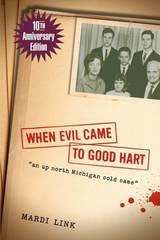
When Evil Came to Good Hart, 10th Anniversary Edition
Mardi Link
University of Michigan Press, 2018
In this page-turning true-life whodunit, author Mardi Link looks into the cold-case files of the murders of a wealthy Detroit-area family in their northern Michigan cabin in 1968, detailing and reviewing all the evidence to date. She crafts her book around police and court documents and historical and present-day statements and interviews, in addition to exploring the impact of the case on the community of Good Hart and the stigma that surrounds the popular summer getaway. Adding to both the sense of tragic history and the suspense, Link laces her tale with fascinating bits of local and Indian lore, while dozens of colorful characters enter and leave the story, spicing the narrative.
During the years of investigation of the murders, officials considered hundreds of tips and leads as well as dozens of sources, among them former secretaries who worked for murder victim Dick Robison; Robison's business associates; John Norman Collins, perpetrator of the "Co-Ed Murders" that took place in Washtenaw County between 1967 and 1969; and an inmate in federal prison in Leavenworth, Kansas, who said he knew who killed the Robison family. Despite the exhaustive investigative efforts of numerous individuals, decades later the case lies tantalizingly out of reach as an unsolved cold case.
This edition, published at the 50th anniversary of the murder, includes a new Afterword by Mardi Link. In it, Link discusses information that’s come to light since the book’s original publication and reflects on how the Robison murders might have been handled differently today.
Worse Than Death
The Dallas Nightclub Murders and the Texas Multiple Murder LawGary M. Lavergne
University of North Texas Press, 2003
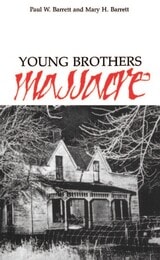
Young Brothers Massacre
Paul W. Barrett & Mary H. Barrett
University of Missouri Press, 1988
On January 2, 1932, near Springfield, Missouri, ten poorly armed law enforcement officers set out to arrest two local farm boys for auto theft. A few minutes later, six of the officers lay dead and three were wounded, setting a record that stands to this day for the greatest number of police officers killed in one incident in the history of the United States. This is the story of how it happened and of the unlikely people whose lives were forever changed.
The two killers, Jennings and Harry Young, were from a peaceful, tiny community named Brookline in central Greene County, Missouri. The "massacre" itself took place at the quiet orderly farm home of the J. D. Young family. Paul and Mary Barrett trace the personalities of those involved in the incident, describe the events of the fateful day, and examine the aftermath of the killings, detailing what was called "the greatest man hunt in the history of Texas," which culminated in the brothers' deaths in Houston.